
When I first learned I would be matriculating to a medical school, I envisioned myself becoming an excellent clinician who would catch details like no other. I looked forward to the day I would be recognized as a master diagnostician.
Yet as I began my studies, I found a clear limitation in what one doctor can accomplish. Seeing patients and attending to their chief concerns had a profound impact on me and felt rewarding. However, much of what I faced in the clinical environment was repetitive and redundant — dealing with the aftermath of issues or conditions that should have been prevented long ago. Many patients visited our clinic due to avoidable chronic illnesses, and I could not help but ruminate on early screening and lifestyle modifications that should have started years prior.
As I thought more about how to expand the impact of my work, I realized that revamping the healthcare system was the ultimate answer. The clinical environment needed to change, protocols and practices that should have been formalized and updated needed to change, and insurance and laws needed to change. In other words, every level of our healthcare system seemed to need some fixing. These frustrations ultimately shifted my focus away from my initial goal of becoming a “master diagnostician” and toward a career in prevention and systemic interventions.
Lo and behold, in my third year of medical school, I came across a specialty I had never heard of: occupational and environmental medicine (OEM). I happened to attend the Suffolk Medical Society Symposium at Brookhaven National Laboratory (BNL) on Long Island, and Dr. John Clarke, then Occupational Medicine Director and CMO of BNL, gave an hour-long talk about his job and introduced the specialty to the audience.
I was captivated as soon as I heard about the unique aspects of OEM. Physicians in OEM specifically worked in the public health domain within companies, institutions, and governmental agencies, and focused on establishing safe working environments for those at risk. For example, Dr. Clarke managed BNL, which is a federal research facility that included a nuclear reactor, a particle accelerator, multiple sources of hazardous chemicals, and radiation exposure. His job as a clinician was to treat injured researchers and staff on-site and to prevent foreseeable medical issues arising from the nature of the work being done in the laboratories.
What Dr. Clarke described was exactly what I wanted. The unique work environments and the population he served stirred something in me, as I kept thinking about how powerful it is to enable those who want to be productive at work and to ensure their safety. My mission to maximize the influence of my work and bring about the greatest benefits to the masses aligned well with OEM. Thus, the direction of serving the American workforce was going to be an answer to my long quandary of my best fit in medicine.
With my interest piqued, I looked for more information and followed updates to see if medical students would be able to apply directly into the specialty. Historically, preventive medicine (PM) and its subspecialties, including OEM and aerospace medicine, were not part of the NRMP and required applicants to be at least PGY1. However, the situation has changed as the specialties under the PM umbrella began participating in the Match starting in 2025.
The difficulty I faced as a medical student in deciding whether to apply for the specialty was accentuated by an overall lack of Match data, rotations offered, and depth of information on residency programs. I realized most of the attending physicians I have worked with have not heard of the specialty, and the few that did know about OEM only did because they had a rare opportunity to either refer patients to or work with occupational doctors within a limited scope. Finding the information I needed realistically could only be done by interacting with individual programs, as few details were readily available online.
Yet I realized I was more fortunate because my school at least offered an outpatient elective rotation in occupational medicine, and I could find a mentor who was board-certified in OEM. Since most academic institutions lack residency programs and physicians are boarded in OEM, I realized many applicants will not have the same opportunities or resources as I do. I later learned that seeking away rotations would involve either applying through the Visiting Student Learning Opportunities (VSLO) process or contacting individual programs directly.
Despite the barrier to entry to the field, I have enjoyed the process of discovering what a gem OEM is. Learning more about the field and the people by attending the American Occupational Health Conference (AOHC) last year gave me a clearer sense of how I fit into it. Of note, the residents I encountered at the conference were the happiest and most relaxed bunch I have interacted with.
The only concern I have about the field is that it faces a major funding crisis. Most residency programs are funded by CMS, yet OEM programs are not. Traditionally, OEM residency has been funded by the National Institute for Occupational Safety and Health (NIOSH) and supported by local and private organizations. With that said, programs have had difficulty securing sufficient funding to support new residents. In fact, during the first Match in 2025, many OEM programs withdrew from the Match, and only five spots were open to medical students for “advanced position.”
So what is the verdict? The funding situation and limited residency spots may not be ideal for most medical students, as options are extremely limited. However, OEM remains a relatively unknown field that offers aspects of medicine that most clinicians and medical students are not familiar with. As it also boasts the lowest burnout rates among specialties, OEM is worth considering for those interested in public health, policy, and outpatient clinical work.
As for me, I hope OEM programs remain in the Match and preserve their advanced positions. Finding a career path that aligns with my passion has not been easy, and it will only get harder for future applicants if the field continues to shrink.
What is your familiarity with OEM? Have you engaged with this specialty in your work?
Ted Kim is a fourth-year medical student at the Renaissance School of Medicine at Stony Brook University looking forward to pursuing residency in occupational and environmental medicine. He is an ardent coffee enthusiast, community builder, and massive fan of systems and design thinking. Ted is a 2025–2026 Doximity Op-Med Fellow.
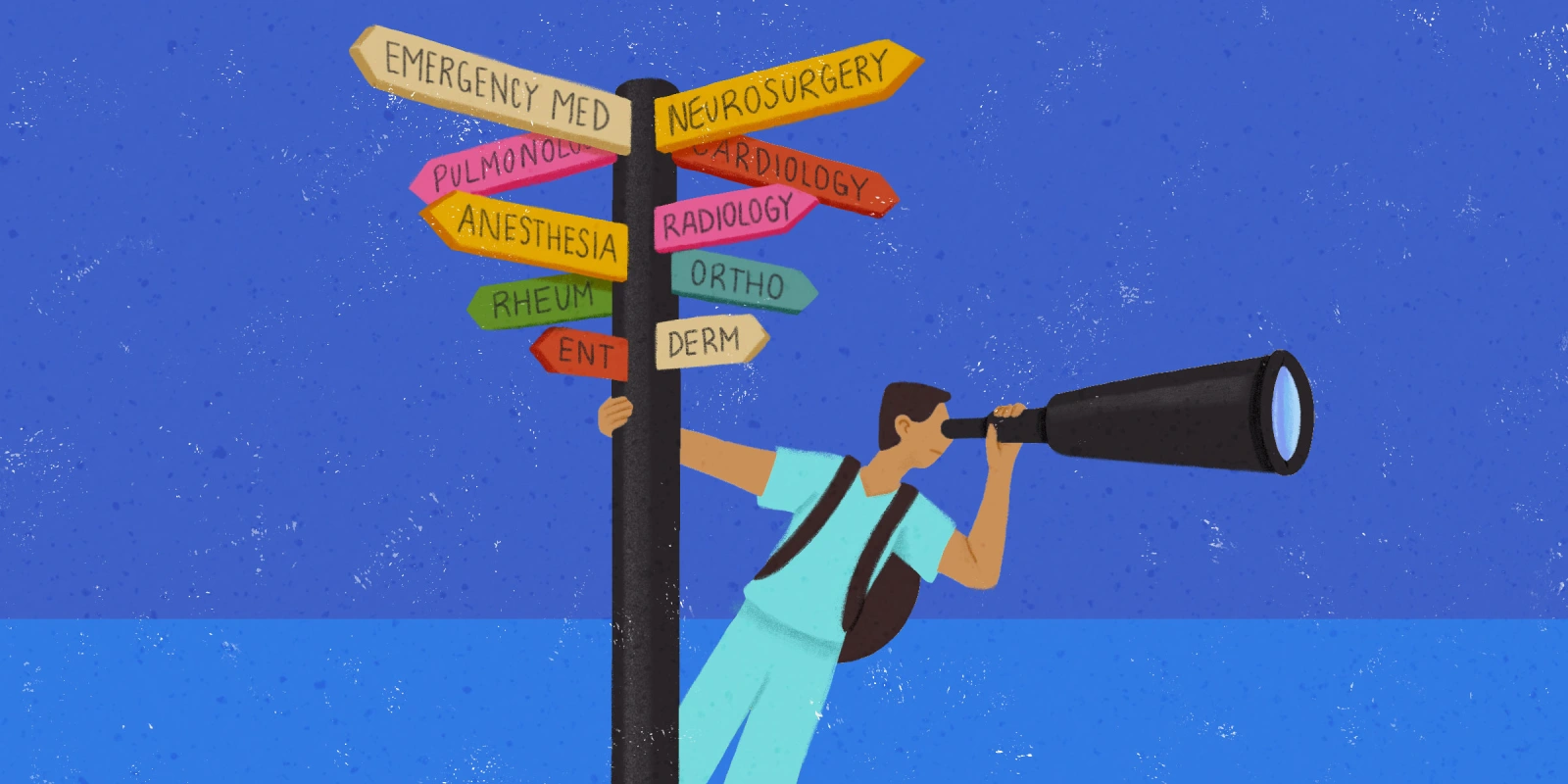
Illustration by Diana Connolly