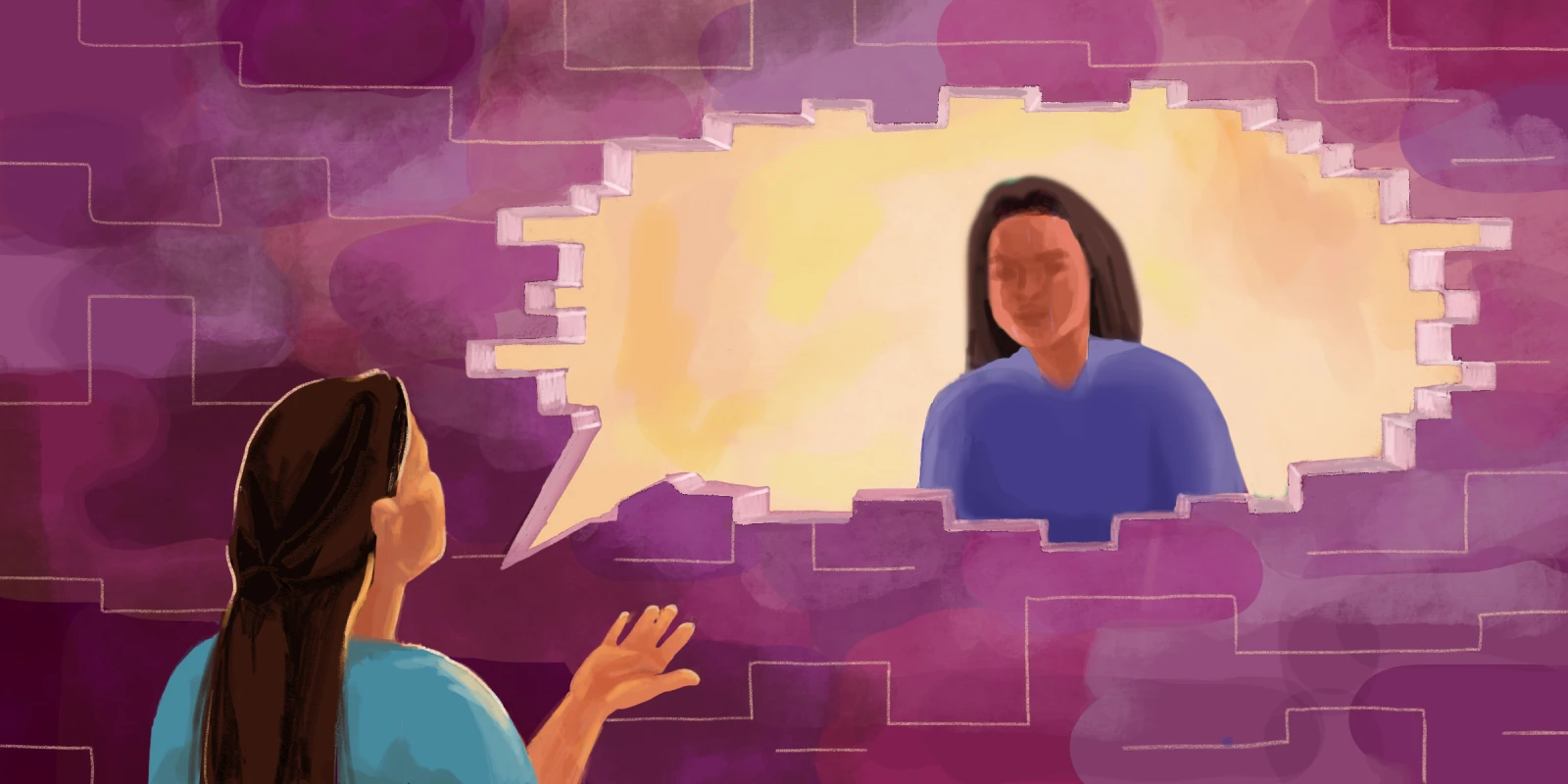

There was a moment, sitting in a high school classroom in Albuquerque, when I stopped taking notes on my judging rubric and just listened. A teenage girl who was doing her final presentation to be awarded the Bilingual Seal talked about the shock of arriving in a new country as a 12-year-old. About walking into a school where everything — the hallways, the lunch lines and menu, the way kids talked to each other — followed rules nobody had written down anywhere. About learning a language not from a textbook but from survival. I knew that feeling. I had lived it.
I grew up in Ecuador, and I spoke English before I moved to the U.S. as an 18-year-old. I had studied it in school, and had translated for my family during trips to Disney World. But classroom English and real-world English are two entirely different languages. One is conjugated and controlled. The other is fast and full of cultural shorthand that nobody explains to you, because everyone around you already knows it. When I arrived here, I understood the words but missed the meaning. For years I said “two peas in a pot” and meant it sincerely. I smiled at the right moments and hoped no one would notice that I was lost.
The loneliness of that period is hard to describe to someone who has not experienced it. There is a particular coldness reserved for those of us still finding our footing, a low tolerance for accents, for pauses, for the slight delay that happens when your brain is running two languages at once and the English one takes longer to load. I learned quickly that I would have to work harder just to be perceived as equally competent. What I did not anticipate was how that would never entirely stop.
I am now a clinical pharmacist specializing in infectious diseases. I am bilingual, genuinely bilingual. I have been called down hallways for people in the hospital who needed a quick translation. I always said yes. Not because it was in my job description, but because I knew what it felt like to be that patient, nodding along while understanding nothing, too afraid to say so. Over the years I have noticed that bilingualism is rarely treated as the extraordinary thing it actually is.
To speak two languages fluently is to be held to two standards simultaneously. When I am tired, I am tired in both languages. When I make an error in English, a word choice, a phrasing, a moment where my accent colors a sentence in a way I did not intend, it is noticed in a way that a native speaker’s errors are not. We are given less margin. We are expected to perform at the same level with half the linguistic ease, double the cognitive load, and none of the cultural familiarity that native speakers absorb without effort from birth. Imagine drafting every sentence twice before it leaves your mouth, then editing it in real time for accent, word choice, and cultural register, while also trying to do your job. Imagine being evaluated on the quality of that output by people who have never once had to do the same. Imagine doing this on your worst days, your most exhausted days, the days when you have already given everything, and still being expected to be precise. That is not a special circumstance for bilingual clinicians. That is a Tuesday. And it is not only the language itself.
The work ethic I brought with me from Ecuador does not always translate cleanly either. At times the intensity I bring reads not as dedication but as something strange. Too serious. Hard to read. It is a disorienting thing, to arrive somewhere with your values intact and find they do not quite fit.
I think about this every time I am called to that bedside. The patient who reminds me of who I was, nodding, smiling, hoping nobody notices. Except now I am on the other side of it, and I know exactly what that nod means. It means I am too tired and too afraid to say I don’t understand. That is not a communication problem. That is a clinical risk.
I have stood at that bedside enough times to know this without the data. But the data confirms it anyway. The research is unambiguous about what happens when that effort is absent from clinical care. Patients with limited English proficiency experience higher rates of adverse drug events, lower medication adherence, and significantly worse outcomes across nearly every infectious disease metric that matters. Language becomes a clinical variable. When a pharmacist or clinician who shares a patient’s language and culture is present in that encounter — truly present, not just interpreted for — outcomes change.
I left that high school tender and tired in equal measure. Tender because those students were so brave, and because I recognized in their voices something I had almost forgotten: the specific courage it takes to show up somewhere you were not made for and decide to stay anyway. Tired because I know what comes next for them. I know because it came next for me too, and I am still in the middle of it. But I showed up to that classroom, in both languages, and I will keep showing up. This is what we do.