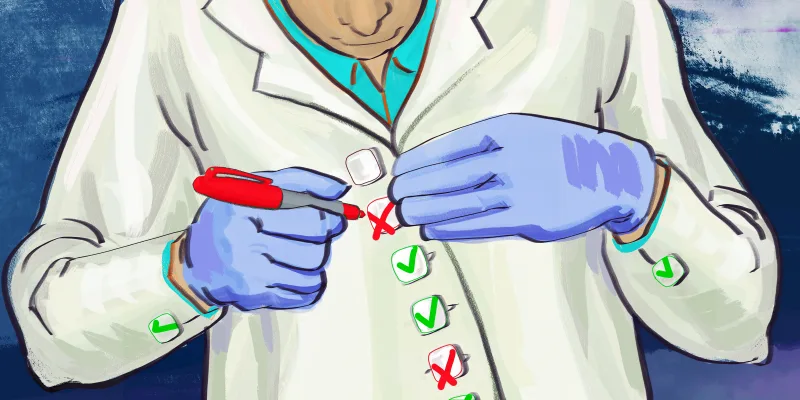

More and more frequently, a practicing clinician asks me some version of the same question. They’ve been working with a patient for many years who has been on upward of two or three medications, none of which have adequately worked, and they want to know whether the patient is "depressed enough" to refer for esketamine.
I appreciate the question every time. It tells me the referring clinician has been paying attention to innovations in care delivery, that they’re optimistic yet cautious about novel treatments, and that they want to do right by the patient in front of them. It also tells me they are working with an idea of what treatment-resistant depression requires that may be more demanding than the evidence asks for.
So here is what I tell them.
The FDA-approved indication for esketamine (Spravato) is treatment-resistant depression in adults. The Janssen / Johnson & Johnson label defines this as a "major depressive episode" in a patient who has not adequately responded to at least two oral antidepressants of adequate dose and duration during the current episode. Some insurance companies tend to differ on these definitions (sometimes requiring up to four antidepressants, sometimes requiring an augmenting agent trial, sometimes requiring psychotherapy), but this is the most agreed-upon definition currently available.
There is a second pathway that referring clinicians should know about. For patients experiencing acute suicidal ideation or behavior in major depressive disorder, esketamine is FDA-approved without the two-medication-trial requirement. The ASPIRE-1 and ASPIRE-2 trials supported that indication and payers I work with recognize it. If your patient is voicing passive or active suicidality and is otherwise medically appropriate, the referral conversation does not need to wait for additional medication trials.
Now, the harder part of the conversation. Many of the prescribers who ask me whether their patient is "depressed enough" have a patient who has been on a single antidepressant for years, sometimes a decade, with partial benefit and incomplete remission. That patient is not yet eligible by label. They are also not "failing" — they are doing the thing the system asked them to do. The work is to bring a second adequate trial into the picture, recognize it for what it is, and move forward if response remains inadequate.
The STAR*D data is the part of this conversation I find the most clarifying. By the third antidepressant trial, cumulative remission rates start to plateau in individuals. By the fourth, response is around 12.5%. Continuing to step a patient through additional monoamine reuptake inhibitor antidepressants past two adequate trials offers a diminishing return that any of us who trained on STAR*D recognize.
Esketamine is a categorically different mechanism. It is an NMDA receptor antagonist that acts on glutamate, not directly on serotonin, dopamine, or norepinephrine. That is why it is a reasonable next step for the patient who has not adequately responded to two adequate trials. Not because the patient has failed treatment but the monoamine reuptake inhibitors have failed the patient, and the science says the same class is likely to keep not adequately working.
So when a prescriber asks me whether their patient is "depressed enough," what I am hearing, almost always, is whether the patient is carrying an illness burden significant enough to warrant an interventional treatment. The honest answer is that the eligibility bar is simply in line with what evidence suggests: after two antidepressant trials of adequate dose and duration, recovery with a third antidepressant is unlikely. It is incumbent on esketamine and general psychiatric clinicians to provide evidence-based care, including incorporating recommendations like esketamine, and also TMS, ECT, and PHPs, when a person does not experience adequate relief with two-plus antidepressant medications.
In short: I tell prescribers that if their patient has been on two adequate antidepressant trials in this episode without adequate response, the patient can potentially be eligible for esketamine. I tell them that if their patient is acutely suicidal, the patient can be eligible regardless of medication trial history. And I tell them that the operational scaffolding of an esketamine referral is well-defined. Medical consultation, eligibility assessment, prior authorization, the REMS workflow, two-hours-or-more post-administration monitoring, collaboration with the clinician team, and follow-up.
The clinical task is recognition. The criterion is more evidence-based than many of us are aware.
Benjamin Yudkoff, MD, is cofounder and CMO at Lumin Health, an in-network esketamine and ketamine practice with locations in the Boston area and the DC area, and an instructor in psychiatry at Harvard Medical School. He has no financial relationship with Janssen / Johnson & Johnson (sponsor of Spravato).
This article is part of the Medical Insights vertical on Op-Med, which features study breakdowns, resources, and insights from Doximity members on popular topics in medicine. Want to submit to Medical Insights? See our submission guidelines here; note that we are especially interested in articles covering oncology, dermatology, or rheumatology.
Image by Anton Vierietin / Shutterstock