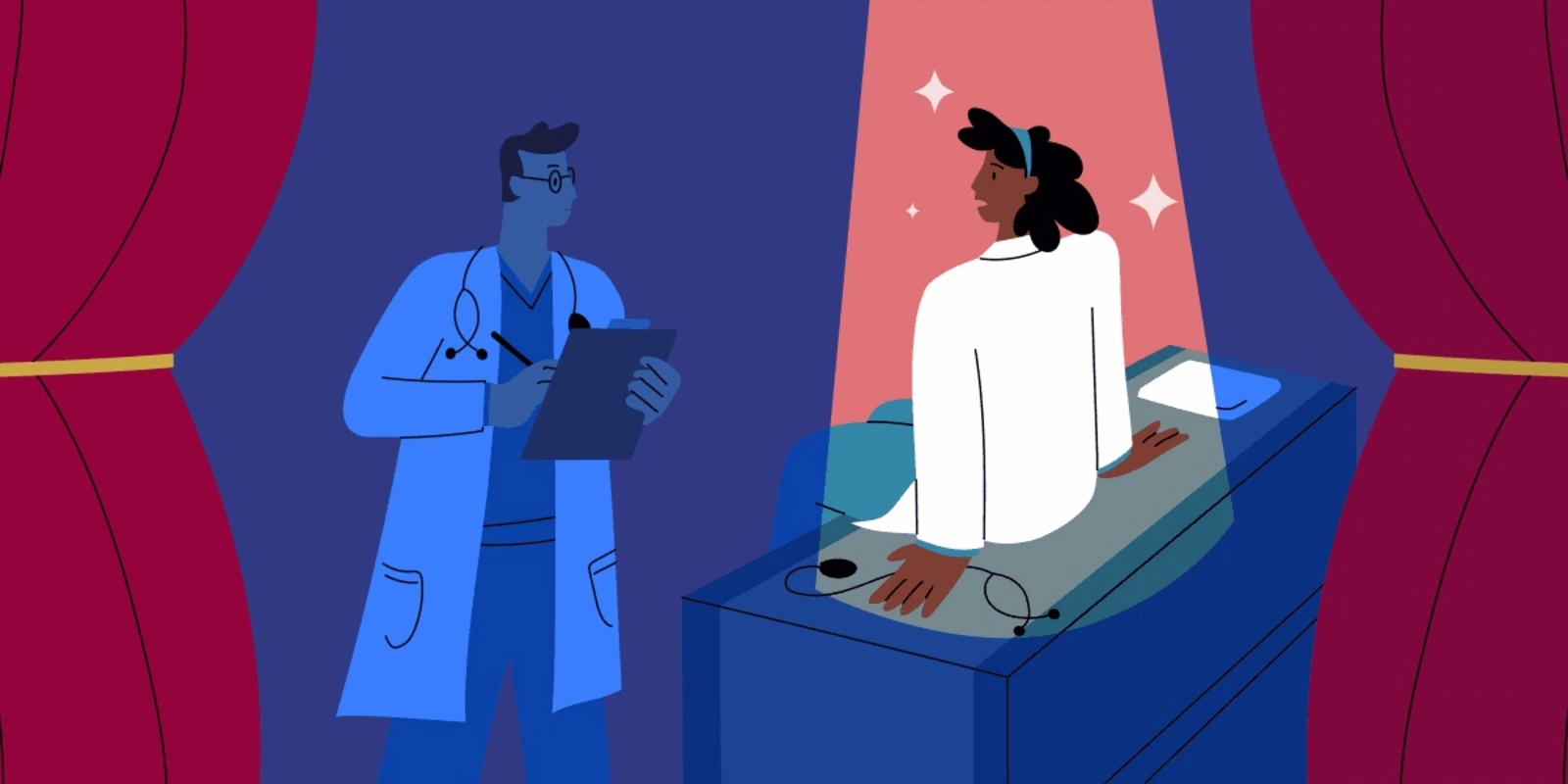

David H. Freedman opens his Atlantic essay “What Having a Fake Disease Taught Me About Health Care” with a strange kind of confession: he regularly walks into an exam room wearing a gown, describes symptoms he doesn’t have, and receives the kind of care most Americans can only get by pretending to be sick in a simulation lab. He describes encounters that “sometimes run as long as 40 minutes,” where students answer questions “without ever looking at their watch,” then “promise to check back in.” And he lands the line that should make every practicing clinician wince: “It’s a shame I have to feign an illness to get that kind of care.”
He’s right. It is a shame.
What stops me cold, though, is not the existence of standardized patients or the desire to teach empathy. What stops me cold is the calm, polished way the system acknowledges — openly, on the record — that it is training physicians in one form of care while running the actual practice of medicine on a completely different moral operating system.
Because here is the thing that everyone in medicine knows and almost no one in power says plainly: We are not failing to deliver empathy because doctors forgot how to be kind. We are failing because the system makes kindness economically irrational and operationally impossible, and then asks physicians to carry the emotional consequences of that impossibility as if it were a personal flaw.
Freedman quotes an ENT resident at Johns Hopkins who says, “You quickly learn as a resident that the job is to move things along,” and admits she avoids questions about a patient’s life because it “opens a door that will add time to the visit.” This is not a character defect. It is a rational survival strategy in an environment designed around throughput. It is the spoken version of what every intern learns without being formally taught: the clock is always ticking, and the system is always tallying.
Then we reach the part that, to me, is the most damning — not because it is shocking, but because it is presented as reasonable. Freedman reports that UCSF’s vice dean for education, Karen Hauer, “did not object to this characterization,” but instead noted that the school advises residents on how to establish “patient rapport when time is short.”
Read that again, slowly, as if you were reading it about any other moral act.
We teach future physicians to connect, to see the human being, to notice fear and uncertainty and shame — and then we tell them, essentially, to do it faster. We do not say, “This is incompatible with the medicine we claim to value.” We say, “Here are ways to compress it.”
Empathy becomes a form of packaging. A tone of voice. A sentence. A checklist item. A performance that can be “abbreviated.”
This is where I want to be explicit: this posture is not merely unfortunate. It is morally incoherent. If you train physicians to practice whole-person care and then place them into systems that structurally prevent whole-person care, what exactly are you teaching them? You are teaching them the shape of goodness while quietly stripping them of the ability to practice it.
That is not education. That is initiation into cognitive dissonance.
Freedman notes that reimbursement for a simple statin visit might bring in revenue, while extra time spent discussing fears, affordability, or diet brings in “$0.” There it is, stated plainly. The system is not neutral about empathy. It is not merely “busy” or “strained.” It is engineered to treat human connection as a non-billable luxury and physicians as the machinery required to keep the billing engine running.
And yet, instead of confronting this as a structural betrayal, we are offered soothing language from leadership. Melissa Fischer, who directs the standardized-patient program at UMass, argues that these lessons can survive residency “even if they have to be applied in abbreviated ways,” because trainees “just have to find faster ways to build them.”
Faster ways to build human connection. Faster ways to care.
Tell me we have lost the plot without telling me we have lost the plot.
There are things in medicine you can abbreviate without destroying the thing itself. You can abbreviate a differential when the probabilities are clear. You can abbreviate a presentation when the audience already knows the patient. You can abbreviate a chart note when documentation is designed to support care rather than defend billing.
But there are other things you cannot abbreviate without turning them into something else entirely. Empathy is one of those things. Not because you cannot say kind words quickly, but because empathy is not the words. It is attention. It is presence. It is allowing another person’s experience to matter enough that it shapes the encounter.
Remove the conditions required for presence — time, continuity, autonomy — and you do not get “abbreviated empathy.” You get customer-service scripts stapled onto an assembly line.
Freedman quotes internist Dave Hatem saying, “If you get the right words to come out of your mouth, and you do it often enough, then you get to the point where you really mean it.” I understand the hope embedded in that statement. But I also know what happens in real practice: the right words do come out, and then you go home hollow, because your day was a series of almost-connections cut short by alarms you were not allowed to silence.
That hollowing-out has a name, and we keep getting it wrong. We call it “burnout,” as if physicians simply failed to pace themselves. But much of what we label burnout is moral injury: the predictable harm of being unable to give patients what you know they need while being told you should feel obligated to do it faster.
Then comes the most hopeful claim in the article, offered by Lisa Howley of the AAMC: that training a generation of more empathetic students will make the system better, that young learners will be “agents of potential change.” I want to believe that. I truly do. But it is an extraordinary move to place responsibility for reform on the least powerful people in the hierarchy.
Students and residents cannot redesign RVU-driven care. They cannot create appointment slots. They cannot unstack waiting rooms. They cannot rewrite payer policies or documentation rules. They cannot hire staff or fix inbox overload. They cannot add slots to medical school classes or primary care residencies.
The people who can do those things already have titles, budgets, and microphones.
What trainees can do is suffer. They can carry the gap between what they were taught and what they are allowed to practice. They can learn to shut doors inside themselves. They can become efficient at not noticing. And if they resist, if they try to practice the medicine they were trained to believe was right, they will be labeled slow, inefficient, unrealistic, or “not a team player.”
So what would honesty look like?
Honesty would be medical education saying: we teach you what good care is supposed to feel like, and we acknowledge that the current system makes it hard (or impossible) to deliver. By design.
Honesty would be academic and health system leadership saying: it is not enough to teach empathy; we must fight for the structural conditions that make empathy viable.
Honesty would be payers and institutions admitting that if they refuse to pay for time, they are refusing to pay for the human parts of medicine—and should stop marketing “whole-person care” while purchasing 10 minute fragments.
Freedman’s essay is not wrong. In fact, it is almost unbearably right. But the hypocrisy deserves to be named more clearly than the institutions quoted in it are willing to name it.
You cannot build a profession on compassion and then run its daily practice as if compassion were a decorative accessory. You cannot praise “patient-centered care” while designing workflows that treat patients as the interruption. You cannot teach young physicians to see the whole person and then measure their worth by how quickly they stop seeing the human in the patient.
If we want empathy to survive, we must stop treating it as something physicians should perform under pressure and start treating it as something the system must make possible. Otherwise, we are not training healers. We are training actors to deliver lines in a play whose ending was decided by RVUs.
And patients — real patients, not standardized ones — deserve better than that.
Tina F. Edwards, MD is an emergency physician and direct primary care doctor in Oceanside, California. She writes about patient care, physician exploitation, and the structural failures of the American health care system.
Animation by Diana Connolly