
I met Sami during the third week of my emergency medicine rotation. He was a young man in his mid-30s who had come to the ED twice in the past 10 days for a diffuse, progressive headache and intermittent nausea. He was afebrile and denied any neck stiffness that would have suggested a meningitis picture. Prior CT imaging of his head had ruled out a subarachnoid hemorrhage. During his first two visits, his symptoms had improved with a migraine cocktail, and he was subsequently discharged. Because he had already been worked up during these previous visits, I assumed this third encounter would also be a quick one.
I was wrong by many accounts.
For one, Sami spoke an uncommon dialect of French. Every exchange was delivered with the help of an interpreter. Through fragmented conversations, I learned about his diffuse abdominal pain and ongoing headache. I also learned about his chronic, daily use of marijuana. As I spoke with him, I was reminded of a patient with cannabinoid hyperemesis syndrome whom I had seen on a previous rotation. In my haste, I decided to anchor on this diagnosis when presenting to my attending.
My attending’s response was kind and instructive. Rather than dismissing my impression, she invited me to sit down and review his workup together. Amid the many negative results from his initial presentations to the ED, mild hyponatremia was the one abnormality we could identify. Undeterred by his preliminary medical workup, my attending encouraged me to consider his broader picture.
Over the next several hours, I returned to Sami’s bedside repeatedly, one hand clutching my phone so I could speak to the interpreter, the other scrambling to jot down every single detail from our conversations. Beyond his abdominal pain and headache, I learned that Sami had immigrated to the U.S. from West Africa a few years ago. He had come here with his family to pursue additional opportunities. As I veered away from the structured interview I had grown accustomed to following, a different picture began to emerge during our conversations, one that broadened to include multiple facets of his identity: Sami was a relatively recent immigrant with no health insurance or established primary care physician, and he did not speak English.
As I talked with Sami, I began to realize that his socioeconomic background was inextricable from his clinical care. In the face of multiple negative lab values and imaging, we had leaned into his social history to fill in the gaps and guide our diagnostic process. Over the course of my eight-hour shift, my attending and I proceeded with a comprehensive workup, one that expanded to include testing for malaria, hepatitis, tuberculosis, and HIV. Given Sami’s nausea and vomiting, we ordered a CT scan of his abdomen. This time, the radiologist reached out directly to us by phone. Sami’s scan had revealed an incidental pleural lesion. Malignancy was now on his differential.
For Sami, the ED was not only a source for emergent treatment, but his primary avenue for medical care. His socioeconomic background was integral to our clinical decision-making. For any other patient with established care, outpatient follow-up would have been appropriate. However, given Sami’s uninsured status, discharging him without a plan in place would have meant leaving him to navigate a system that had already excluded him.
We rolled him back to the CT scanner once again, this time for a dedicated scan of his chest. He would have to be admitted to the inpatient medicine service. Through it all, I swung by Sami’s bed regularly, updating him on every step of his ED journey.
It would take more than a week before Sami was diagnosed with tuberculosis meningitis. By then, I had completed my emergency medicine rotation. However, his case has stayed with me. In those intervening days, I found myself wandering back to his chart, almost obsessively checking for medical updates. My downtime was spent reading through the multiple consult notes from pulmonology, infectious disease, and neurology. Part of me did so out of curiosity, to understand how his medical journey would unfold in the subsequent weeks. But another part of me was driven by remorse, by guilt for even considering that his symptoms could be explained by cannabinoid hyperemesis syndrome. I was humbled to realize how my initial impression could have barred Sami from receiving the care he needed. My attending’s guidance — firm but never dismissive — created space for me to recalibrate and learn from my misstep. She gave me just enough direction and autonomy to proceed while still taking ownership of his care.
My encounter with Sami provided a new appreciation for the privilege and responsibility of caring for patients. Medicine requires humility for learning and growth to take place. This is a process that involves dismantling assumptions, curiosity, and a desire to understand the patient before us beyond the framework of a singular diagnosis.
How do you practice humility in medicine? Share in the comments.
Bonnie is a third-year medical student at the Perelman School of Medicine at the University of Pennsylvania. She enjoys painting outside the lines, cultivating her ever-growing plant collection, and tossing together hearty salads. She is a 2025–2026 Doximity Op-Med Fellow.
Patient name and identifying details have been modified to protect patient privacy.
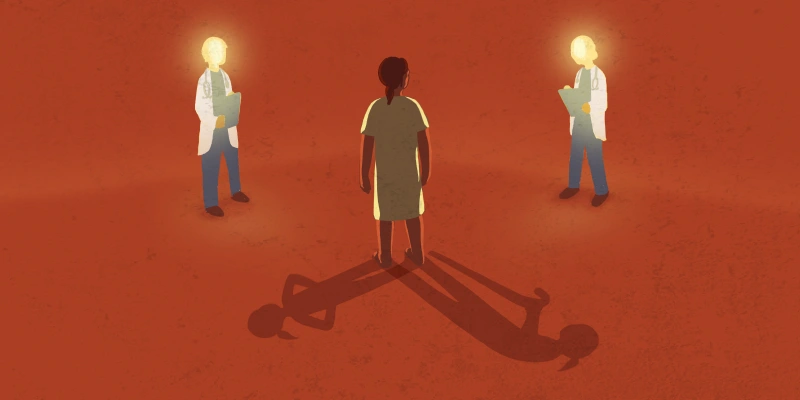
Image by Alphavector / Shutterstock