
I distinctly remember the moment I realized as a young physician that the healthcare system in the U.S. wasn’t broken. It was approximately 3:30 p.m. on a Friday, and I was a freshly graduated attending physician. The revelation came in the form of a telephone encounter: a simple web message marked “high priority” from a patient of mine who had just returned from an overseas vacation. Her leg was swollen, and she was wondering whether it was anything to worry about, or whether it could wait until Monday. Staring down the rest of my schedule and knowing I’d end up falling further behind as a result, I started the task of figuring out what was going on with her.
As a first step, I recall wanting to order an ultrasound to confirm the diagnosis of DVT. I instructed my receptionist to call over to the radiology department of the local hospital, and was promptly informed that the patient’s insurance required a prior authorization before the department was able to accept the referral. No problem, I thought; I quickly scribbled a note, handed it off to my staff, and had them push things through while I finished up the last few patients of the afternoon. By the time 4 p.m. rolled around, I hit a new snag: the authorization was approved, but the ultrasound tech had gone home for the day. In the view of the outpatient department, if the patient wanted to get an ultrasound, they’d need to go through the ER.
I weighed my options. I could put my patient on a blood thinner without confirming the diagnosis, but what if I was wrong? Or I could send her to the ER — but this seemed overkill when I felt confident already that the only thing she needed was an ultrasound. I could add her on at the end of the day — but this wasn’t making a decision so much as delaying it until after 5 p.m., when it would be harder to address the issue. I erred on the side of caution and ultimately did send the patient to the ED, much to my own disappointment, in hopes that they’d be able to get the ultrasound she needed more easily. It turns out my confidence was misplaced; the ER didn’t have an ultrasound tech after 4 p.m. either, and she was empirically started on a blood thinner and told to come back Monday for the scan, when they had a tech in-house.
Medical details of the case aside, I now look back on this episode as a turning point in how I thought about the healthcare “system.” Each decision made sense in a silo. The patient reached out appropriately with the patient portal. The office responded looking to obtain her authorization and schedule her for the test she needed. The hospital outpatient department wanted to make sure they got paid for the exam — after all, nobody works for free. The ER physician did the best they could, given the constraints, to make a clinical decision with limited information. Even the insurance company could be said to be acting rationally by requiring prior authorization for a study, so it wasn’t ordered unnecessarily. All of us did “what we could,” but in the end, it was the patient who suffered: from discontinuity, fragmentation, and a system that is not truly a system, but a hundred systems in a trenchcoat.
W. Edwards Deming, the father of the quality improvement movement in industrial manufacturing, is often credited with the quote “Every system is perfectly designed to get the results that it gets.” I’d endorse that statement when it comes to healthcare, with the caveat that I’m doubtful we can genuinely be said to have a system at all. When two hospitals in town run the same EMR but don’t “talk” to each other, is there a “system”? How about if a clinician runs a claim through insurance, but it's bounced back from a clearinghouse and denied before it even reaches the insurer? When a pharmacy can’t get through to the prescribing doctor because their fax line is busy for a med clarification, can we consider healthcare a system at all, or are we simply deluding ourselves into believing that our multiple, optimized, parallel processes are somehow intertwined in any meaningful way that benefits the person who needs care: the patient? To say that the healthcare system in the U.S. is broken vastly understates the issue: a system cannot be broken if it does not exist at all.
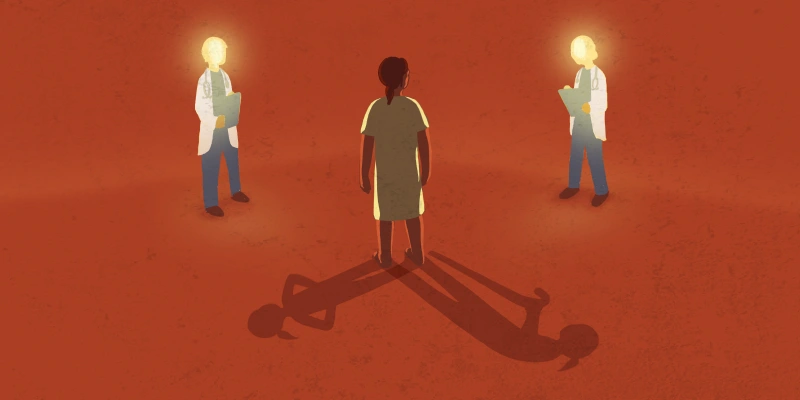
Perhaps it’s semantics, but I believe that the healthcare system in the U.S. isn’t broken — far from it. It more accurately does not exist. What we contend with is “designed” to get exactly the outcomes that it gets — the optimal outcome for each individual component, and rarely the patient. As physicians, we all want to go “above and beyond” for our patients. We’re frequently celebrated when we do, but it’s the lack of a system itself that we have that makes this necessary in the first place. When barriers like prior authorization prevent us from getting tests or medications, staffing crises limit the types of care we can provide, and scheduling leaves us without a moment to consider what’s best for the patient, we’re tempted to say that the system is broken. But the system isn’t broken: it's optimized for each individual part, rather than the whole. If or until we break down those barriers, we’ll be stuck with the same system: a perfect one, for everyone but patients.
I think back to that Friday often — not because the case was unusual, but because it was ordinary. The patient did everything right. So did my staff, the hospital, the insurer, and I. And still, the outcome made no sense. That’s the absurdity we all have experienced in American healthcare: not bad actors, not bad intentions, but the absence of a structure that allows people to reliably deliver good care. We keep calling the system “broken,” but that gives it too much credit. You can’t break something that was never built to function as a whole to begin with. What we have is a collection of optimized parts, each doing its job, none designed to work together. Until we acknowledge that truth, we’ll keep getting the same results.
I don’t believe the American healthcare system is broken. I believe it doesn’t exist at all. And I think that, once physicians can accept this fact, we will realize that the most challenging work ahead isn’t fixing a broken system. It’s finally building one to begin with.
Dr. Brennan Kruszewski is an internal medicine physician in Hudson, Ohio. He is passionate about transforming primary care. He enjoys spending time outdoors, especially biking the trails of Northeast Ohio. He is active on social media, and blogs at his personal website. Dr. Kruszewski was a 2024-2025 Doximity Op-Med Fellow and is a 2025-2026 Doximity Op-Med Fellow. Opinions expressed here are his own and not the opinions of his employer.
Illustration by April Brust