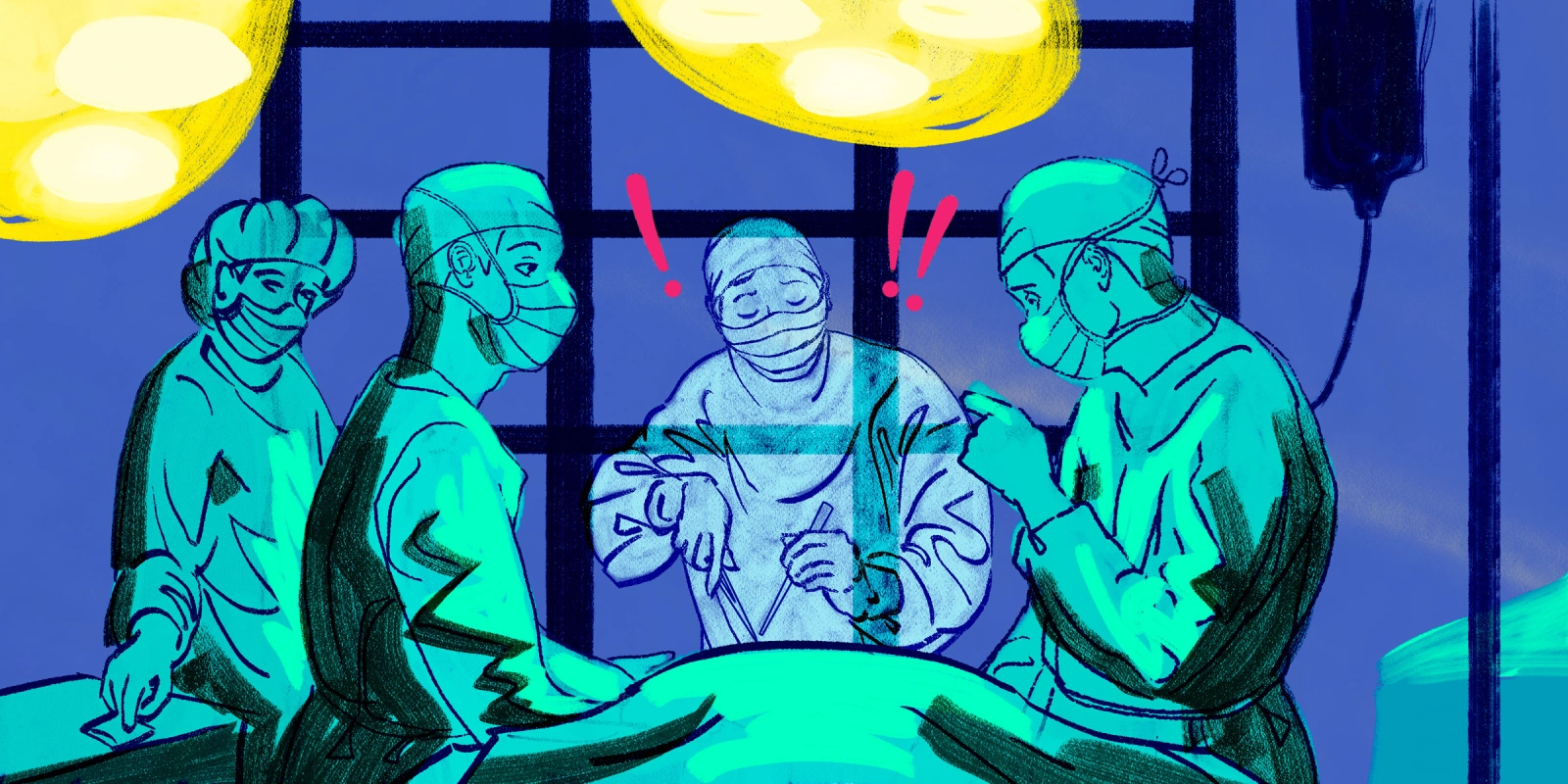

Surgeons rarely talk about it, but we all feel it. Anxiety disorders have skyrocketed since the pandemic, and that hum of nervous energy seems to follow us everywhere. If you’re a surgeon who struggles with anxiety, you’re in excellent company.
To understand anxiety, it helps to separate it from fear. Fear is immediate and useful; it protects us in real time. It’s what makes you swerve when a car veers into your lane or run when danger is near. Fear lives in the body and demands action. Anxiety, on the other hand, is fear projected into the future. It’s the fear response applied to imagination.
When we feel fear, our bodies take one of five classic actions: fight, flight, freeze, fawn, or flop. Most of us know the first three, but fawning — people-pleasing — is just as common, especially in surgery. It’s the instinct to appease a perceived threat. Think back to residency, when a chief resident raised their voice and you responded with exaggerated deference. That’s fawning, and surgical culture rewards it.
Anxiety mimics fear physiologically, but it’s triggered by imagined scenarios. It’s what happens when we use our remarkable creativity to script worst-case outcomes. If we can imagine the best and feel joy, we can also imagine the worst and feel dread as if it were real. The irony is that anxiety proves the danger isn’t actually happening. If it were, fear would already have taken over.
The other irony is that anxiety is rarely about what we think it is. On the surface, it may look like we’re worried about a surgical complication like a carotid injury, a CSF leak, or a facial nerve transection, but underneath, we’re really anxious about what it means: losing our livelihood, being judged, feeling humiliated, or disappointing a patient.
Sometimes it’s about how we imagine others will perceive us. Surgeons live under constant pressure to appear competent. I remember a sinus case early in my career where I back-bit the lamina and suddenly found myself looking at periorbita. My heart skipped, but I repaired it and the patient did beautifully. Even now, as I write this, part of me worries about being judged. That’s how deep the conditioning runs. Our anxiety isn’t only about outcomes; it’s about reputation, belonging, and identity.
Physiologically, anxiety activates the same circuitry as fear. The amygdala and related centers flood the body with stress hormones like epinephrine and cortisol. Left alone, the surge passes in about 90 seconds. But when we attach a story to the emotion, it reinforces the loop. We see bleeding in the field and think, It’s carotid. Our heart rate spikes, sweat beads under our scrubs, and our brain insists the story must be true because we feel it so intensely.
This is how anxiety hijacks intuition. Instead of trusting our training, we catastrophize. Instead of curiosity, we default to panic. The mind clings to its narrative even when the evidence in front of us says otherwise. Neurologists see a version of this in stroke patients who deny ownership of a paralyzed limb: the mind simply refuses facts that contradict its story. The same happens in the OR when anxiety takes over.
We may verify the anatomy and still not believe what’s in front of us. We double-check unnecessarily, justify it as “an abundance of caution,” and sometimes underperform out of fear, calling it “first, do no harm.” In truth, the anxiety loop blocks access to our own wisdom.
When that happens, we have two options. Option one: buy into the story. Option two: act like someone who isn’t anxious. Breathe deeply instead of shallowly. Name what you see, hear, and feel: That’s middle turbinate. That’s lamina. That’s septum. Ground yourself in certainty and let the hormones wash through. It only takes 90 seconds. If possible, shake it off afterward. Animals do this naturally after escaping threat.
If anxiety persists, examine the thoughts behind it. Identify what story you’re telling yourself: You caused a CSF leak. You cut the facial nerve. You hit the carotid. Bring the thought forward but don’t believe it. Ask, Do I absolutely know this is true? Usually, the answer is no. Once doubt enters the story, curiosity can return. Curiosity moves us out of the anxious left brain and into our body, which holds our skill and intuition.
Suppressing anxiety never works. What we resist persists. Unacknowledged anxiety often surfaces as irritability or overcontrol, like an attempt to manage uncertainty through compulsions or superstitions. We start believing a certain pair of socks or scrubs will keep the world in order. It’s a false sense of control born from fear.
The opposite of control is creative response. The Indian teacher Amit Desai Guruvé describes it as “existing in perpetual creative response to whatever is present.” That’s what great surgeons do when they’re at their best. A bleeder appears; we tamponade, pause, think. We adjust and continue, not from panic, but from presence. It’s like surfing a wave instead of fighting the ocean.
Imagine showing up to surgery, to your family, to your entire life that way: steady, adaptable, creative. Not reckless, but responsive. Not driven by control, but guided by skill and awareness. That’s mastery.
There’s nothing wrong with being a surgeon who feels anxiety. In fact, it’s one of the most courageous things you can do: to walk into an OR with anxiety and perform with precision anyway. Anxiety, when understood, can become a superpower. It sharpens awareness, builds empathy, and connects you to the human experience of your patients, each of whom feels their own version of fear before surgery.
I’ve come to see my anxiety as a teacher. It has made me brave, compassionate, and attuned. It reminds me that courage is not the absence of fear; it’s moving forward while fear is present. Anxiety doesn’t make you weak. It makes you human. And when you learn to work with it instead of against it, it can make you extraordinary.
Dr. Mel Thacker is an otolaryngologist, certified coach, and co-founder of the Hippocratic Collective. She works part-time as a locum tenens ENT surgeon in Western Massachusetts and leads Empowered Surgeons, a coaching platform helping physicians rehumanize surgical culture through mindset and self-leadership.
Illustration by Jennifer Bogartz