I felt my shoulders droop even more today, as I passed on relevant information about our little critically ill patients from the night in the PICU to my colleague taking over. It had been a busy night, and I had not gotten any sleep. Again. This was not unusual. Since kids returned to school after COVID-19 lockdowns, many had gotten very sick from previously relatively harmless viruses, such as rhinovirus or RSV, and we struggled to find enough beds and ventilators. The PICU had rarely been busier.
“Do you think it’s OK if I head out?” I asked my colleague. Did I really ask her for permission to take care of myself after my grueling 24-hour shift?
“Go home, get some rest,” she urged, but I shook my head.
“I better prep for the quality meeting this afternoon, and journal club, and finish my license application. Oh – and catch up on my notes!” She knew I was busy. We all were. She knew what it felt like. We had had a nearly identical conversation the other way around days prior, when she had looked at me with eyes that seemed to have lost their spark. That day, she had not given herself permission to put her health first, even if I gave her mine.
I remember the time another colleague had a medical emergency while on call. She’d kept managing the patients in the PICU from the ER, until we practically pried her pager and the service from her. She never asked for help. She would have kept going if it had been possible. I knew that. I felt just like her. I had been in a very similar situation when I was in the ER with a status migrainosus, worried who would cover my call that night. This job, these kids, this responsibility seemed more important than anything, even if it meant it got us sick.
There wasn’t one moment that changed me. There were many. Maybe they all needed to happen. Like rain drops falling one by one. But all watering the parched tree over time. Giving myself permission to care. Not just for my patients – that has always been a given – but for myself.
Most of us go into medicine because we want to help. We want to relieve suffering, ease pain, soothe ailments, save lives. We want to heal. We want the world to be happier, healthier, more whole.
For that, we willingly sacrifice; time, money, even friendships and relationships. Long study sessions, cramming through nights, tough exams, missed celebrations, endless reading. We work our butts off to pass, to excel, to pay for our education. We accept criticism and ridicule, and judge ourselves even harsher, never feeling good enough. We work through days and nights, weekends and holidays. Eighty-hour weeks, whatever hour weeks, it doesn’t matter. We know this is important. Whatever it takes. This matters.
We expect it to be hard and when it is, we keep going. The training, the work, the journey to become experienced. And we watch everyone around us do the same. It is the unspoken currency we pay with. Somewhere along the way, it becomes normal. Normal to not take of ourselves the way we counsel our patients to take care of themselves. Normal to be chronically sleep deprived, to fall asleep in a conference, at a red light, at our desk, even in the OR, holding retractors. Normal to eat crap. If we make time to eat at all. The stale donut at the nurses’ station, the dry bagel after grand rounds, the last scraps of mac and cheese from the cafeteria two minutes after closing. Normal to swig cold coffee but little water and skip bathroom breaks, as there is no time.
We become specialists in overruling our own needs. We train ourselves to power through, to ignore the quiet voice urging us to slow down, to rest, to figure out what we might need. Or what we might even want for ourselves. We are there for our patients, our colleagues, but not so much for us.
We even twist our discomforts into proof of our devotion: achy feet in clogs, tense shoulders at the computer, the stitch in our side sprinting down the hall to a code blue. It becomes a badge of honor. To always be busy, always exhausted, never caught up, never have time; constantly driven to do more, more, more.
We all know that physicians have higher burnout, higher rates of depression, and even higher suicide rates. But similar to the cancers, infections, and injuries we treat, these do not really affect us. They happen to others, not us. Until they do. I began noticing the toll this culture took on my colleagues and me. Some struggled with infertility, mental health crises, cancer diagnoses, or in my case, debilitating migraines. Others quietly burnt out. I watched us age faster than our non-medical friends, our friends who had kids earlier, who traveled, who bought vacation homes, who knew what hedge funds were. As physicians, we should know best how important self-care is for our health. We preach and prescribe it, yet we are the worst at applying it to ourselves. We feel selfish if we even consider it. But maybe, the self-sacrificial way of life does not really get us where we want and need to be. And maybe it makes us worse physicians: constantly tired, stretched thin, overwhelmed. But it is more cost-effective, and it’s how it’s been done for decades.
The American Medical Association code of ethics states: “When physician health or wellness is compromised, so may the safety and effectiveness of the medical care provided. To preserve the quality of their performance, physicians have the responsibility to maintain their health and wellness, broadly construed as preventing or treating acute or chronic diseases, including mental illness, disabilities, and occupational stress.”
In all my years of training, no one has ever told me this, nor have I ever seen anyone model this.
It will take years, maybe decades, for the system to change. It will take physicians who dare to speak up, who acknowledge that caring for ourselves makes us better for our patients, too. Physicians who refuse to mistake self-care for selfishness and who are brave enough to admit that, after all, we are human, too.
I think of my colleague, exhausted after her long call night, asking if it was “OK” for her to go home, just as I did. She didn’t need my permission, and neither did I need hers. What we all need is the awareness that tending to our own well-being isn’t optional. It is essential, and as important as the care we offer each one of our patients.
Steffi is a pediatric intensivist, a mom of three, surprisingly healthy kids, a triathlete, and a writer. Having grown up in Germany, she now lives in central Massachusetts, where she enjoys the fall foliage, apple pies, skiing the East with her husband and their (now) much faster kids in the winter and frolicking with them in the waves of the Atlantic in the summer.
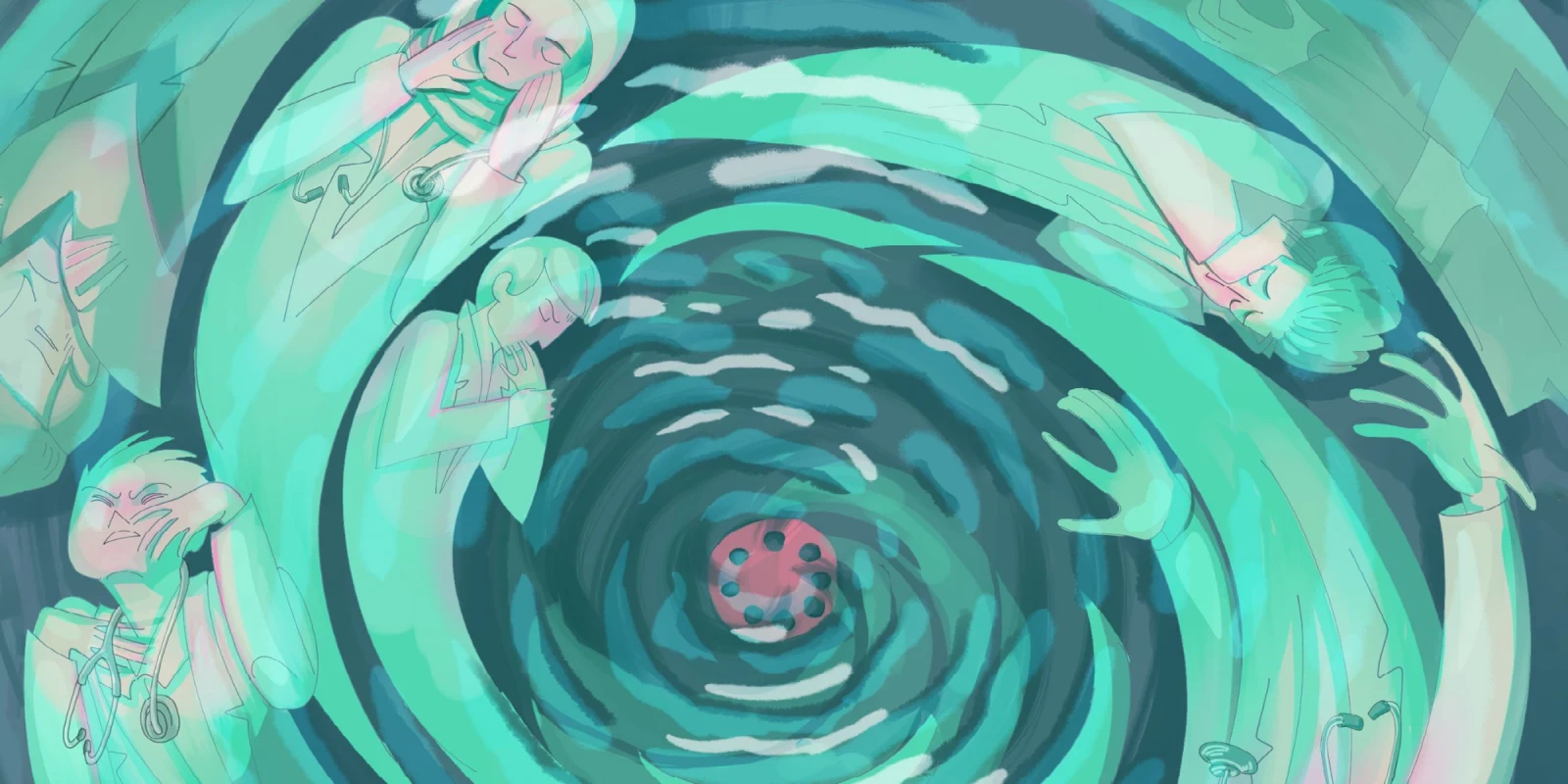
Illustration by April Brust