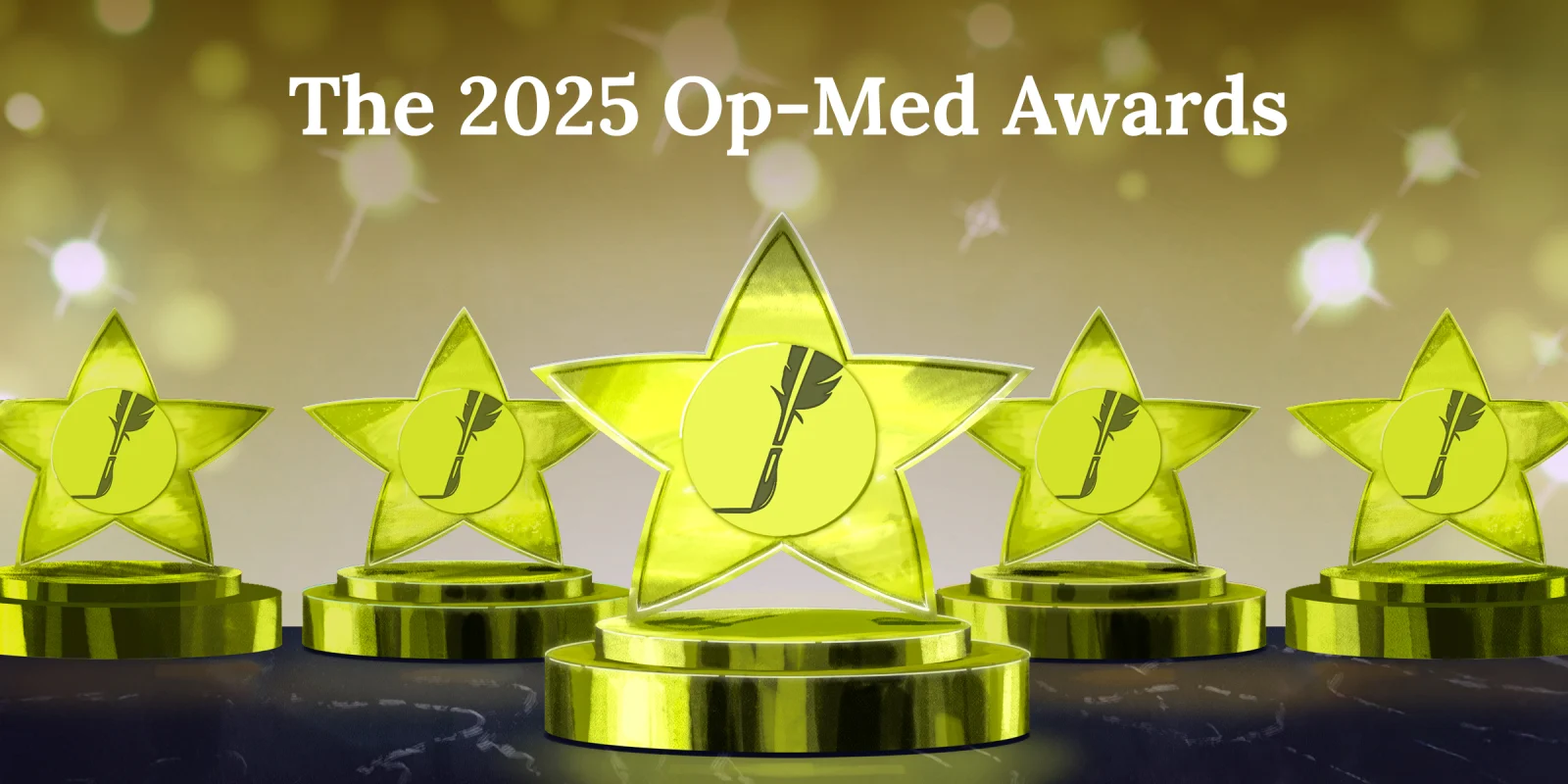

In 2025, Op-Med published more than 450 essays from Doximity members, who shared the good, the bad, the sad, the funny, and everything else that comes with working in medicine. It is from this group of writers that we bring you this year’s winners of the Op-Med Awards.
The Op-Med Awards highlight exceptional publications in six categories as voted on by the editorial staff: Community Favorite (the piece driving the most community engagement); Foreground Award (the best discussion of a new or existing problem in health care); Pathos Award (the most moving piece); Rising Star (the most promising voice among first-time contributors in 2025); Best Fellows Piece (the best work by one of our Op-Med Fellows); Editor’s Pick (our top choice overall).
We hope you enjoy this year’s winners.
Community Favorite
The Value of Physician Availability by Shannon Elizabeth Meron, MD
As health care increasingly relies on physicians doing patient care beyond what happens in the exam room, like insurance, prior authorizations, and other hurdles, Dr. Meron, an anesthesiologist, laments that call is “part of the job” — an unpaid part, which takes availability of physicians for granted. With nearly 500 comments from fellow physicians, it was clear that our community agreed.
“Availability of care is one of the drivers of market competitiveness,” writes Dr. Meron, “and yet the pressure on physicians created by that availability remains wholly uncompensated by the biggest winners in the game: hospitals and insurers. After all, why pay for something that has so long been given away for free?”
Runner-up: Why Doctors Tolerate Second-Class Treatment (And What They Can Do About It) by Jordan Frey, MD
Foreground Award
The Elephant in the OR: Anxiety and the Modern Surgeon by Melinda Thacker, MD
Surgeons are often caricatured as being brash and overly confident, but rarely is the human underbelly of doubt a surgeon faces talked about. Dr. Thacker, an otolaryngologist, examines uncertainty in the OR with a scalpel in hand, carefully pulling apart and separating out fear and anxiety and how to handle them mid-surgery. Dr. Thacker admits to feeling anxiety in the OR herself, and shares how she has been able to change the story she tells herself to tamponade that doubt. One top-voted comment says the article is so clear-eyed about this taboo topic that “every surgeon” in training should read it.
Runner-up: How Chatbots Can Unintentionally Validate Distorted Thinking by Miguel Angel Villagra-Diaz, MD
Pathos Award
The Baby the System Had Given Up On by Eli Brennan, Medical Student
The hospital is meant to be a place of healing, but in a busy medical system, sometimes showing up is the best thing we can offer. In his heartwrenching piece, medical student and new father Eli Brennan reflects on caring for an infant patient with severe failure to thrive, whom no family came to visit. Brennan holds two worlds in careful tension: his son’s infancy, filled with warmth and love, contrasted with this tiny patient’s infancy, characterized by absence and isolation. It’s a beautifully written and heartbreaking reminder of how showing up for another person, despite how overwhelming their situation may be, “is where care begins.”
Runner-up: There’s No Billing Code for Goodbye by Saima Tahir Chaudhry, MD
Rising Star
The Most Important Rounds Are at Home by Andrew Mohama, Medical Student
Medical training often unfolds within the hospital’s controlled choreography: the clipped efficiency of rounds, the hierarchy of the OR, the steady pulse of monitors. Andrew Mohama, a third-year medical student, steps outside that ecosystem to examine what medicine looks like beyond its walls. In chronicling his experience on home visits with an internal medicine physician, Mohama contrasts the system’s obsession with efficiency with the slow, intimate work of bearing witness to patients’ real lives. From a bedridden woman’s whiteboard filled with the names of family members coordinating her care, to a nearly 102-year-old man who tosses his keys out the window with stubborn independence, he illustrates how much of health care goes uncharted in the EMR. Mohama reflects on how these visits reshaped the story he tells himself about what it means to “discharge” a patient, arguing that the hardest chapters begin at home.
Runner-up: I Received a One-Star Review by Laura C. Whisler, MD
Fellows Award
The So-Called Care Crisis Is Very Real by Emily Jeanne Johnson, MD
Doximity Op-Med Fellows are clinicians who have been selected as regular contributors to Op-Med; they write longer-than-typical pieces on a wide range of specialty and general interest topics. This year, our Fellows Award goes to Dr. Johnson, a family physician, who both addresses the somber realities of the national care crisis and offers a hopeful and nuanced reframe of caregiving itself. Her assertion that “life is a constant ebb and flow of giving and receiving care, often simultaneously” serves as a beacon for clinicians, those of us who are in the business of caring for others in a system that seems set up to undermine it. Lucid, graceful, intimate, and rigorous, this essay sets a high bar for Fellows and non-Fellows alike.
Runner-up: Is the Physical Exam a Thing of the Past? by Nicole Bernice Hight, MD
Editor’s Pick
Doctor, Heal Thyself by Jennifer Peak Rubin, MD
In the editors’ favorite piece of the year, Dr. Rubin, a child neurologist, tells the story of two foot fractures 18 years apart, and how she was able to successfully heal each without (recommended) surgical intervention. Celebrated in the comments for its relatability and humor — with one physician rightly calling it “brilliant” — the piece highlights how “medical decisions are nuanced and not always clear-cut,” and reminds us that in the case of broken bones, watchful waiting can be as legitimate an option as surgery. For its wit, insight, and candor into an unconventional approach, Dr. Rubin’s essay stands as an example for all would-be contributors to Op-Med.
Runner-up: An Honest Look at Life’s Inevitable Conclusion by Neha Sahota, Medical Student
Do you want the chance to see your name on this list? Submit to Op-Med by emailing opmed@doximity.com. Note that in addition to narrative essays, we publish creative writing (via our Medical Humanities vertical), conference coverage (via our Conferences vertical), and breakdowns of recently published studies (via our Medical Insights vertical, for which we’re currently seeking articles on oncology, dermatology, and rheumatology).
Illustration by April Brust and Jennifer Bogartz