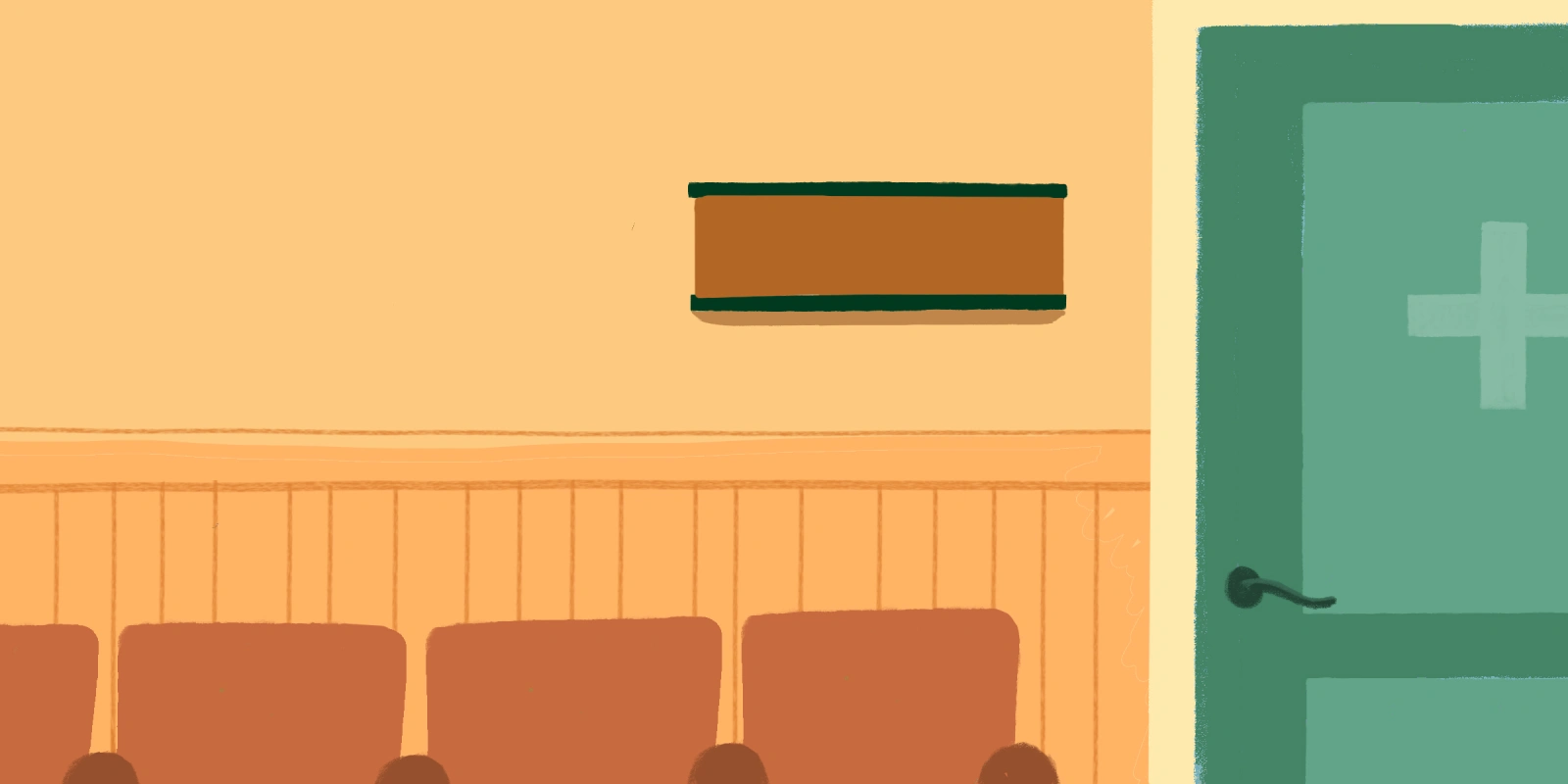

Crimson fluid leaked onto the floor. My hand throbbed, freshly incised and packed in three places. Tears rolled quietly down my face as I sat among a square of plastic chairs.
To my left, a woman clutched her flank with one hand, an IV pole tethered to the other. Across from me, a man leaned back groaning with his eyes closed, an emesis bag dangling from his fingertips. Clinicians drifted in and out, discussing kidney stones, antibiotics, outpatient follow-up. I listened with guilt, helplessly complicit in an abolishment of privacy. And beneath that guilt, a fear gnawed at me: Would I be forgotten there?
Two months later, I entered medical school. More than three years have passed, but that sense of exposure and abandonment remains vivid. What strikes me most is how routine it has become – patients lined in hallways, stripped of privacy, as if it were normal. As if it were acceptable.
That plastic chair seemed to whisper to me about how little comfort I had “earned.” Now, in my clinical years, I carry guilt along with my stethoscope as I approach each hallway patient, wondering if they feel the same. My disappointment compounds as I see sicker and sicker patients in the hall. Ascending cholangitis. Rapid atrial fibrillation. Alcohol withdrawal. Suicidal patients relegated to hallway recliners.
Hallway medicine has become commonplace. One study shows nearly one in three patients in the ED spends some portion of their stay in a hallway bed. The reasons for this practice are many. EDs have become the safety net of a fragmented system. Primary care shortages, inadequate mental health resources, lack of insurance coverage and difficulty accessing outpatient care funnel patients toward the ED – the only guaranteed entry point. Some patients remain in the ED for hours to days waiting for an inpatient bed. Add seasonal surges and staffing shortages, and the result becomes predictable: hallways lined with patients who deserve better.
Hallway medicine is difficult not only for patients, but also for us as clinicians. For nurses, the logistics can feel nearly impossible. As an ED technician, I remember the challenge of obtaining an EKG on a female patient without compromising her privacy. Later, as a student, I watched a nurse rearrange beds and chairs just to plug in a pump for a transfusion, while the patient sat in shock that such a critical intervention would occur in a hallway.
Every pillar of medical ethics is undermined by hallway medicine.
Autonomy: Patients rarely get to choose whether they are visible to strangers.
Justice: Patients of color, individuals with public insurance, or those with behavioral health complaints may be more likely to be placed in hallway beds, reinforcing inequity.
Beneficence and non-maleficence: Patients are more likely to be unsatisfied with hallway care. There’s evidence hallway patients undergo fewer diagnostic tests, are less likely to be admitted and are twice as likely to return to the ED within 30 days.
Medicine can be practiced in a hallway, but clearly not optimally. IV fluids can be hung, labs drawn, orders placed. But healing requires privacy, dignity, and peace. None of those exist in the hallway.
Time blurred that night, almost like a dream, until a woman in scrubs appeared. “You can follow me,” she chirped. Finally, a room. I sank onto the crinkled paper – alas, a bed. A ceiling mural of a meadow. The tension in my body began to release.
Some time later, I met Kevin, a hand surgery fellow. He shook my hand, then sat beside me. “What do you do for fun?” he asked. My role as just “patient” began to slip away, I was feeling human again. I stopped thinking about the prognosis for my hand. I was chatting about walking in nature. I was sharing about my beloved pets. We eventually discussed the possibility of surgery, but in those first five minutes the sense of abandonment that had blanketed me in the hallway was lifted. I would not be forgotten after all. That brief encounter taught me a timeless lesson: it doesn’t take much to show a patient you are not only examining them – you are seeing them.
Now, when I see a patient in the hallway, I start by naming the wrong. I look them in the eye and say, “I’m so sorry you’re in the hallway. I can imagine how uncomfortable this is.” I offer small comforts when I can: a blanket, headphones, eye covers. I protect conversations by kneeling to their level, lowering my voice. These gestures do not erase the indignity, but they acknowledge it.
Lastly, no matter how busy I am, I ask one question that isn’t part of the history of present illness. I ask at least one thing about the history of present human – the person in front of me, who deserves comfort, dignity, and to be seen.
I know that blankets and whispered words cannot solve the deeper problem of crowded hallways and strained systems. But they can remind the patient, and myself, that healing begins not only with medicine but with healing and humanity. And sometimes, that humanity can begin even in the hallway.
Daniella Carnevale is a fourth-year medical student applying to internal medicine residency and a Gold Humanism Honor Society inductee, dedicated to advancing patient-centered, humanistic care.
Illustration by Diana Connolly