As I reach the halfway point of residency, I no longer feel like the wide-eyed intern I once was. My clinical reasoning is sharper, I anticipate next steps more confidently, and I trust my judgment. Yet on many rotations, my daily tasks remain nearly identical to those of an intern: writing notes, paging consultants, managing admissions. I live in a space between independence and uncertainty. This tension is common in family medicine, where much of our training occurs off-service and we are often the “new person” joining an established team. At certain times, I’m nudged into being “just another intern.” At others, my broad exposure across fields makes me the one deferred to, like when I answer an adult medicine question on pediatrics. The mismatch between role and experience leaves me in a gray zone — more advanced than an intern in some ways, less advanced in others. It has also made for some awkward teaching experiences, such as early in the academic year when a senior began to teach me how to put in discharge orders (a task I’ve been doing routinely for the past year), or when a pediatrics senior assumed I knew the basics of a genetic disease I had never heard of.
Medical hierarchies magnify this tension. They provide structure and accountability but often suppress agency and communication. The word intern itself carries a history of confinement — its roots in being “interned” mirror the limited autonomy and rigid hierarchy that once defined training. While the title is fading in some programs, its legacy persists. To be called an intern is to be marked as the most junior resident, the most constrained. Even when the work is indistinguishable from that of a senior, the label carries implicit meaning: deference, restraint, and submission to authority. The intern’s input has less weight than the senior’s, sometimes to the point of being dismissed or unheard.
In reality, hierarchy is rarely so neat. Medical hierarchy was designed to create a chain of command based on experience, but when a PGY2 functions as an “intern,” does the title — and its implicit hierarchy — lose its meaning, or does it reinforce it even more? Nontraditional paths and varied identities expose similar cracks: there is some awkwardness on both sides when the 20-something senior supervises an older intern who had a whole other career before coming to medicine. Hierarchy is neither wholly virtuous nor wholly toxic. It clarifies roles, but it also risks inequities and exclusion when treated as rigid instead of relational. Living in the space between “intern” and “senior” has shown me that hierarchy may organize teams, but it often carries more significance than it deserves.
Perhaps this gray zone is the most honest reflection of training. Medicine depends less on rigid categories than on the ability to adapt to the various roles a team requires and to learn from one’s colleagues. A senior new to a service may rely on interns familiar with the workflow. A medical student may catch a subtle finding that even an attending missed. An emergency medicine resident may teach an off-service resident how to better handle a rapid response. A consulting nephrology fellow may learn about a patient’s cardiac status from the primary team’s intern. These moments highlight that medical learning is not always top-down, and competence is not bound to one’s level of training. The discomfort of not fitting neatly into “intern” or “senior” reflects the nonlinear nature of growth and learning in medicine.
Yet our training structures rarely reflect this truth. Hierarchy, rather than remaining fluid, often becomes calcified. By clinging to strict learner roles and titles, we reinforce a model of training that values deference over collaboration. Programs could shift this by explicitly acknowledging the fluidity already present in daily practice. Evaluations could reward adaptability and contributions to a team rather than certain rigid year-based benchmarks. I find it most helpful to listen to presentations from juniors on the team, because they often have the time and passion to get to know patients better, as well as the nitty-gritty pathophysiology knowledge I have lost from early in medical school. It would be more helpful to evaluate how a medical student provided unique perspectives regarding a patient’s social situation that changed the course of their care than to simply boil their evaluation down to “their fund of clinical knowledge was appropriate for their level in training.” We all have life experiences, expertise, and perspectives both within and outside of medicine that make our contributions essential. Acknowledging this with small gestures legitimizes the shared, shifting nature of learning, and ultimately, it is up to an attending or senior to model and uphold that value.
In the end, the cracks in hierarchy are not flaws to be fixed, but openings to reimagine training itself. Titles will always exist, but their power lies in how flexibly we use them. When medicine recognizes that belonging depends less on one’s rung in the hierarchy and more on the background each person brings — from past careers to personal medical experiences to individual identity — we move toward a culture that produces not just competent physicians but also resilient, collaborative teams. What feels like being “neither here nor there” may in fact be the clearest sign of growth — and a path forward for how we train clinicians.
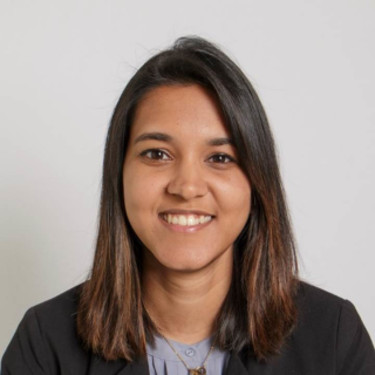
Dr. Brinda Sarathy is a family medicine resident at the University of Colorado in Denver, CO. She is passionate about social justice, medical education, and storytelling. In her free time, you can find her hiking, paddleboarding, or exploring a local bookstore. Dr. Sarathy was a 2024–2025 Doximity Op-Med Fellow, and continues as a 2025–2026 Doximity Op-Med Fellow.
Illustration by Diana Connolly