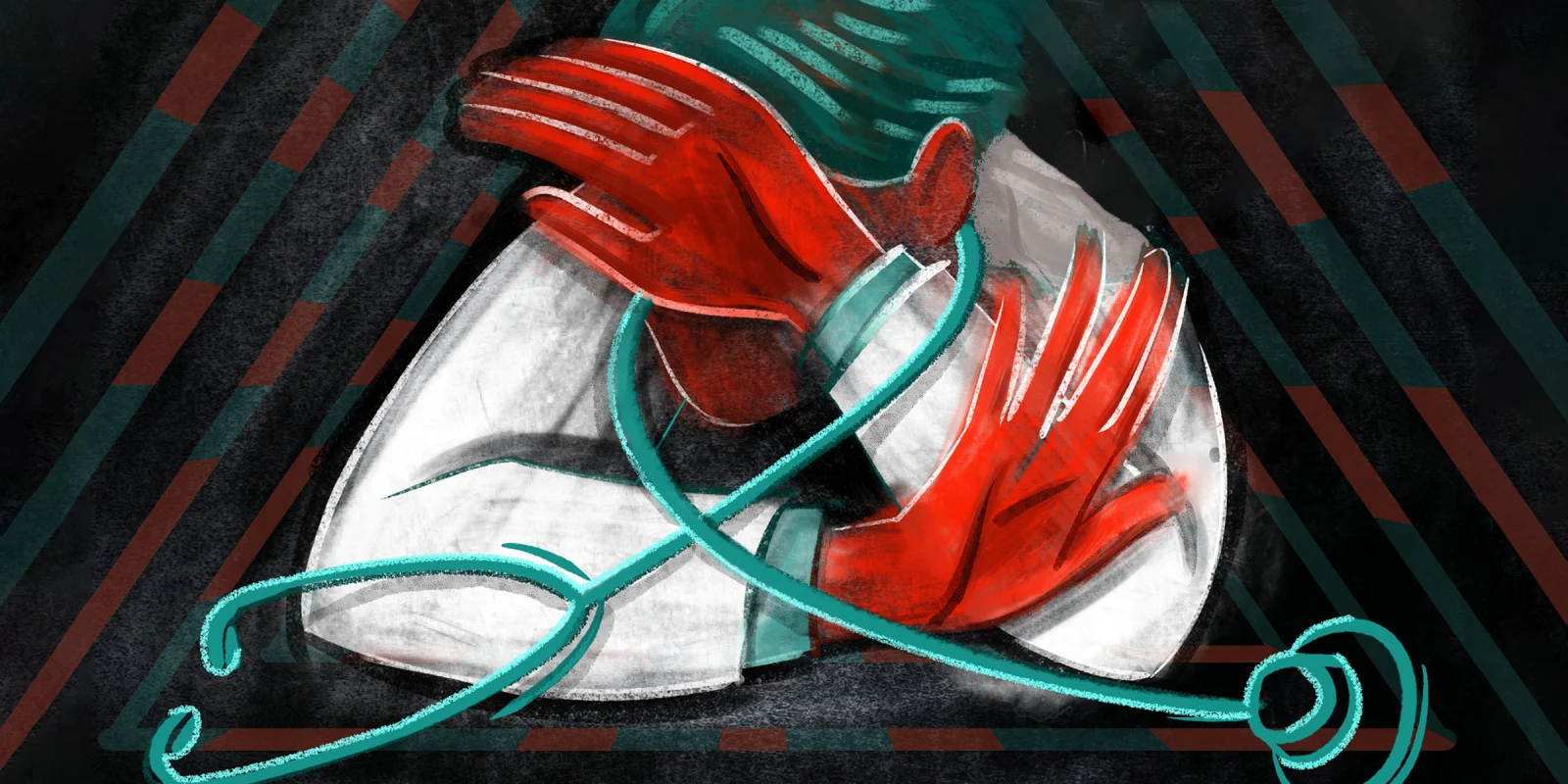

I was finishing a routine psychiatric assessment when the patient rose to leave. In an instant, she spun around, punched me in the face, and locked her arm around my neck. For several minutes I was dragged around the room, gasping, until staff rushed in to break her hold. The bruises healed. The memory has not.
And I am not alone. Across America’s psychiatric hospitals, healers endure assaults at staggering, normalized rates, often in silence. Assault is not limited to bruises or broken bones. In law, it means the intentional act of causing another to fear imminent harmful or offensive contact. For health care workers, that can mean a fist, a shove, or the words, “I’m going to hurt you.”
Health care workers face a dramatically higher risk of on-the-job violence worldwide than people in any other profession. The WHO estimates that nearly four in 10 health care professionals across the globe experience physical assault at some point in their careers. In the U.S., the problem is even more severe. Between 2021 and 2022, the health care sector recorded 14.2 nonfatal violent incidents per 10,000 workers, almost five times the rate seen across all industries (2.9 per 10,000 employees).
In general hospitals, workplace aggression is both widespread and escalating. A study from a tertiary care hospital in the U.S. found that about one in three health care workers had experienced some form of workplace violence, and roughly one in eight suffered physical assault. Among those affected, three out of five reported symptoms of post-traumatic stress, nearly one in 10 left their jobs, and about one in three considered leaving the profession altogether.
Within health care, the burden falls heaviest on those working in mental-health workers: about one in 20 experience an assault serious enough to require time off. A Press Ganey analysis found that a nurse is assaulted every 30 minutes in the U.S. Research echoes these numbers: in psychiatric hospitals, as many as eight out of every 10 staff members have been physically attacked by a patient in a single year, and a nurse experiences an average of one assault every five weeks.
Yet reporting remains the exception rather than the rule. Many incidents go unreported because institutional policies are often weak, reporting systems cumbersome, and leadership support inconsistent. Workers fear being blamed or simply assume that nothing will change even if they speak up. Over time, we’ve been conditioned to accept violence as “part of the job.”
Even when health care workers report assaults like mine, the response often ends in a quiet procedural void. An officer arrives, takes photographs, notes the injuries, and files a report. He explains the case will go to the county prosecutor. Like me, most of us never hear another word.
In one hospital study, over one in three reported cases of workplace violence were never prosecuted, and only about one in 20 reached indictment. While the study was conducted outside the U.S, it mirrors what many American clinicians experience: a system that quietly absorbs violence without consequence. In the U.S., no national data track prosecution rates for assaults on health care workers, a silence that speaks volumes.
Prosecutors often decline to pursue charges, viewing patient-perpetrated assaults as “clinical incidents,” especially when mental illness or cognitive impairment is involved. Yet this restraint often crosses into neglect. When incidents go uninvestigated or undocumented, patterns of aggression are lost, and high-risk patients can move through hospitals without warning or safeguards.
This institutional indifference has a larger echo, one that reaches all the way to Capitol Hill. Despite the scope, meaningful protections remain elusive. The Occupational Safety and Health Administration has no enforceable standard for workplace-violence prevention in health care; it can act only under a vague “general duty” clause.
The Workplace Violence Prevention for Health Care and Social Service Workers Act, reintroduced in 2025, would require hospitals to implement prevention plans, risk assessments, and staff training nationwide. Yet it languishes in committee.
Meanwhile, the Save Healthcare Workers Act (H.R. 3178) would make assaulting hospital staff a federal crime, carrying penalties of up to 20 years. It was introduced in May 2025 and still awaits action.
The contrast is telling: When flight attendants were assaulted, Congress acted within months. When nurses are punched and physicians choked, Congress shrugs. The message to health care workers is unmistakable: your safety is negotiable.
Protecting caregivers is not separate from caring for patients. Unsafe workplaces lead to poorer patient outcomes, lower satisfaction, and higher error rates. When caregivers are fearful, traumatized, or driven from the profession, the quality of care inevitably suffers. Safety for staff is safety for patients.
True safety in health care isn’t built from a single policy. It’s carved, layer by layer, from priorities that support one another. At its base is adequate staffing, the foundation on which everything stands. Understaffing breeds frustration and leaves workers exposed. Maintaining safe ratios and reliable backup coverage reduces violence and allows faster response when it occurs. Above that stands de-escalation training, the skill set that turns awareness into prevention. Regular, standardized simulations in communication and early warning signs equip all staff to defuse tension before it becomes aggression. The next layer is environmental design: secure nurses’ stations, clear exits, restrict access, and provide better lighting. At the top is policy and culture: leadership’s visible commitment to zero tolerance, consistent reporting, and post-incident support without retaliation.
When I was attacked, I was lucky to be pulled away before more damage was done. Across hospitals and clinics, too many colleagues are not as lucky. They carry fractures, concussions, or invisible scars that drive them from the work they once loved; not always because of the blows they endured, but often because of the silence that followed. What haunts me most isn’t the punch, it’s how easily the system moved on. I can still feel it some nights, not in my body, but in my trust. In a system that keeps asking us to show up, even when it forgets to show up for its own.
Do not dismiss violence as the cost of doing our jobs. Report every incident; every punch, shove, and threat. Reporting is not complaining; it’s how we build the evidence for change. Demand that workplace violence be treated with the same seriousness as infection control or sentinel events. Measure it. Track it. Act on it. Safety should be built into the job. Change won’t come from policies alone. It will come from us, from a profession that refuses to accept danger as duty or silence as strength.
Let’s not wait for headlines or another tragedy. Caregivers matter every day, not only when their suffering makes the news.
Fawad Taj, MD is an assistant professor of psychiatry at Case Western Reserve University and a psychiatrist at University Hospitals of Cleveland with over a decade of experience in psycho-oncology, emergency psychiatry, and serious mental illness. His leadership lies at the intersection of mental health, policy, and community advocacy. Dr. Taj is a 2025–2026 Doximity Op-Med Fellow.
Illustration by April Brust