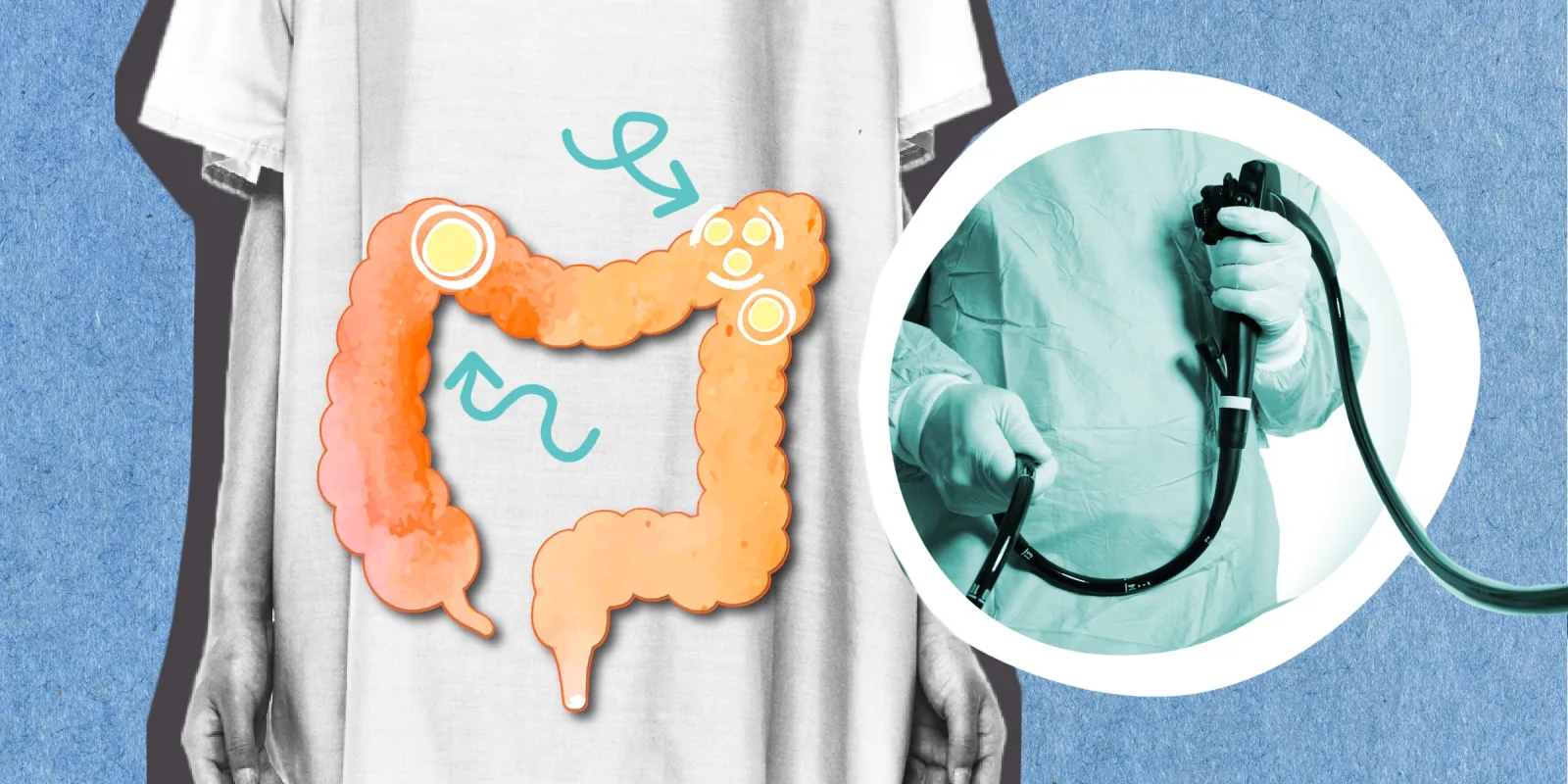

Who would have thought one could learn so much about life from a colonoscopy?
Now, I know what you are thinking — this GI doc has stared at the inside of one too many colons (this may be true). But hear me out.
Here are a few of the life lessons I have learned from over a decade of colonoscopies.
1) Every colon is different.
After 10,000 colonoscopies, it may seem like all colons are the same. But, in truth, every colon is different in some way. Some are straight, some are twisted, some are pink, some are black. Some are long and tortuous, others short and sweet. Prep quality, diverticulosis distribution, blood vessel pattern, polyps, hemorrhoids — you name it, there is always variation.
We are quick to assume our daily clinical experiences lack variety. Colonoscopies remind us that every colon, and more importantly, every patient, is unique (and should be treated as such).
2) Progress is not always linear.
The first thing we learn as GI fellows is to reduce our loops, in other words, to pull back and straighten the scope to eventually successfully move forward through the colon. As trainees, our instinct is to continuously push the scope into the patient — pulling back to straighten the scope seems preposterous. I finally got through this pretzel twist of a sigmoid colon and you want me to do what?!
When we finally master the art of reducing loops, it is downright Zen-like. There is no better feeling for an endoscopist than when our scope effortlessly glides forward through the colon while we pull back on the shaft.
In colonoscopy, as in life, progress is not always linear. Sometimes you have to pause, back up, and reorient before you can truly move forward.
3) Prepare to be humbled.
What a day! You have banged out eight colons before lunch, removed a dozen or so polyps, and are running 30 minutes ahead of schedule. You are feeling good. The next case on the schedule looks to be another straightforward colonoscopy — a 45-year-old, thin, healthy male for a screening colonoscopy. Fifteen minutes into the case, you are still floundering in this patient’s tangled sigmoid colon. You have tried every trick you know — turned the patient, asked the nurse for abdominal pressure, even switched to a thinner, more flexible scope — but your position in the colon has not changed. In fact, the only thing that has changed is the sweat running down your brow and the anesthesiologist’s growing frustration with the amount of propofol being infused.
Life is like that, isn’t it? Always knocking us down a peg, or two, when we get a little full of ourselves.
4) Go with the flow.
Performing a colonoscopy can be meditative. There is a rhythm to inserting, withdrawing, twisting, and straightening the scope as you make your way through the colon. In the background is the reassuring hum of the suction machine. On a good day, all of this can put an endoscopist in a trance-like state. Athletes often describe entering “the zone.” Physicians, too, can relate to entering a flow state. There is a sense of harmony that comes with skillfully doing something repeatedly.
5) Who you work with matters almost as much as what you do.
The conversation and energy in an endoscopy room can make or break your day. Sure, we GI doctors love to do procedures, but let’s face it, not every endoscopy is exciting. The pleasant back-and-forth banter between GI docs, anesthesiologists, and nurses helps keep the mood light and the energy up. The endoscopy suite is where I learn about the latest TikTok trends and Netflix shows, but more importantly, where I catch up on the lives of my colleagues. The list of topics covered in an eight-hour day is comprehensive — family matters, recent travels, new recipes, etc. The conviviality adds color to my day — I anticipate it is one of the things I will miss the most when I eventually hang up my scope.
6) The end is really just the beginning.
Ask any first-year GI fellow their goals for fellowship and they will say “to consistently get to the cecum.” We become obsessed with being able to advance the scope to the promised land and grow despondent when we realize how easily our attendings achieve this goal while we flounder in the sigmoid colon. Even many experienced attendings view cecal intubation as the most important aspect of colonoscopy (cecal intubation rate is, in fact, one of our quality metrics). In fact, many endoscopists pride themselves on reaching the cecum as quickly as possible.
Reaching the cecum does not, however, prevent colon cancer. Careful examination of the colon and meticulous polypectomy technique are far more impactful but often get lost in the desire to perform more procedures in a given day.
Colonoscopy reminds us to remain mindful of what really matters. We owe it to our patients to deliver high-quality care. We also owe it to ourselves.
In the end, isn’t it our commitment to what really matters that keeps us coming back, day after day?
What has medicine unexpectedly taught you about life? Share in the comments.
Anish A. Sheth, MD, is chief of gastroenterology at Penn Medicine Princeton Health and is the author of several books on gut health including the bestseller, "What's Your Poo Telling You?" He is a mid-career physician who loves practicing medicine and is looking for ways to keep the fire burning! Dr. Sheth is a 2025–2026 Doximity Op-Med Fellow.
Collage by Jennifer Bogartz / Shutterstock