
Surely, you will remember graduating from medical school and the first time someone called you a doctor. Perhaps you'll even recall how the word sat in the air like your own proud secret. If it was during the pandemic, you may not have touched a patient in months, and certainly you were no more a doctor today than you were yesterday, and yet — doctor. Like a birthday, the twitch of the hand on a clock that tells us yesterday is not today, which, we can be assured, is different and yet — and we know this to be true — is still very much the same.
When I've talked with co-residents and graduating residents in other fields, the underlying theme is how great it will be to be an attending. It has the undercurrent of leaving your parents’ house for college at 18, finally out from under their roof. No one to tell us what orders to put in or challenge our decisions. What we discuss less is the anxiety that comes with this newfound freedom.
As is common, and frankly, imperative, our attendings provided graduated responsibility. With each passing year, there was less direction as their input morphed from prescriptive to simply being the last check before admitting or discharging a patient. But there were always guardrails in place. In my final year of training, I prided myself on working independently, asking questions only after careful consideration, with a patient’s plan and final disposition already in place. Like anyone whose career progression has hinged on a series of day-long exams, I disliked having my plans overridden by attendings and wanted, more than anything, to be right. As if there is such a thing in medicine.
Like a teen leaving for college, our attendings prepare us as best they can, but ultimately, the quality of the training we receive and the medical care we provide is in our own hands. Sometimes it is also limited by the cases we do and don’t see, experiences we do and don’t have. In my last year of training, I sought out any presentation that I found myself asking, What do I do with this? Or better yet, Please, not today. Like fear was something I could smell on myself. That meant signing up for the ever-vexing multiple complaints presentation, fishhooks inadvertently applied, ankle dislocations, unstable arrhythmias, congenital heart defects, and any gastric tube or PICC line complication I could find. If I didn’t find them, I knew they’d find me — at 2 a.m. and alone at a community hospital with minimal support overnight.
As of writing this, I've been practicing on my own for a month now. A month is so infinitesimally small in the shape of a year, a decade. My experience as an independent doctor is a speck on the windshield of a lifelong career. As the adage goes, you don't know what you've got until it's gone, and I miss the subtle head nods, even the approving silence of another who has decades. In the absence of which, I've spent hours mulling over a decision to send a patient home. On days off, I log in from home to see if any of my recent discharges have returned. There will be a little calendar icon over which an arrow makes a 360-degree swoop. Back to where we started. More than anything, I fear my own sense of guilt and disapproval if something goes wrong, knowing that it was my choice, and mine alone.
I tell myself that my anxiety is what keeps my patients safe. If adrenaline is a bear chasing you, then the waiting room is forever full of bears. It is good — to a point. It’s what drives me to order four EKGs in a row to look for dynamic changes and drives my nurses crazy. I run through scenarios for sending the patient home. Do I call the cardiologist — who will laugh not because he is mean but because he is right — and then send them home, and sleep better at night? Or do I trust myself to send her home without a second opinion, testing my expertise like weight on a bridge whose construction I have closely observed but never crossed?
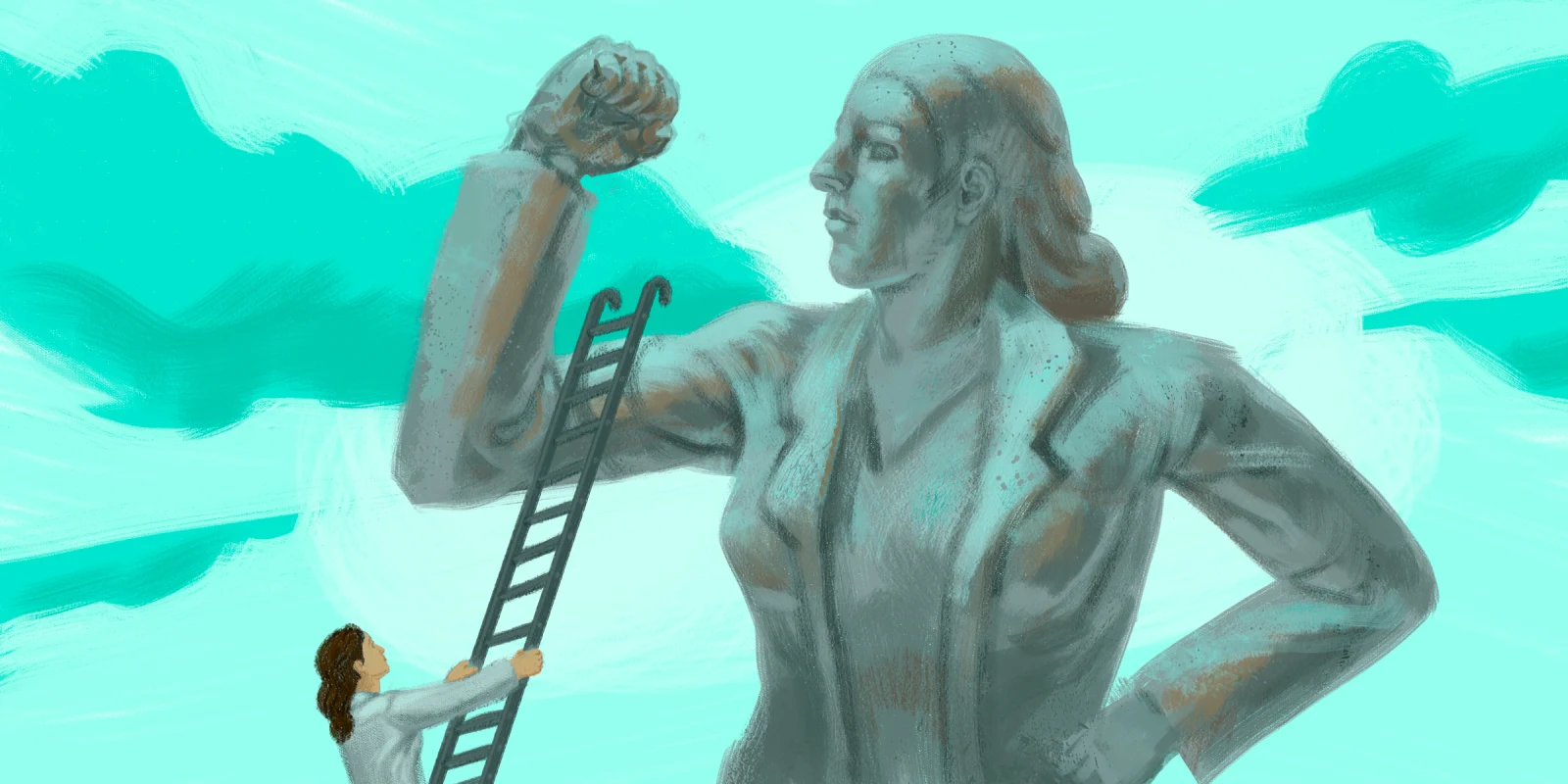
If I were going to send a postcard home, which is to say, back to my residency director and leadership team, I'd say I'm still only as confident as my last patient: my last success or perceived failure. I think it will be that way for a while and maybe forever. I’d tell them the month of July is the same as August: it’s still hot, and I’m still a doctor, and just as the title is beginning to fit, an attending now, too. So, dear attendings (how is it that I am among you?) I'm having so much fun away from home. It is equal parts challenging and gratifying, and while I thought I was doing all the work in residency by writing notes, I realize now the true task is done staring at the last set of vitals and agreeing to send a patient home. The weather is nice, and the lakes here stay cool all summer. Wish you were here.
Liana Meffert is an emergency medicine physician in Wisconsin. Her writing has been featured in JAMA, The Lancet, The Maine Review, SWWIM, and X-R-A-Y, among others. You can find more of her work at LianaMeffert.com. All views expressed are her own. Dr. Meffert is a 2025–2026 Doximity Op-Med Fellow.
Illustration by Jennifer Bogartz