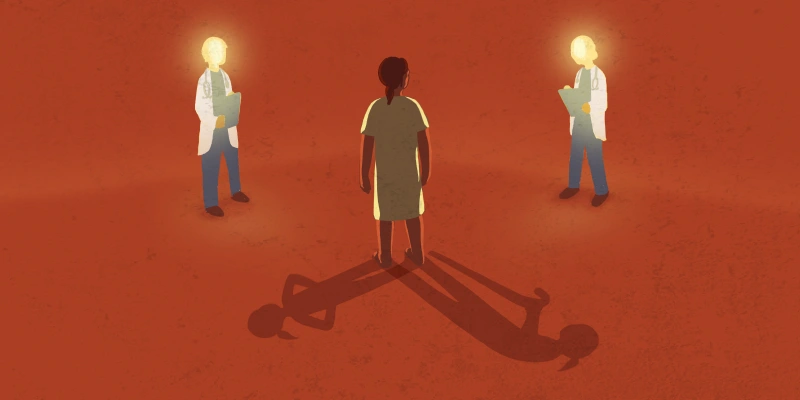

This poem is part of the Medical Humanities vertical on Op-Med, which showcases creative writing by Doximity members. Do you have a comic, poem, work of lyric prose, or flash fiction piece related to medicine that you’d like to share with the community? Send it to us here.
Four Poems
How even survival
She is thirty-six
already a “survivor”
her breast carved, irradiated,
scar tissue mapping
where fire once passed through
and now her heart is drowning
in its own fluid
pericardium turned prison
drain coiled like a leash at her chest
as monitors pulse out
mercilessly and
how unfair that
a body
that learned to endure
is made
to endure again and
how even survival
can feel like an
incorrect
breathless
never-ending
run-on
sentence and
instead I just stand
in the room
stethoscope heavy
wishing I could lift or siphon some corner of the weight from her chest
The Wrong Flag
In the old story,
Theseus forgets.
He returns victorious,
but the black sail remains.
From the cliff,
his father sees the ship—
believes his son gone,
and leaps into the sea.
I think of this
when I talk to families.
It is easy to forget:
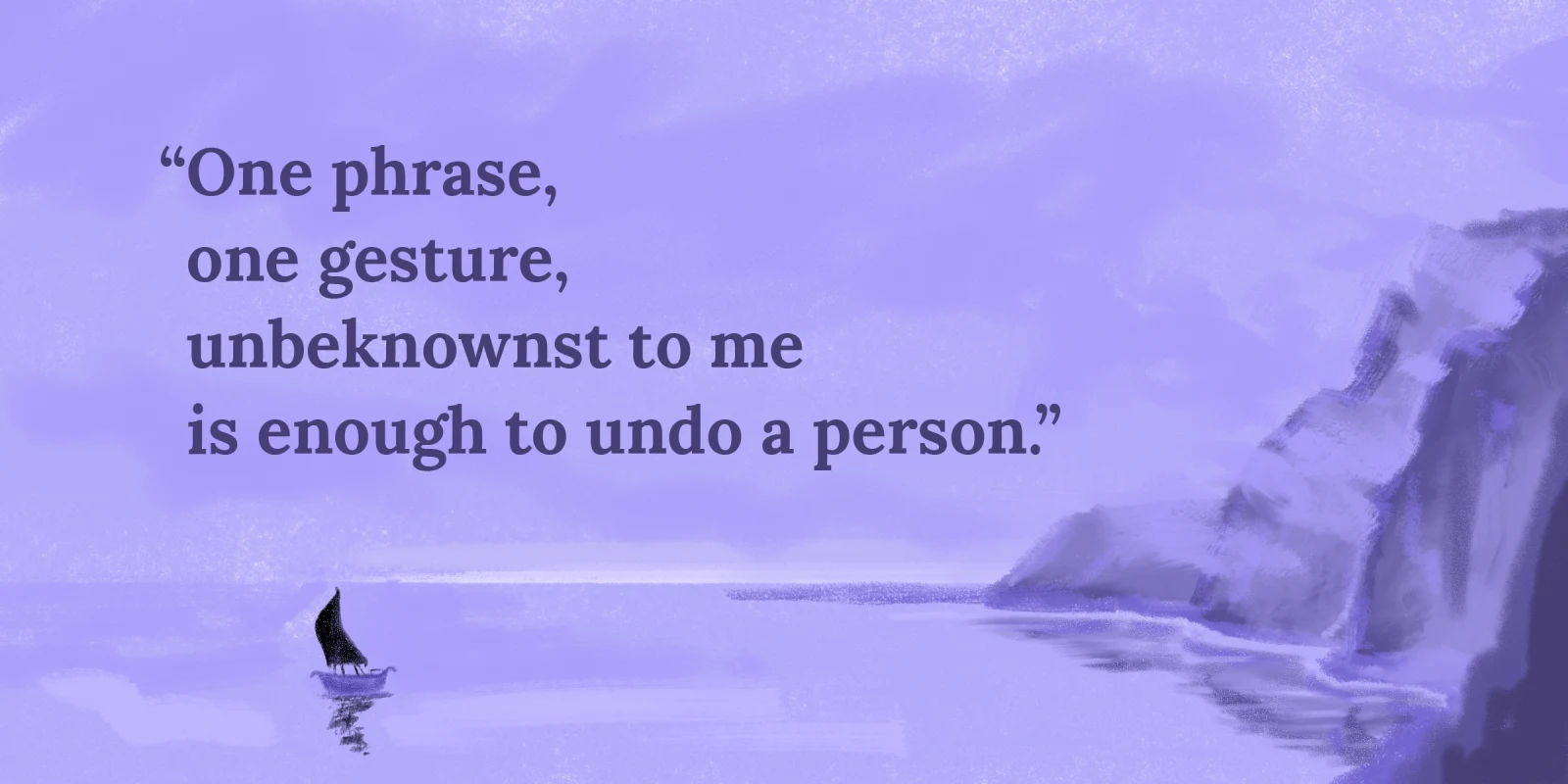
One phrase,
one gesture,
unbeknownst to me
is enough to undo a person.
I say stable.
They hear decline.
We mean recurrence.
Someone hears death.
It is a small thing—
a flag, a word, a silence
though none are neutral.
I watch my signal,
I choose my words carefully,
unfurl them like sails,
white against the sky,
lest misunderstanding come rushing,
and the sea open below.
Haircut
She asks me,
“How much longer before it falls out?”
I hesitate.
The drugs are exact,
but their side effects scatter
like starlings flushed from a field.
Her daughter brings scissors —
small, purple, plastic,
meant for paper and glue.
Together they cut a first lock,
then another.
Laughter echoes down the hall
like rebellion.
I want to tell her
the alchemy of medicine
measures only doses,
counts only cells.
Not imposed resilience,
not the way a mother
can turn sorrow into play,
loss into ritual,
a haircut into a song,
and falling strands into wings.
Achilles on the Floor
The chart says “young, otherwise healthy.”
His arms are thick from construction work,
forearms darkened by the sun,
palms still rough with callus.
He does not look like someone who could fall.
But the CT lights up
with a clot coiled in his lung,
a white dagger across the field.
One weakness, invisible until it wasn’t.
I think of Achilles—
his mother dipping him in the river,
her hand firm at the ankle.
Even love leaves a place exposed.
The family stares at me:
How could this happen?
He never smoked,
never missed a day at work,
still carried lumber on his shoulders last week.
I do not tell them
that all bodies have a seam,
and sometimes illness
slips through that seam
with perfect aim.
An Interview with the Author
Why did you choose this medium? What interests you about it?
Nothing makes me pause, think, and savor words as much as poetry does. I think poetry is digestible for many because we know there can be a multitude of interpretations, and I appreciate how accessible this makes poetry.
How long have you been writing creatively? What got you started?
I started writing poetry specifically in my second year of medical school, but my appreciation for reading and writers more generally began in college when I read pieces of the literary canon in my classes.
What was your inspiration for these poems? Did other creative works, if any, influence your creation of these pieces?
I draw inspiration from all my patients — I try to take away something different from every encounter and interaction. The poets I read the most include Mary Oliver, Maya Angelou, and Louise Glück.
How do these poems relate to your medical practice?
“How even survival” focuses on the patient experience and what chronic illness and the journey to recovery can feel like.
“The Wrong Flag” reflects how I try to carefully choose my words and how I frame things when I'm talking to patients, so that I can do it in the most empathetic, compassionate, and medically accurate way that I can. This is definitely something I'm working on daily — trying to hone my precision of language (verbal but also body language).
I'm frequently moved by how resilient and adaptable patients are, in both small and bigger ways, and my poem “Haircut” focuses on one expression or illustration of that. There are, though, many forms of resiliency — some may look different and may not outwardly seem as optimistic — and those also move me in different ways.
Finally, “Achilles on the Floor” focuses on acknowledging the complex emotions of patients and families when they're suddenly affected by illness.
Tulsi Patel is an internal medicine resident at the University of California, San Diego. Her appreciation for both poetry and humanistic care stems from her time at Columbia University, where she took a class on caring for individuals at the end of their lives while volunteering at a publicly funded senior living facility in East Harlem.
Illustration by Jennifer Bogartz