
Under general anesthesia, a patient cannot tell us whether an incision hurts. The usual signs are indirect: heart rate increases, blood pressure rises, and the patient sweats or a pupil dilates. Yet each of those changes has other explanations in the OR. Tachycardia could reflect hypovolemia. Hypertension could mean inadequate hypnotic depth. Vasopressors, beta-blockers, temperature, and surgical manipulation can all change the same signals. Anesthesiologists are left asking a basic question with an imperfect set of clues: Is the patient experiencing pain, and do they need more analgesia?
New nociception monitors try to make that decision less subjective. The first distinction is that they do not measure pain. The International Association for the Study of Pain defines pain as a personal sensory and emotional experience, while nociception is the nervous system's encoding of a noxious stimulus. General anesthesia provides hypnosis, immobility, and analgesia, but those are separate goals. A patient may be unconscious and unable to move while an incision still activates peripheral nociceptors. Signals travel through A-delta and C-fibers to the spinal cord and brainstem, where they can produce autonomic responses even without a conscious report. Historically, anesthesiologists have used changes in heart rate and blood pressure to decide whether a patient needs more pain medications. The problem is that these signs are widely nonspecific.
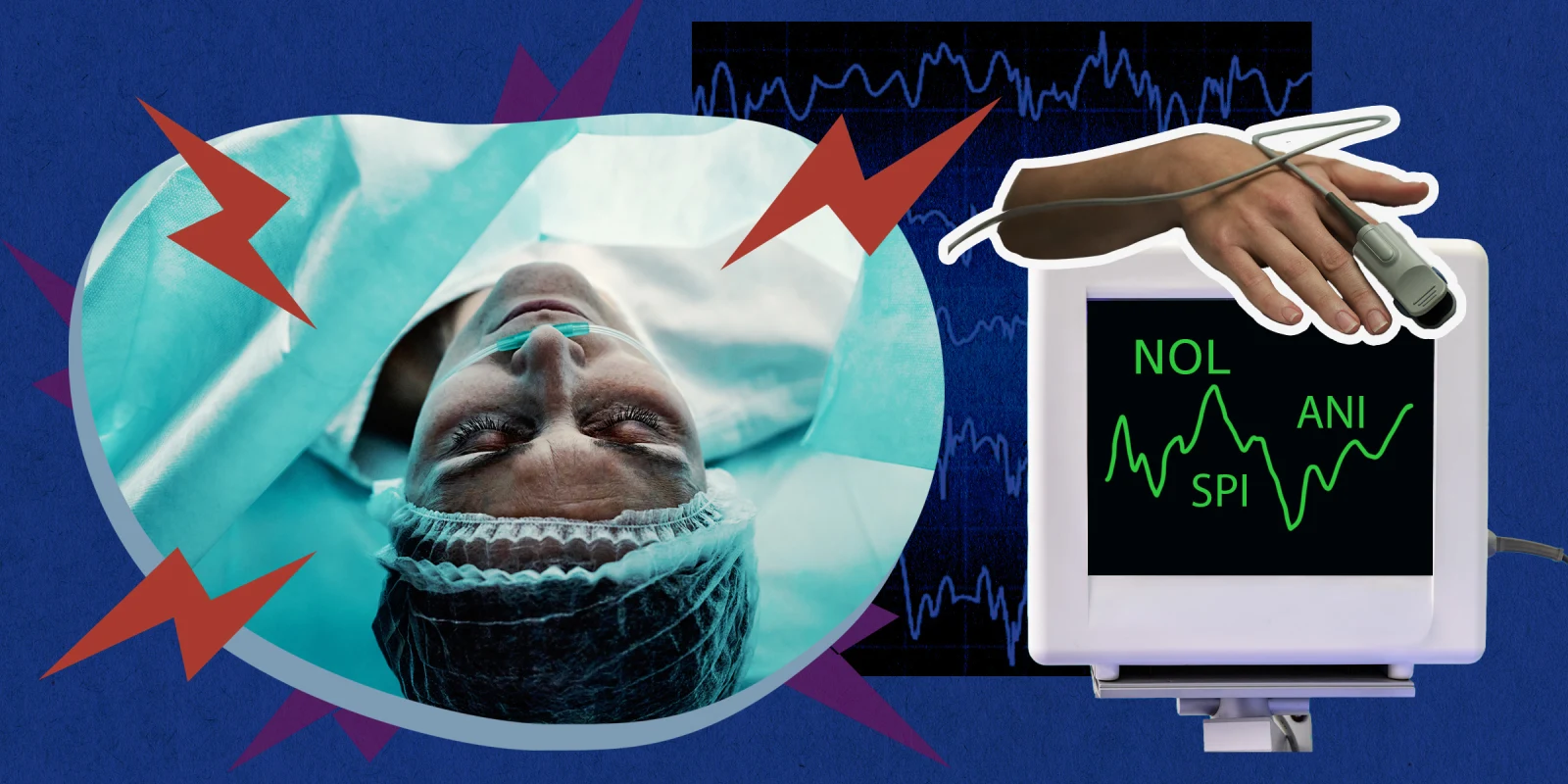
This is where newer nociception monitors become interesting. They analyze different parts of the autonomic response and convert them into a number that can be followed throughout surgery. The Nociception Level Index, Surgical Pleth Index, Analgesia Nociception Index, and pupillometry each approach the problem differently. They are often grouped together, but they do not measure the same physiology and their scores are not interchangeable.
The Nociception Level Index (NOL) is the most multifactorial of the group. A finger sensor combines heart rate, heart rate variability, pulse-wave amplitude, skin conductance, and peripheral temperature. The algorithm produces a score from 0 to 100, with a higher value suggesting more nociceptive stress. Instead of asking the anesthesiologist to interpret several small changes at once, NOL combines them into a trend. That could be useful when one monitor is noisy, although poor perfusion, arrhythmias, and vasoactive medications can still affect the result.
The Surgical Pleth Index (SPI) uses information already collected by the pulse oximeter. It analyzes the plethysmographic pulse-wave amplitude and the interval between heartbeats. Sympathetic activation causes peripheral vasoconstriction and changes both inputs, producing a score from 0 to 100. Higher values suggest greater surgical stress. It is simple and continuous, but vascular tone, hypovolemia, arrhythmias, pacing, and vasopressors can all alter the number.
The Analgesia Nociception Index (ANI) looks at the opposite side of the autonomic balance. It analyzes ECG-derived R-R interval variability, especially respiratory sinus arrhythmia, to estimate parasympathetic tone. The score also ranges from 0 to 100, but the direction is reversed; a lower ANI suggests parasympathetic withdrawal and more nociceptive stress.
Pupillometry uses a different response altogether, although it is still bound by sympathetic and parasympathetic responses to surgical pain. It measures pupil dilation after a standardized stimulus, such as a brief electrical current. The pupil can respond quickly, but the test is an intermittent measurement and may be limited by eye access, ambient light, or ocular disease.
The search for a more reliable signal has been underway for decades. Since the early 2000s, researchers have been studying pupil dilation as a marker of noxious stimulation under general anesthesia. The SPI was introduced under a different moniker in 2007, also to identify if surgical pain could be objectively measured. A real time ANI monitoring system called the PhysioDoloris was described in 2010, followed by the development of the NOL in 2013. All of these systems were designed with the end goal of estimating if surgical stimulation exceeded the analgesia being provided.
These technologies have since moved beyond the laboratory. SPI is actually available as software on select patient monitors, while ANI, NOL, and automated pupillometry are being sold as dedicated monitoring systems. However, commercial availability has not increased adoption; according to a 2024 review, “nociception monitors remain … underutilized,” and most ORs still rely on heart rate, blood pressure, and the anesthetist's gestalt. One reason for the slow adoption nationwide may be the need for proprietary algorithms and their limited evidence of improved outcomes.
Nevertheless, these technologies hold real promise. More than just offering a new vital sign, nociception monitors could do things like help personalize opioid dosing in real time, show a response before heart rate or blood pressure changes become obvious, and reduce the tendency to give opioids based on habit. They also give researchers a way to study the balance between nociception and analgesia continuously. That is a meaningful change from relying on a blood-pressure reading every few minutes.
The challenge is deciding how the number from a new monitor can be useful. In a 2026 study of 47 living liver donors, ANI and SPI gave the same analgesic classification in only 32.4% of paired measurements, with a kappa of 0.03. That does not necessarily mean one monitor was wrong. ANI emphasizes parasympathetic activity, while SPI depends heavily on peripheral vascular tone. Their disagreement shows that a universal nociception signal has not been identified and that the anesthesiologist must still consider a patient's perfusion and medications among many other pieces of information.
The larger question is whether monitoring changes outcomes. A 2026 meta-analysis of 38 randomized trials and 3,243 patients found that nociception-guided anesthesia reduced opioid use by the equivalent of 0.6 mg of morphine in the recovery unit and 2.56 mg over 24 hours. Both differences were below the threshold considered clinically meaningful by the authors. Pain scores, nausea and vomiting, respiratory events, urinary retention, delirium, and chronic postsurgical pain did not improve. These monitors can change how anesthesiologists dose opioids, but current studies have not shown that they improve recovery.
One possible next step is to connect a nociception monitor to an opioid pump. In a 2025 randomized trial of 52 adults undergoing burn surgery, a rule-based system used ANI, blood pressure, and heart rate to adjust remifentanil. It administered 17.8% less remifentanil and reduced the proportion of anesthesia time with hemodynamic instability from 19.4% to 4.2%, without worsening pain during the first two postoperative hours. Still, clinicians interrupted automatic mode in 35% of patients to give additional remifentanil. The study is an interesting proof of concept, but does not support that an opioid pump can manage analgesia alone.
Future systems will probably need more context than any single index provides. A useful platform might combine an autonomic nociception score with EEG-derived anesthetic depth, blood pressure trends, vasoactive medication use, patient characteristics, and the phase of surgery. It should explain why it recommends a dose and must allow for immediate clinician override. The endpoint should be better recovery with fewer respiratory complications and more stable physiology, not a lower morphine equivalent or a tight monitor target.
So, can we measure pain while a patient is unconscious? Not directly. We can measure several physiologic responses to nociception, and newer monitors organize those responses in ways that may be more useful than heart rate and blood pressure alone. For now, they are adjuncts rather than answers. Their most promising role may be helping anesthesiologists see changes earlier, test more individualized dosing strategies, and eventually support carefully supervised automation. The number can only inform the decision. It cannot supply the clinical comprehension required to make it.