
Medical school teaches you many things, but one lesson in particular rarely shows up in a textbook: leave yourself at the door. Somewhere between my first white coat ceremony and my final rotation, I started treating my personality, including a restless love of travel, less like a resource and more like something to manage carefully. I learned to speak in a certain register, laugh at a certain volume, and tuck away the parts of myself that didn't seem obviously useful to "becoming a doctor." By fourth year, I had gotten fairly good at this kind of shapeshifting. I could read a rotation the way you read a room, by adjusting my humor, my posture, even how much of my own opinion I offered, to whatever version of "professional" that service seemed to reward.
Then, almost by accident, I stopped.
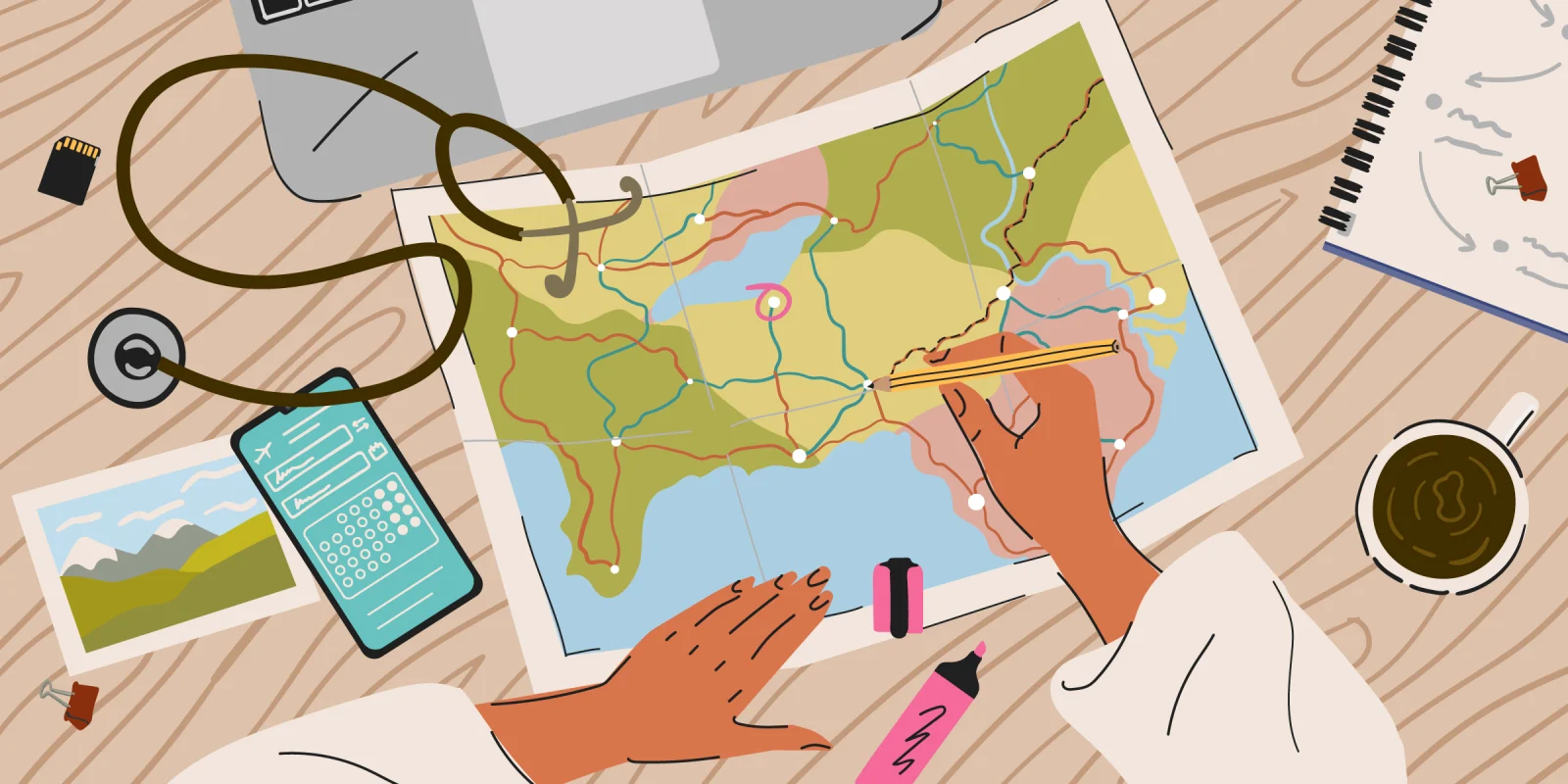
The fourth year of medical school is famous for its slackness. The applications and interviews are behind you, as are the boards, and for a few months the schedule opens up before residency swallows it whole. Like many students, I decided to fill that space not with more resume-building, but with the kind of travel that had shaped my personality long before medicine ever touched it. I went on a pilgrimage in India. I spent two weeks in Morocco traveling solo alongside a group of women I had never met before landing. I sat with family in London and in India for the first time in four years. I did a month-long rotation at a hospital in Vienna, stumbling through German in the mornings and wandering the city at night. I hit conferences in a couple of different cities, meeting old friends and making new friends. After Match Day, I took a trip to Japan, where I got engaged. I visited my best friend in Beijing. I flew to Korea for a family reunion and to Thailand just because I had dreamed of visiting for so long.
None of this happened by luck. I spent years saving so I could pursue it. I applied to scholarships and travel grants specifically for these opportunities. I prioritized my interviews and rotations, carefully scheduling travel around them. This wasn't a year off from ambition; rather, it was ambition redirected toward a part of my life that medical school had taught me to set aside: the part that isn't measured on an evaluation form.
What I noticed, somewhere between a camel ride in the Sahara and a quiet afternoon with my family in Hyderabad, is that none of this travel had any obvious "professional value." It took place after applications were due; it wasn't the kind of thing I'd bring up on rounds. In some ways, it even ran counter to what four years of training had trained me to prioritize. But for the first time in a long while, I felt like myself. I wasn't performing for anyone. I was just living, reconnecting with parts of me I'd inadvertently set aside.
I don't say any of this as someone who rebelled against medicine. I love my training, and I love this profession. But I've started to wonder whether professional expectations of clinicians sometimes smooth out anything in a trainee that isn't visibly useful to the institution. There's a common assumption, rarely stated outright, that suppressing who you are outside the hospital makes you more objective. Now, starting out as a first-year resident, I'm finding my own experience points somewhere slightly different. It turns out the more of myself I hold onto — not less! — the better care I’m able to give.
The version of me that returned from that year of travel, the one who has stood in a mosque in Fes, who has laughed with strangers in three languages, who got engaged watching the sun set in Izu, is not a distraction from my work. She is the reason I have anything left to offer at the end of a long call day. Empathy isn't a technique you can learn from a lecture on bedside manner, and it isn’t an escape from what matters either. Rather, it’s the opposite. Sitting with family I hadn’t seen in years, admitting I didn’t know a word of the language spoken around me, and getting lost more times than I could count were not vacations from the person I needed to become. These experiences taught me how to sit with not knowing, how to be present with people whose customs and languages weren’t my own, and how to be still with discomfort instead of rushing to fix it. These skills are what medicine has required of me every day since.
I’ve only just started, but I’ve heard that residency has a way of asking a lot of you. The hours are long, the identity of "doctor" is heavy, and it's easy to let the job crowd out everything else you are. I can understand why: a trainee who is fully absorbed in the work can seem easier to schedule, easier to train, easier to standardize. I'm not suggesting rigor or discipline or commitment to patients should give way to anything. I'm just describing something I've come to believe is true for me: that staying whole and remembering the person under the white coat — her love of travel, of life lived outside the hospital's walls — isn't a distraction from the work. It's part of what makes the work possible. It's not really a rebellion, and for me it's not even much of a choice. It's simply what lets me walk back into the hospital tomorrow, and the day after that, still able to see the patient in front of me as a whole person, because I can still remember how to see myself as one too.