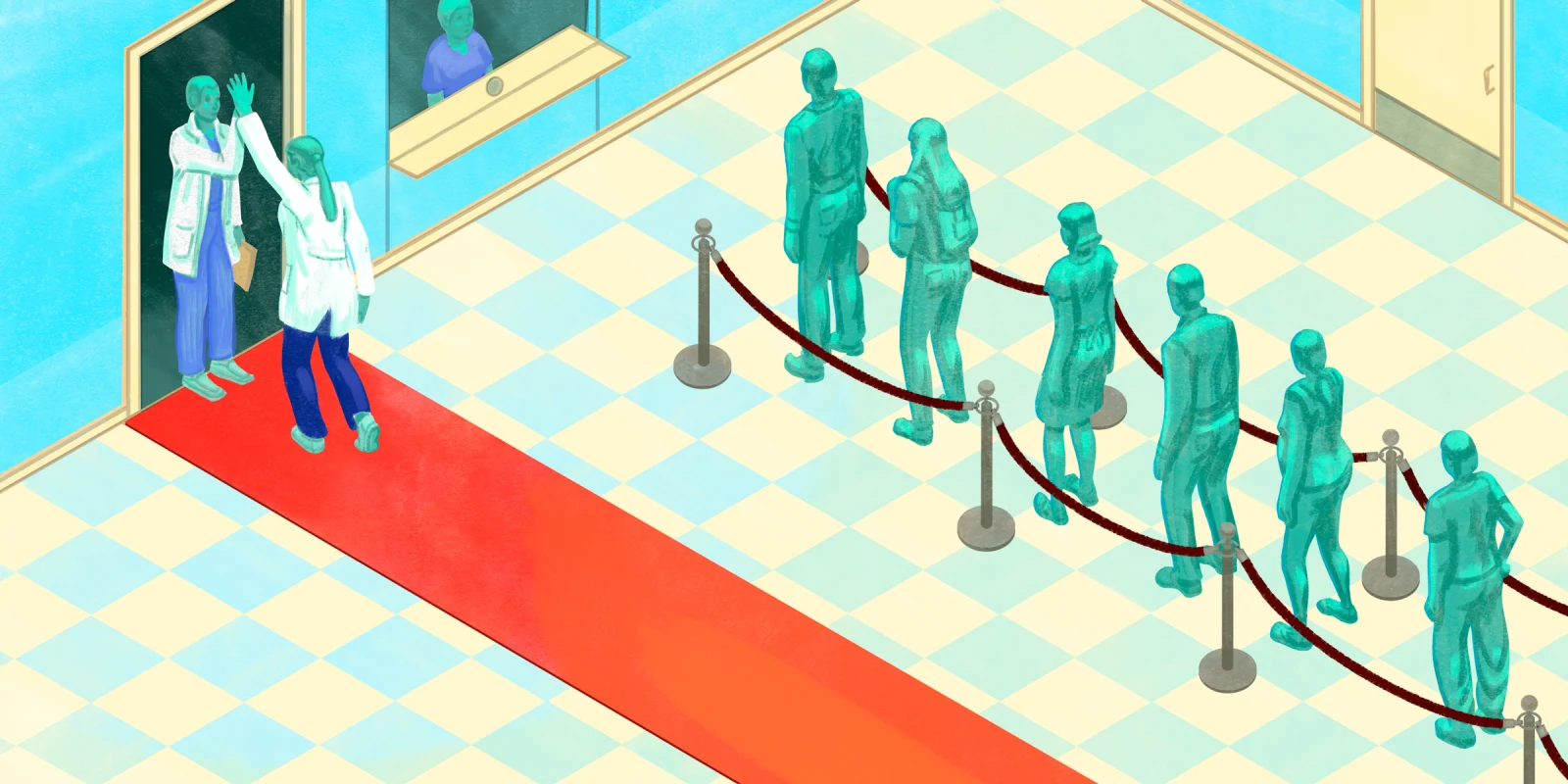

8:06 a.m. The ophthalmologist’s waiting room was already full. Standing out among the largely geriatric crowd, I watched patients file in, almost competing for the few remaining seats. In the hallway, the doctor rushed past in his white coat, caught me in his peripheral vision, and offered a high-five from across the room. Moments later, he opened the clinic door himself, rather than waiting for the nurse, and introduced me to his staff as a friend who didn’t need to wait. I was relieved but also unsettled. I justified it to myself anyway: I had my own patients scheduled to start at 9 a.m. Before I left, he handed me his business card and wrote down his personal office number, advising me to call directly if I noticed any new floaters.
As physicians, we often receive forms of preferential treatment when we become patients ourselves – sometimes subtle, at other times more overt. Research suggests that clinicians may receive prioritized care, including expedited scheduling and shorter wait times, much like what I experienced at my ophthalmology visit.
Qualitative studies have also described additional privileges afforded to physician-patients, such as greater flexibility around hospital routines, including visiting hours, fewer institutional constraints, and more informal access to care. Beyond logistics, clinicians may document more extensively and engage physician-patients more directly in shared decision-making, practicing a more collegial version of care – one we often say should be universal.
I have been guilty of using this position to my advantage – requesting an MRI for mild knee pain, or a CT scan to rule out a hernia, both of which ultimately returned normal. Although there is no clear evidence that physician-patients achieve superior clinical outcomes, the ethical question remains: Should physicians receive different care simply because they are physicians?
The default answer seems to be no – equitable care should apply to everyone. Yet some argue that physicians may be uniquely predisposed to delayed or neglected care due to demanding workloads, embarrassment, or an ingrained sense of resilience. Others point to the ease of informal corridor consultations, the temptation to self-treat, or the absence of longitudinal primary care relationships – factors that can quietly undermine appropriate care.
A broader consideration also emerges: whether caring for physicians ultimately serves patients by sustaining the workforce on which healthcare depends.
Treating the physician-patient can be complex and, at times, formidable. By training and temperament, physicians are conditioned to project competence, and we often assume the same of one another. As an intern, I cared for an elderly patient on the wards whose daughter was an ob/gyn. She was astute, as one might expect. I found myself tense at the bedside, bracing to be questioned at any moment. It wasn’t until later that I realized she knew no more about acute tubular necrosis than I knew about labor management.
This discomfort was not unique. The term VIP patient is used to describe individuals perceived as having status, power, or a special identity – such as celebrities, politicians, and physicians.
Over time, the definition has broadened to include any patient who makes a clinician feel intimidated, sometimes accompanied by physical manifestations such as anxiety or tachycardia. VIPs have also been described as patients whose personal attributes or behavior meaningfully influence a clinician’s judgment or actions.
This is not a new phenomenon. In 1964, psychiatrist Walter Weintraub coined the term “VIP syndrome” to describe how perceived importance can subtly distort clinical decision-making. Importantly, VIP syndrome does not reliably lead to better care. Instead, it produces different care – at times more attentive, at other times fragmented or even inferior. Routine practice may be loosened or bypassed altogether, creating deviations from usual safeguards. This is rarely intentional; physicians are often unaware that they are practicing outside routine guidelines, motivated not by entitlement but by discomfort or a desire to do well.
Studies confirm that caring for other physicians can provoke insecurity, unease with shifting identities, and self-doubt. Clinicians describe uncertainty around boundaries, strain with role reversal, and fear of being judged by a professional peer. At the same time, many report a sense of flattery or professional validation when treating one of their own, as well as greater ease in discussing complex medical issues. Together, these opposing forces create a uniquely fragile clinical dynamic.
I was baffled the first time I encountered a “break the glass” notification in the EHR as a medical student. The patient was a middle-aged physician with bilateral femur fractures after jumping from a window in a suicide attempt. I found myself grappling with questions: How could this be? And more quietly, do I address him as “Doctor” or by “Mr.”? In that moment, his professional title felt misplaced.
For both the treating physician and the physician-patient, situations like this can carry hesitation – particularly when navigating sensitive topics such as substance use, mental health, or other intrusive aspects of the history. The stakes can feel especially high as revelations may carry professional consequences, including concern about referral to licensing authorities or one’s employer.
As a result, clinicians may hesitate to probe, and physician-patients may offer selective disclosure. This dynamic can lead to under-testing or avoidance of certain studies like rectal examinations, further distancing care from standard practice. At the same time, physician-patients may struggle to relinquish their professional identity – a tension that can be both protective and harmful – especially when the treating physician is younger or feels scrutinized.
There is also a tendency to assume that physician-patients are not only knowledgeable, but also socially or financially secure – and therefore capable of managing their own care. My suicidal patient was financially well-off, yet profoundly isolated. For physician-patients, as for all patients, vigilance, not assumption, is often what compassionate care requires.
Not all of us will care for physician-patients, but we may encounter some version of a VIP patient in our careers. Though there is little formal guidance, it becomes essential to recognize the biases we carry, whether explicit or unconscious. Caring for clinicians and colleagues can trigger a deontological dilemma between professional duty and personal familiarity. Even when we intend to offer the same care we provide to all patients, we may not.
Acknowledging this does not mean abandoning standards; it means recommitting them. It requires asking the uncomfortable questions, offering routine testing when appropriate, and resisting the urge to defer or overcorrect – knowing that deviation in either direction risks suboptimal care.
The answer may lie in practicing responsive care: an approach that recognizes a patient’s identity and preferences without allowing status to distort clinical judgment. There is no one-size-fits-all model in medicine; it is, and has always been, both science and art.
Ultimately, each of us will one day sit on the other side of the exam room. When that happens, we may become wounded healers – carrying empathy born of vulnerability back into our work.
Perhaps our discomfort in caring for physician-patients stems from this very truth: that in them, we are forced to confront not only professional identity, but our own fragility. The task, then, is balance – holding both identities at once: the colleague within the patient, and the patient within the colleague.
What is your experience with VIP patients, and how has it impacted your approach to care? Share below.
Dr. Naila Khan is an internal medicine physician practicing in both inpatient and outpatient settings in Southern California. She is passionate about lifelong learning and teaching – from patients as much as from students. She loves the ocean, croissants, soft Urdu music, and finds joy in hearing her loved ones laugh. Dr. Khan is a 2025-2026 Doximity Op-Med Fellow.
Illustration by Jennifer Bogartz