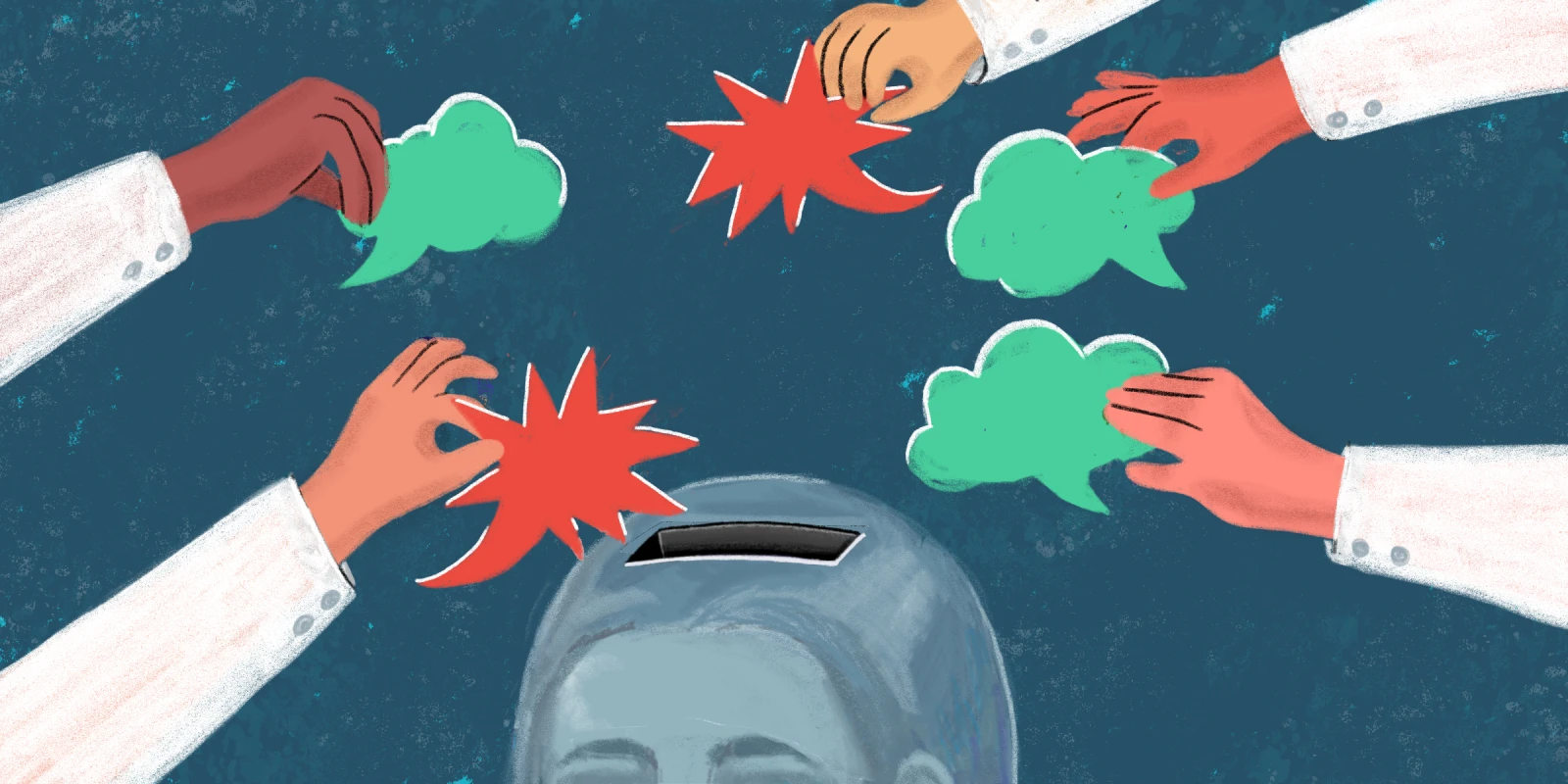

Last month I listened to a fellow tell a patient's wife that the medication we were starting "causes nausea in about 40% of people." She called the next morning to report he'd been vomiting since midnight. I don't know whether he was vomiting from the medication or the number we gave his wife. What I do know is that we handed her a number designed to inform and instead delivered a nocebo — a measurable worsening of symptoms generated not by the drug, but by how I described it.
I'm a palliative care physician. I manage pain, breathlessness, nausea, and the existential weight of serious illness. Communication is supposed to be my core competency. And yet I did what most of us do every day without thinking: I used language that primed harm, because informed consent culture has trained us to lead with threat.
We need to talk about this, because the evidence has gotten harder to ignore.
Placebo and nocebo effects are not synonyms for "fake" or "gullible." They are real, clinically significant psychobiological responses — the measurable impact of context, expectation, learning, and communication on a patient's brain and body. Colloca and Finniss established in JAMA that nocebo effects operate during routine clinical treatments, not just sham-pill studies, negatively affecting outcomes through negative framing and prior unsuccessful therapies. The implication is blunt: how we talk to patients changes what happens to them physiologically.
A 2025 meta-analysis of 60 randomized controlled trials found that even open-label placebos — where patients know they're receiving a placebo — produce measurable benefit, with an effect size of 0.35 across outcomes. The effect was significantly stronger for self-reported outcomes than for objective ones. That distinction should stop every palliative care clinician in their tracks. Our outcomes are overwhelmingly self-reported: pain scores, dyspnea scales, quality of life measures. We are working in the exact domain where meaning, context, and expectation exert their strongest measurable effects.
This is not a confession of weakness. It is an argument for treating communication as a clinical science with a dose-response curve — and training it accordingly.
Lucas and Booth made the palliative-specific case in BMJ Supportive & Palliative Care: Placebo effects driven by the therapeutic relationship, the context of care, and the significance of meaning likely contribute to symptom relief across pain, breathlessness, and depression. They may also underlie much of what patients experience as the benefit of complementary therapies integrated into palliative programs. Recognizing this isn't an endorsement of pseudoscience. It's an acknowledgment of mechanism. You are deploying placebo effects whether you acknowledge it or not. The question is whether you're doing it well.
The flip side is equally concrete. Every time we say "this medication causes nausea in 40% of patients," we are not just informing. We are priming. The expert consensus led by Evers, Colloca, and colleagues laid out evidence-based recommendations for navigating this: transparency preserved, but framing delivered with deliberate care. Not lying. Not withholding. Framing with precision.
In practice, this means replacing threat-heavy scripts with language that preserves agency. Compare these two:
"This causes nausea."
"Some people notice nausea. If that happens, call us — we have options."
The information content is identical. The psychobiological impact is not. The second version normalizes the possibility, offers a response plan, and positions the clinician as an ally rather than a herald of side effects.
I've started scripting what I call epistemic consent — telling patients and families a triad: "Here's what we know. Here's what we don't. Here's what we're watching for." Three sentences. Concrete, repeatable, and built on honest uncertainty rather than false confidence in either direction. That framing does two things at once. It inoculates against the overconfident certainty of the wellness influencer who promises root causes and clean answers. And it models something patients actually need from us: a physician who doesn't pretend to know everything but who is clearly paying attention.
If we train residents and fellows to titrate opioids — adjusting dose, route, frequency, monitoring for effect and toxicity — we should train them to titrate language with equal rigor. The data support it. The ethics demand it. And our patients, who are living in the domain where meaning and context exert their strongest biological effects, deserve nothing less than deliberate, evidence-informed communication from the clinicians managing their suffering.
I still think about that phone call. The vomiting may have been the drug. It may have been the number we handed his wife. I'll never know. But I've changed my script since then, and the next family got a different sentence — one designed to inform without priming, to preserve honesty without weaponizing statistics.
Communication is not the soft skill we squeeze into the last afternoon of a fellowship retreat. It is a clinical intervention. It has a mechanism. It has evidence. And most of us are prescribing it without reading the label.