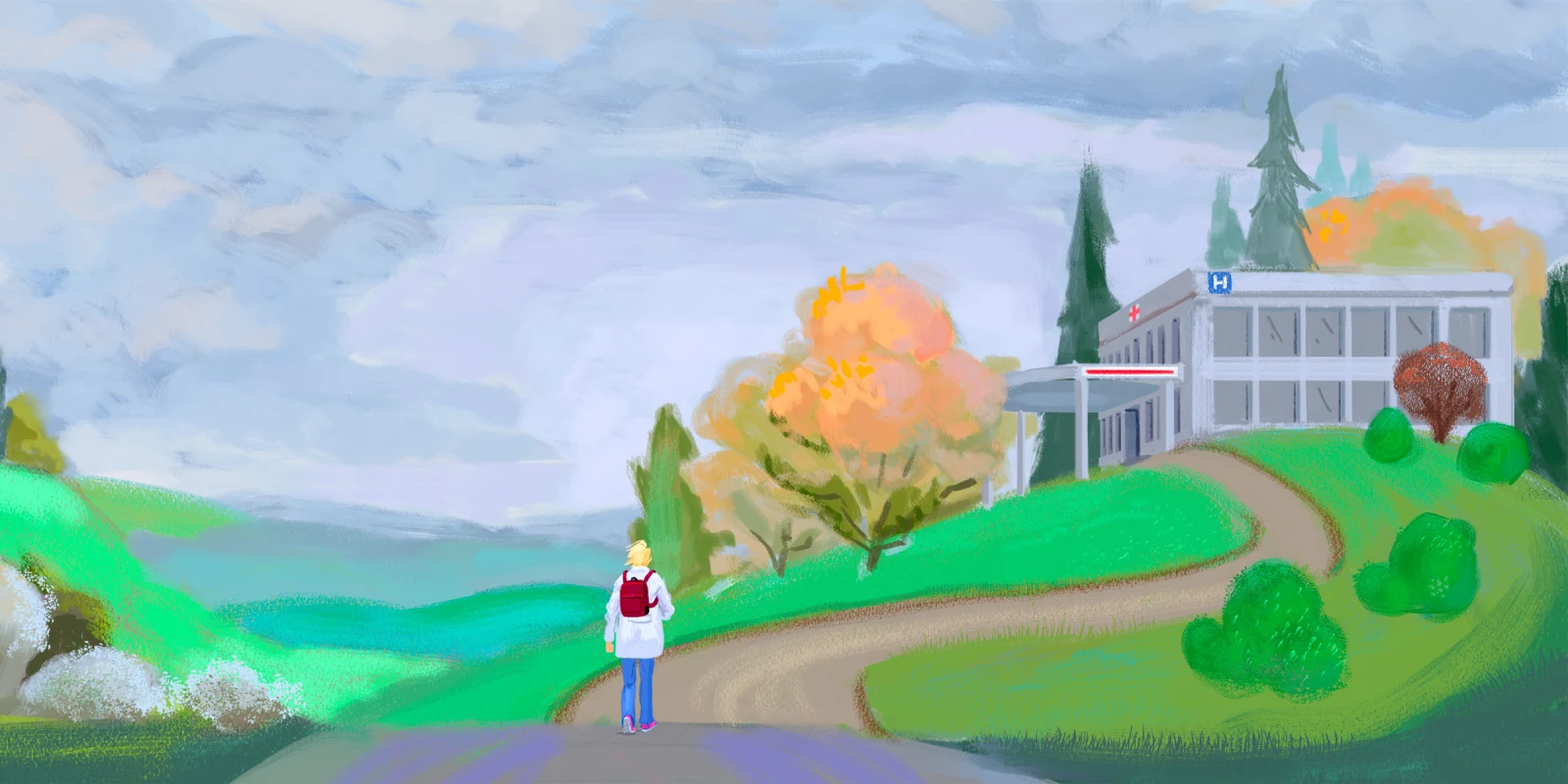

I work in a hospital so small that calling it a hospital feels absurdly generous. On the way there, I pass through a portal that takes me back to 1990. The ED is essentially an urgent care with a CT scanner. There are four inpatient beds. No MRI. No respiratory therapist. No bedside ultrasound. Formal ultrasound exists Monday through Friday, 8 a.m. to 6 p.m. We still use paper charts and handwritten orders.
I am the ED doc AND I am the hospitalist. There is no one else.
I work three to four consecutive 24 hour shifts a month. That’s long enough to learn who belongs to whom, who drinks their coffee black, and who will end up in the ED whether they intend to or not. In a town this small, the ED is not a destination. It’s an intersection.
I eat breakfast with my patients. I shop with them. Some days I see people I’ve treated doing better. Other days I see someone loading groceries and think, with uncomfortable accuracy, I’ll be seeing her soon.
Bill is one of those patients. Bill has a chronic wound living at the intersection of venous and arterial insufficiency, surrounded by thickened, erythematous skin that tells the story before he does. It has been infected more than once. Healing has never been simple. Bill also does not reliably come in when he needs to.
For a while, we had a wound care clinic. It ran out of a trailer in the parking lot. It worked. Patients showed up. Dressings were changed. Infections were caught early. Then it was shut down for reasons that were administrative rather than clinical — which is how functional things in medicine usually die.
Bill came in on my first shift looking like a mess, two weeks after discharge from the hospital. This hospital. He hadn’t come back since discharge. His infection was worse. Again. The tech working with me had done wound care with the wound nurse for years, until they closed the clinic. She changed his dressing the way it was supposed to be done, because she’d done it so many times before.
Bill is a cantankerous old man. He argues recreationally. He relentlessly teases anyone within earshot. Usually, that’s fine. Usually, that’s part of the fun. This time, it wasn’t. Transportation is a real barrier here. There’s a county service, but it only runs weekdays, and the county is one of the poorest in California. Admission would not solve that problem. Bill didn’t want to be admitted anyway. He probably wouldn’t stay.
The tech told me she’d called him after discharge. He wouldn’t come in. He didn’t want to leave his cats. A cat scratch is how all this started. So I stopped joking. I told him frankly that if this continued, he was going to lose his leg. Not as a threat. As a forecast. I told him it didn’t have to happen. We could see him two or three times a week in the ED. We would change the dressings. We would watch it closely. But only if he showed up. He promised he would. He didn’t. So we called him. And called again. And again. Until he came in.
Over a few days, the wound started to look better. Over weeks, it improved. Bill did not become “compliant.” He became reachable. That distinction matters.
In a larger system, Bill would have been labeled noncompliant and quietly amputated by process. His failure to attend clinic would have been treated as a character flaw rather than a transportation problem, an access problem, or a trust problem. Here, we already knew him. And because we knew him, we kept calling. This is not continuity of care as a billing concept. This is continuity as labor — unpaid, undocumented, and essential. It is work the system does not value because it does not fit cleanly inside a procedure code.
Emergency physicians are not supposed to follow patients. I didn’t avoid family medicine because I dislike continuity or because I dislike talking to patients. I avoided it because modern primary care punishes both. EM used to allow listening — until 2.0–2.2 patients per hour became the standard, after someone else skimmed off the easy cases, and clicking became the job.
Here, I am an emergency physician, a hospitalist, and, frequently, a social worker at 2 a.m. with DoxGPT open, working through admitting orders, antibiotics, and discharge plans because there is no one else to hand it off to. Me and DoxGPT have become good friends.
We lack almost everything most people think matters. Whenever I ask, “Do we have—” the staff answers, “No, of course not,” before I finish the question. We are sometimes out of vancomycin. The last STEMI I had, we were out of thrombolytic. The receiving hospital was 90 minutes away by helicopter. We don’t have paramedics, except for the one guy who likes the town enough to volunteer on holidays. What we do have are volunteer firefighters and EMTs who will do anything for their community. Nurses who speak to patients with advanced dementia the way they would speak to their own grandparents. A skilled nursing facility that does not produce pressure ulcers or the smell of neglect. Families who visit daily. Neighbors who come to the ED together.
And yes, we laugh. Not at patients, but with them. We laugh at the absurdity of practicing medicine with limited tools and maximal responsibility. When weather grounds the helicopter, nurses will sit with patients for hours, keeping them stable, because that is what care looks like when there is no escape hatch.
Someday, someone will die because we can’t get them out. Not because they couldn’t have survived elsewhere, but because elsewhere was unreachable. Someday, someone will die because they refuse to leave. That is rural medicine. People who live here are stubborn by necessity and temperament. Out here, that’s a feature.
I didn’t expect to love this work. I didn’t expect to love practicing medicine where it’s just me, a nurse, a tech, and whatever we can MacGyver in the moment. I didn’t expect to love doing CPR with firefighters trying to save one of their own, holding back tears as they watch their friend die.
But I do.
Because here, I get to be the doctor I was trained to be. The doctor I wanted to be. The kind of doctor whose work matters now, not in six months, not after prior authorization, not once the system catches up.
Bill didn’t keep his leg because of technology, speed, or protocols. He kept it because people who knew him refused to let him disappear.
When you let the relationship back into medicine, the outcomes are not abstract. They are immediate. They are visible. And they are the reason I will never practice otherwise.
Are you the doctor you wanted to be? Share why or why not in the comments.
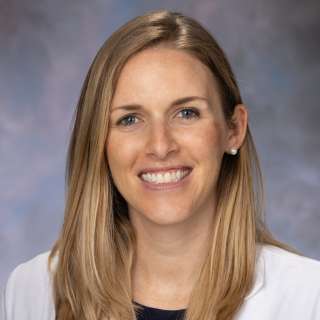
Tina F. Edwards, MD is an emergency physician and direct primary care doctor in Oceanside, California. She writes about patient care, physician exploitation, and the structural failures of the American health-care system. All names and identifying information have been modified to protect patient privacy.
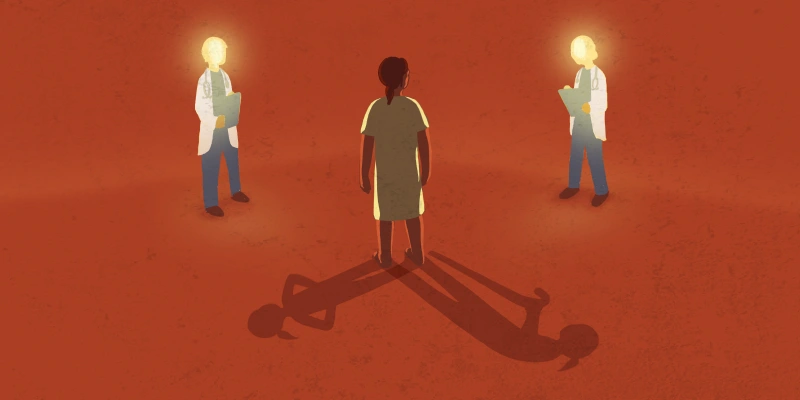
Illustration by Jennifer Bogartz