
It is a wet mid-November night in 2022, and I am trudging to an open mic in Manhattan's lower east side. Apple Maps told me the bar was around the corner. It wasn't. Instead, I found four cop cars boxing in a suspect on a trash-strewn street. I had just moved from Seattle to Jersey City, partly to relaunch my stand-up comedy career. Becoming a comedian is a nocturnal, unglamorous process best pursued by those who are comfortable being ignored and living in the dark — perfect for a radiologist.
I signed up for four lessons in stand-up comedy in the winter of 2007 while working as a nuclear medicine resident in Seattle. The last lesson was a "bringer" gig, meaning we had to invite our friends to watch us perform a five-minute "set" at a comedy club. Radiologists are often understated, but I'm also a comedian … I rocked the house! I blame it on gamma rays altering my neurochemistry (but unlike Bruce Banner, I transformed into a comedian instead of The Hulk). I went on to perform in and around Seattle for two years before the demands of private practice ended my nascent comedy career.
During a vacation in New York City in 2022, I stepped onto a grimy stage at a Manhattan open mic and delivered an old five-minute set. As I walked off the stage, a disheveled figure emerged from the rear of the club. It was the club booker, who told me he liked the set and invited me to perform at Industry Night, as long as I brought five people. Hurrah! I'd been discovered! Reality check: Industry Night books 20 new comics every week. I was just another hopeful among the thousands stepping onto New York stages every night, chasing stardom.
Now, I live two lives — teleradiologist by day and comedian by night. As a teleradiologist my hours are 6 a.m. to 3 p.m. At 3 p.m. there is a "shift change," when the comedian wakes up and the radiologist takes a break, swapping a workstation for a stage in the process. The early stages of comedy are a lot about open mics – that's where you "train" in front of other comedians. Most of the other comics are 20-somethings who make jokes about their sad dating lives and genitalia. Teleradiology is very isolating but comedy involves constant socializing with people half my age. It adds a much-needed element of human contact and youth to my middle-aged life.
Crafting humor for a non-medical audience is good for my mental health because it forces me to focus on my life outside of medicine. Modern comedy is personal: it's about one's perspective on life because jokes on marriage, work, and even going to the doctor have all been done before. Just as in radiology, comedy makes you look beneath the surface of life. Making jokes out of how I see myself and the life I lead forces me to make light of all of life's experiences. Think about that for a moment: my second job teaches me how to look at life and laugh at it, no matter what it brings. That's a cure for much of what ails our fragmented, digitalized society.
Making medical humor for the public is challenging. The public mainly thinks about the bills, the insurance companies, and rectal exams for prostate cancer. Most of them only understand doctors through medical dramas that mainly feature surgeons and ER docs. Radiologists are largely unknown to the public. We look at black-and-white pictures of organs and talk to ourselves in the dark, like a bunch of color-blind serial killers. So I give the public an insight into the hidden world of medicine's computer nerds. Another source of humor is being a middle-aged doctor who has to see other doctors for my own health needs. Having lunch with the same guy who did your colonoscopy is an experience the public can laugh at, even if they aren't in the medical common room.
Having two careers can be exhausting, but the reward is the freedom to express the humorous insights that have always bounced around my head. Three years after that fateful open mic, my wife and I have begun to produce a comedy show, with shows in Manhattan and Jersey City. Producing my own show has allowed me to provide my fellow comics with what they value the most — paid stage time!
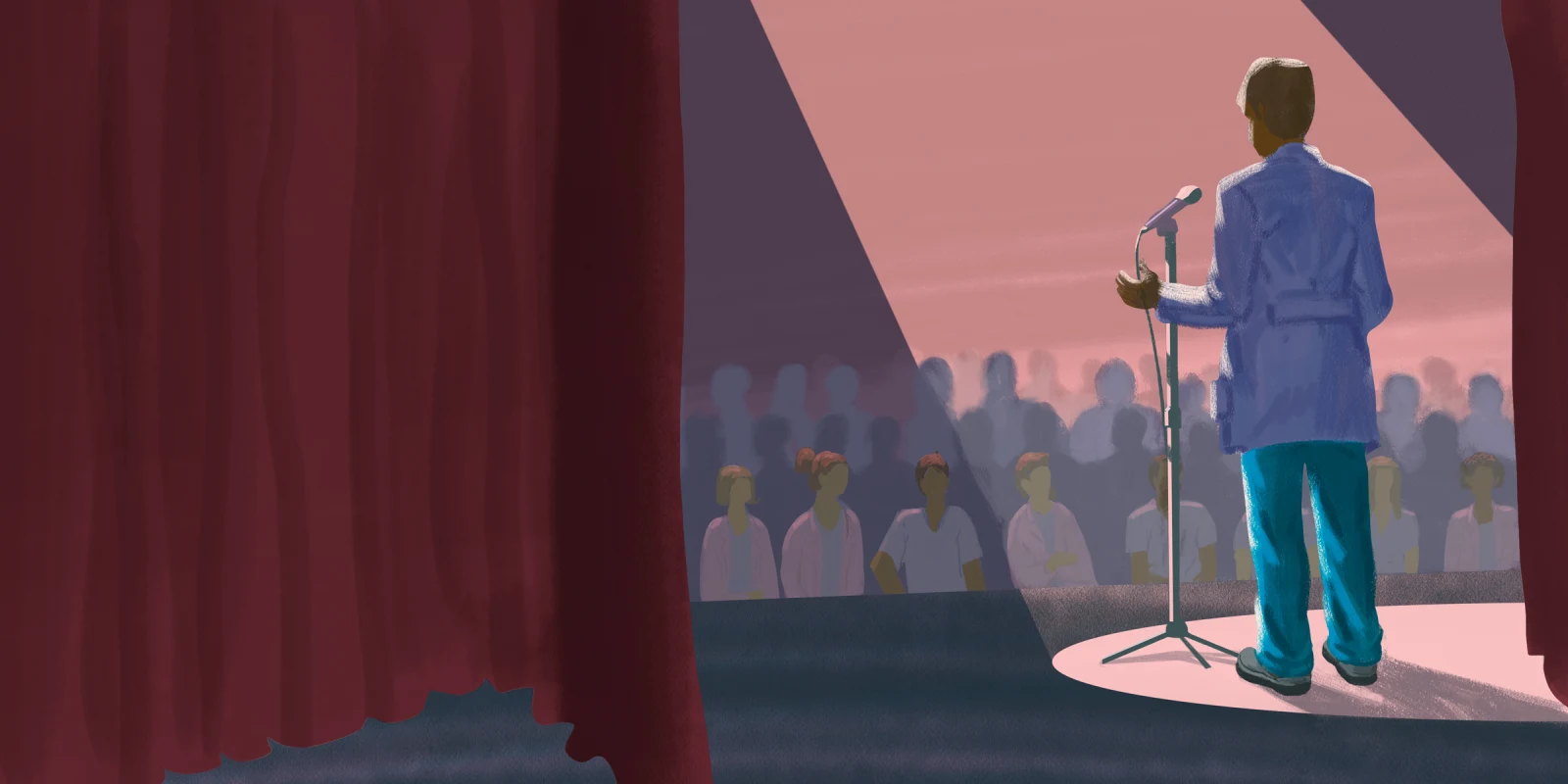
Physicians in general, and radiologists in particular, are not known for being humorous. I think it's time the wider world knows that radiologists are real and can be funny. In a way, stand-up can be like radiology; one stares into a spotlight and delivers a monologue. The difference is that the comedian gets rewarded with laughter. As physicians, our profession is about helping and healing, and I believe that laughter is indeed the best medicine, for the audience and the practitioner. So I stepped out of the dark and into the spotlight.
Previously published in ARRS In Practice.
Illustration by Jennifer Bogartz