Not long ago, my fellow Harvard Medical School students and I took a field trip to Boston Scientific’s Headquarters in Marlborough, Massachusetts. The trip was part of a class called “Translational Biomedical Engineering” — an elective offered for students interested in bringing medical innovation from benchside to bedside. We heard from company leaders, including physicians who had left practice, on how medical training intersects with med-tech innovation. “Of course,” one said as a throwaway, “we still need people to become physicians. We need the data to train AI.” A few chuckled. I wondered if only I felt the uncertainty and tension in the room.
Everyone talks about AI changing the world … then continues with their regularly scheduled programming. Every student on that day — in a class self-selected for interest in translational medicine — is still planning to do residency.
I understand why. Because for the longest time, I was too. There’s a particular gravity to the medical training pathway: By the time you’re a fourth-year medical student, you have already given at least eight years of your life, taken on significant debt, and organized your entire identity around a single destination. You are, by every external perception, almost there. The sunk cost fallacy never felt so rational.
Yet, the more honestly I looked at it, the harder residency became to justify. This essay is my attempt to think through the decision out loud. It’s an exploration of why I didn’t apply to residency, and what this decision reveals about the changing value of clinical training in the era of AI.
The Declining ROI of Residency
Let me paint you a picture of the future of clinical medicine. A patient arrives with diarrhea. AI has read through their entire medical record, conducted the patient interview, and double checked the latest literature. It has also generated differential diagnoses, pended tests, and drafted the note. The one thing it hasn’t done is reviewed its own work, which is where you come in: As the physician, your job is to read over the AI’s recommendation and press the “approve” button. Once you do so, the patient gets a prescription for tinidazole and is satisfied.
This actually wasn’t a thought experiment. It was my experience using the AI platform Counsel Health with an uninsured patient two weeks ago. The trajectory is clear: the cognitive core of medicine (history taking, pattern recognition, differential diagnosis, treatment selection) is being automated.
Research shows a steady increase in AI models’ human-equivalent “time horizon” — the length of tasks they can autonomously complete. If you follow these curves seriously, what is the value of medical expertise if I finish residency in 2030, let alone when I might retire in 2080? The standard investment case for residency goes like this: yes, you accumulate debt and start off slow for 3-7 years, but you’re investing in expertise that compounds over a 50-year career. In the era of AI, however, the payoff is no longer the same. As AI’s capabilities grow, the economic value of the cognitive skills human physicians are building depreciates. AI is making intelligence “too cheap to meter,” per OpenAI CEO Sam Altman — and when AI is cheap, robotics is not far behind.
Now, I don’t think physicians will disappear in my lifetime. However, at some point being a doctor may — as in my Counsel Health example — mean little more than being a customer service representative with liability. While this is certainly a blow to the profession, research suggests patients may not mind: They’re already turning to AI due to frustrations with care, and a systematic review of 15 studies discovered patients consistently find AI responses to be more empathetic and satisfying than human physicians — with physicians agreeing in some cases. So what unique value does residency add?
What Does Residency Teach?
The standard defense of residency is that you can’t really understand medicine without living it: the hours are the point. I think this is partially true but massively overstated. The 10,000 hour rule is a popular concept that says mastering a skill, such as becoming a world class musician, takes 10,000 hours of deliberate practice. Deliberate is the key word here. A 2009 CMAJ editorial made an uncomfortable observation: “The time spent by a resident … admitting the fifth ‘weak and dizzy’ patient at 4 a.m. probably doesn’t fall into the category of deliberate practice.” Not because residents aren’t working hard, but because deliberate practice is focused, feedback-rich, and corrective. In reading about medical education and talking to resident friends, it appears that most of what residents do is service. With 80-hour weeks, residency is not primarily a learning program. It is an endurance program that also contains learning. Endurance is in and of itself a valuable skill in medicine. But AI does not need tenacity, only electricity.
On rounds, I’ve watched residents step back from broken workflows and mutter: someone should really figure this out — then move on to the next patient, because there were seven more waiting. Residency doesn’t teach you to look at physiology and ask whether there’s a better way. It teaches you to execute existing protocols excellently. These are different skills, and optimizing hard for one can actively suppress the other. Nobel laureates and business founders have a phrase for this: you’re the only one crazy enough to do it. The outsider’s clarity, the willingness to question a workflow that everyone else has accepted as given, is what often led them to their greatest breakthroughs. 10,000 hours trains that out of you; we learn complacency.
Timing is Everything
Consider radiology, one of medicine’s most purely cognitive specialties. On the aptly titled Radiology’s Last Exam benchmark, board-certified radiologists score 83%. Radiology residents score 45%. That 38-percentage-point gap represents 4-5 years of intensive training. At the time of publication, Google’s Gemini 2.5 model scored only 30%. Yet by January 2026, Gemini 3.0 Pro, a generalist AI model not trained on radiology, scored 51%. That’s 27 percentage points of improvement in 12 months. A human radiology resident improves roughly 8-10 percentage points per year, at the cost of 60-80 hour weeks, mental exhaustion, and delayed life milestones. At current rates, AI available to the general population will match board-certified radiologists well before I would finish a radiology residency. And unlike human expertise which plateaus, AI improvement appears to be exponential.
Medicine has always been about delayed gratification. It’s a system built on hierarchy and patience. Yet, in just five years of medical school, I have seen ideas I did not have the bandwidth to build become impactful AI companies — from AI scribes to AI charting. The next few years will determine the fundamental architecture of how and if AI is used to improve human lives.
“Physician And” is Not Enough
I came to medical school planning to be a “physician and.” I still remember my white coat ceremony, where our Dean explained Harvard’s philosophy. In a world where great change is happening, the world expects me to be a great physician ... and. Physician and scientist, physician and entrepreneur, physician and innovator. Practically, this translates to: do residency, do a fellowship, practice at an academic hospital and build from within the system. I still think it’s the right path for many people. But the more time I’ve spent on the track, the more clearly I see a structural problem.
By the time you reach the “and” of “physician and” you’re 35, possibly with a family, carrying real debt, and structurally risk-averse in ways that weren’t true when you donned the coat. Ask a physician what would improve care and they’ll tell you a faster horse, not a car. The window for the first-principles, high-variance bets that meaningful innovation requires has closed.
And even when you become an academic physician, the gap still is not filled. While there are certainly doctors making brilliant innovations, in the field of AI, academia is too far behind. Top journals are publishing model evaluations using generalist models from two years ago. Countless papers use gotchas to argue AI’s outperformance of physicians in simulated encounters doesn’t mean clinical readiness. While they publish, Google is performing a nationwide randomized trial of their AI, AMIE, in real telehealth settings. What else can you expect when academia is so compute-limited and so focused on publication count?
Next Steps for Med Students
I think the most helpful piece of advice I received is this: maximize the time spent doing what matters. If seeing patients one by one every day is what makes life feel meaningful to you, do residency. We genuinely need excellent physicians. We need clinicians who will manage the transition. And, if you can stomach it, we do need physicians to train AI. I would not argue for anyone who finds real meaning in direct patient care to walk away from that.
I come from a family and Jain culture where knowledge is considered the highest value. I was internally motivated by learning long before I thought about medicine, and medical school satisfied that need. Learning physiology, pathophysiology, and clinical reasoning — I would not change these last five years. But four more years of executing on what I’ve learned, without the bandwidth to build or question, is not enough for me and not enough for the moment we’re in.
So, what am I doing instead of residency? I’m staying in the health care world — but coming at it from a tech perspective. Specifically, I’m founding a company based on my vision of a predictive health care system. The entire business model of medicine — insurance as catastrophe coverage, reimbursement as post-hoc payment, care delivery as reactive response — was architected around an unquestioned truth: we cannot predict who gets sick, or when. The new era of abundant intelligence gives us the tools to try. My MD gave me the foundation to do this work seriously with the understanding of risk and benefit, the vocabulary to work with regulators and payers, and the clinical experience that maintains urgency. Most of all, it gave me a guiding star: using health care to improve people’s health and life itself.
Medicine is changing now. The question is whether we spend years preparing for a world that’s already disappearing or participate in changing the world. I choose the latter.
What value do you see in residency? Share in the comments!
Aditya Jain is an MD student at Harvard Medical School, and a researcher on applications of AI in medicine at the Broad. He is interested in the business of health care and its intersection with technology and policy. More of his writing can be found on Substack @adityajain42. Aditya was a 2023–2024 and a 2024–2025 Doximity Op-Med Fellow, and continues as a 2025–2026 Doximity Op-Med Fellow.
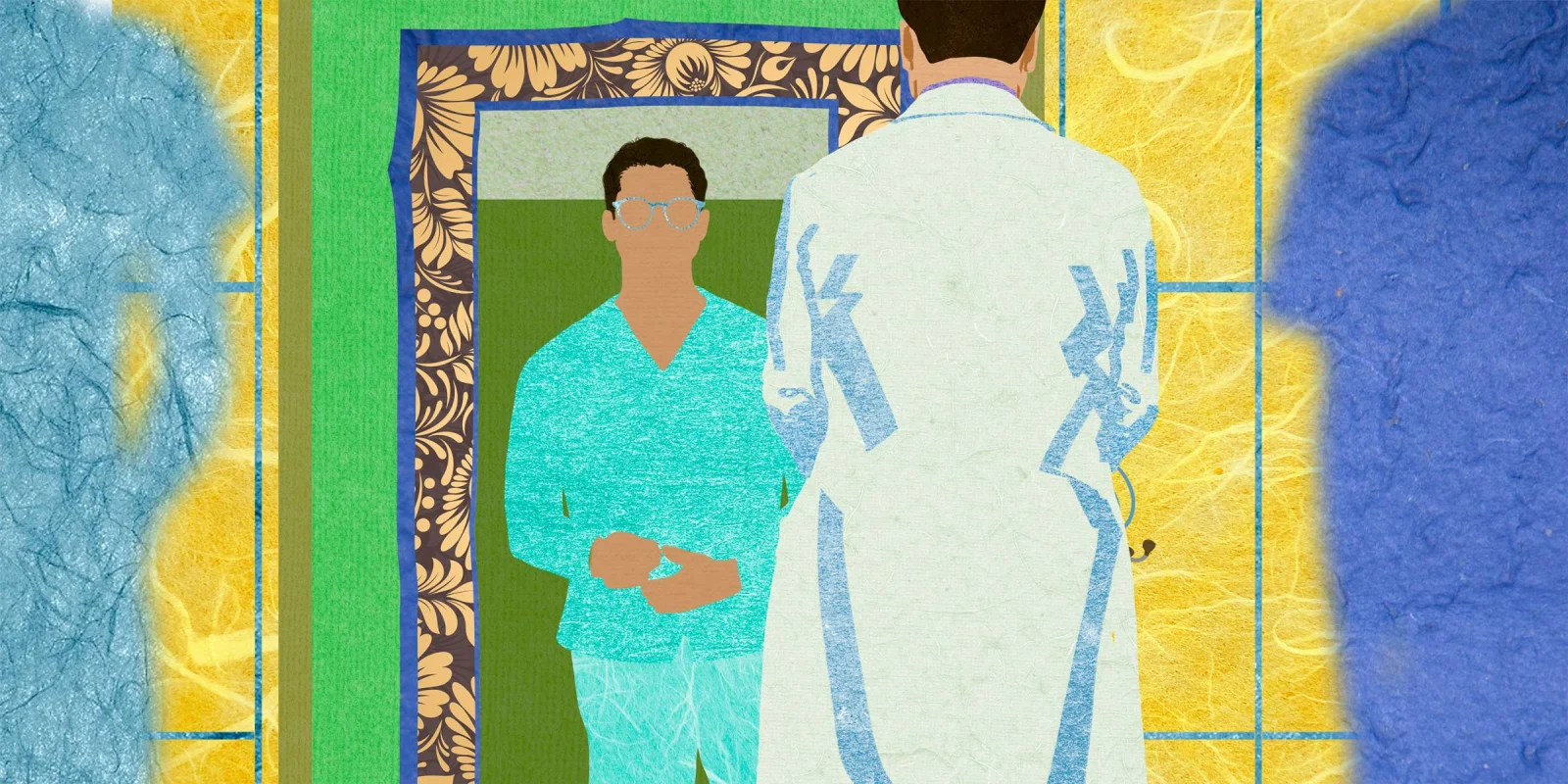
Illustration by Jennifer Bogartz