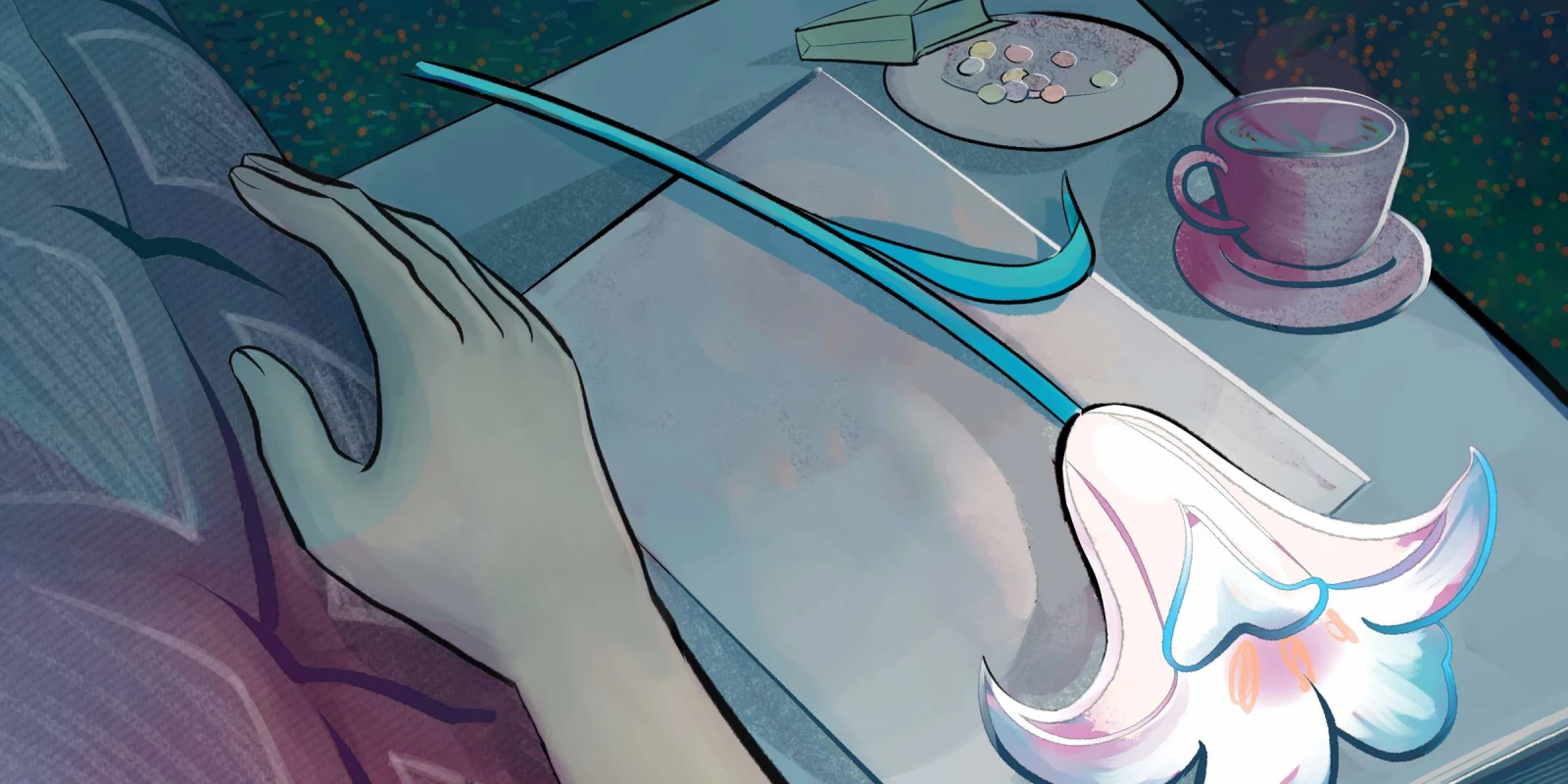

“They promised us he’d be comfortable.” Tears streamed down the patient’s son’s face as he tried to keep his father’s thrashing arms safely inside the hospital bed.
Mr. F’s son spent the night this way — helplessly watching his father suffer from terminal delirium, a common end-of-life complication that can present with agitation but can be treated with medication and by addressing other underlying causes, such as uncontrolled pain.
Very little of U.S. medical education explicitly focuses on death, dying, or end-of-life care. Most of us enter medicine driven by the desire to help, fix, and heal. We spend years mastering how to diagnose and treat disease — but almost no time learning what to do when illness runs its natural course. What happens when we reach the limits of modern medicine, when the body tells us the fight is ending, yet we were never taught how to help someone die peacefully?
Like giving birth, dying is a process our bodies already know how to move through, with a series of largely predictable steps. We can’t shy away from our role in recognizing and easing that transition. But a lack of training on caring for the dying reinforces the idea that a clinician's role is only to prevent death, not to accompany patients through it. National data back up what many of us experience. Across U.S. medical schools, students receive an average of 10–20 hours of formal instruction on death, dying, or palliative care during four years of training. We teach how to prolong life, not how to honor its end.
Too often, clinicians lack both the training and the language to provide even basic end-of-life care. Traumatic final hours can haunt families in their grief — and clinicians, too. When caregivers witness a loved one in visible distress at the end of life, they’re more likely to experience depression and anxiety symptoms during bereavement. As a palliative care physician, I’ve learned that most patients don’t fear the finality of dying nearly as much as dying uncomfortably. What they want — and what their families need — is comfort, dignity, and relief from suffering.
Even our rhetoric distances ourselves from the responsibility for the dying. We talk about “withdrawing care,” when we mean stopping aggressive interventions like life support. That phrase urgently needs reframing. A patient’s death doesn’t mean clinicians have failed. Patients entrust us to care for them, across their entire illness journey — from first diagnosis to final breath. A dignified death shouldn’t depend on a doctor’s subspecialty or training background.
Whose responsibility is it to help patients die well? This isn’t a rhetorical question — but an uncomfortable one that needs to be asked. Should we depend on cardiology to manage every patient who comes in with chest pain? What if they’re not in-house overnight? If you’re rolling your eyes at these questions, help me understand why we regard basic end-of-life care differently. This isn’t to say those of us in palliative care don’t want to help. We do. But a peaceful exit should be possible for all patients. It should be a core skill for every clinician. We learn complex ACLS algorithms in medical school — why not the basics of helping patients die well?
Many prescribing pitfalls I see stem from fear and stigma. What does the evidence show? Opioids are the well-established choice for managing end-of-life dyspnea and pain. Yet pervasive misconceptions — like the belief that opioids hasten death — leave patients suffering from inadequate relief. Another myth I still hear is that only morphine works for breathlessness at the end of life, which is false; any opioid can be effective.
We become comfortable with the medications we use every day and wary of the ones we don’t. I’ve watched that lightbulb moment when trainees realize that managing a continuous opioid infusion follows the same logic as the diuretic drips they titrate for heart failure. When they increase a Lasix drip from 10 mg to 20 mg per hour, they instinctively give a bolus for a faster response — because they know the higher hourly dose won’t reach a new steady state blood level for hours.
The same principle applies for end-of-life care. When a patient’s pain or dyspnea worsens suddenly, the answer isn’t to keep turning up the infusion rate — it’s to give an IV opioid bolus dose. That immediate dose provides the relief patients need within minutes, not hours later. With a few boluses of IV dilaudid for his pain and haldol for agitation, Mr. F’s loved ones were able to resume their roles as family — not care attendants.
Education about death and dying should be a required part of every medical school curriculum. Students should learn how to recognize when someone is nearing death and how to manage common end-of-life symptoms: pain, shortness of breath, delirium, anxiety. EMRs can support this with simple order sets for comfort care medications. For clinicians seeking guidance, Palliative Care Fast Facts offers quick, evidence-based resources for end-of-life care.
We owe it to patients, and to ourselves, to make dying part of the care continuum, not an afterthought. Dying is not the absence or withdrawal of care; it’s a shift in care goals, and remains a core part of our responsibility as clinicians.
What do you think is missing from clinician training on end of life care? Share in the comments.
Lindsey Ulin is a palliative care physician in Dallas, TX. She enjoys writing in indie coffee shops and bookstores and spoiling her dog Winston. She tweets at @LindseyUlin. Dr. Ulin is a 2025-2026 Doximity Op-Med Fellow.
Illustration by April Brust