Behind a thin, floral-print curtain that served as a makeshift exam room wall in a church basement, I sat on a folding chair across from a man who had arrived in the country only weeks prior. Outside our “room,” the chaotic sounds of children roughhousing near the church stage echoed off the linoleum floors.
This was my first clinical experience as a first-year medical student. I wore a neatly ironed button-down, had a stethoscope I barely knew how to use wrapped around my neck, and had an elementary level of medical knowledge. However, I possessed one asset that even the most experienced physicians in the “real” hospital often lacked: time.
My patient needed a physical exam to clear him for a new job, a common gatekeeper requirement. In that semiprivate partitioned section of room, to the best of my ability, I collected a full history and performed a basic physical exam. After I eventually precepted his case to the volunteer physician, he left that night with his necessary signed paperwork, and he was cleared to work.
That moment felt like a victory. But as I’ve progressed through my medical training, that fond memory has transformed from a simple success story into a discouraging example of the dysfunction of our healthcare system. My experience is far from unique. It’s a common rite of passage for many medical students. Uninsured or under-insured patients receive fundamental care from volunteer physicians, nurses, and other clinicians often in retrofitted community spaces. Unfortunately, free clinics are the de facto safety net of our healthcare system. While beneficial for patients, these opportunities provide a unique and essential learning opportunity for early clinical learners.
For students, the free clinic is where the “social determinants of health” are a reality. We don’t just passively discuss “transportation barriers” in the lecture hall; we meet the patient who took multiple buses or a long taxi ride because the traditional clinic was inaccessible for one reason or another.
Volunteering is a formative learning experience for many of us. In fact, research in medical education suggests that participation in free clinics is strongly associated with a lifelong commitment to providing care for underserved populations and may impact the likelihood of choosing primary care specialties.
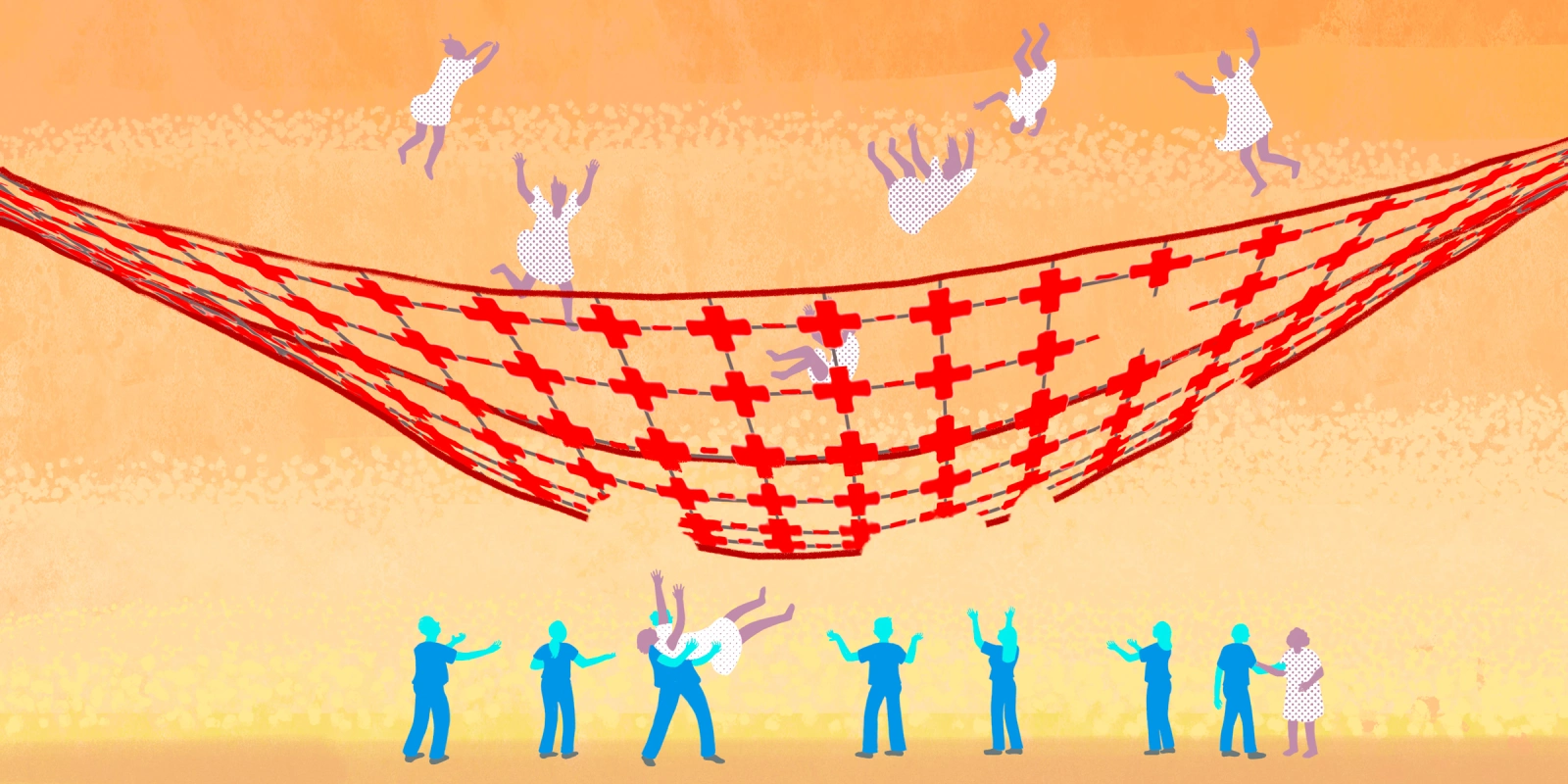
However, as I look back on that church basement, I’m a bit frustrated. There is an inherent, uncomfortable irony of the most inexperienced members of the medical profession learning from the most marginalized members of our society. Free clinics are a testament to the “oath-bound” generosity of physicians, but they are also an indictment of our health system. We rely on the volunteerism of clinicians to meet basic human needs because the “system” is a business with a bottom line that often excludes those who cannot contribute to it. While patients generally view free clinic services favorably, viewing them as a lifeline compared to the prohibitively expensive or inaccessible alternatives, we must acknowledge that these services are a stopgap, not a solution.
By involving students, we introduce a secondary layer of ethical consideration. We are learning our trade on patients who have no other choice. Is it “socially mindful” to provide care in these retrofitted spaces, or does it simply habituate us to a tiered system of justice where the poor receive “good enough” care while the affluent receive “the best” care?
Does the free clinic truly create more socially mindful, community-oriented clinicians? It’s a difficult question to answer with data alone. Exposure doesn’t always lead to empathy. Sometimes, in the face of overwhelming systemic failure and limited resources, it leads to burnout or cynicism. I, in fact, am growing evermore cynical through my medical training.
For me, the experience was a pivot point. It stripped away the clinical sterility of the classroom and replaced it with the messy, loud, and deeply human reality of community medicine. It served as a primary motivating factor in my decision to pursue a career in family medicine and community health. I wanted to be in the rooms where the gaps were widest.
Yet, I worry for the students who see the free clinic as a “checkbox” for their residency applications, a temporary detour into the lives of the underserved before retreating into the relative comfort of private practice or specialized academic centers. If we use these clinics only to build our resumes without questioning why they need to exist in the first place, we are failing our patients and our profession.
I’m still inspired by the work of free clinics in my community and across the country. When the formal health system fails millions of patients, it is the volunteer physicians, nurses, and students who step into the breach. These clinics are a stark, beautiful reminder of the fundamental “goodness” of the calling to be a physician. Ultimately, the free clinic is a mirror. It reflects the best of our profession — our compassion, our resilience, and our dedication — and the worst of our society — our inequality, our indifference, and our systemic failures.
As I move forward in my training, I carry that church basement with me. I remember the sound of the children playing, and the look of relief on my patient’s face when he realized he could finally start his job. I’m grateful for the work these clinics do, but I hope for a future where they are no longer necessary. Until then, we must ensure that the lessons we learn behind those floral curtains are not just about how to examine a patient, but about how to advocate for a system where no one has to go to a church basement to see a doctor.
Are free clinics normalizing inequity? Share in the comments.