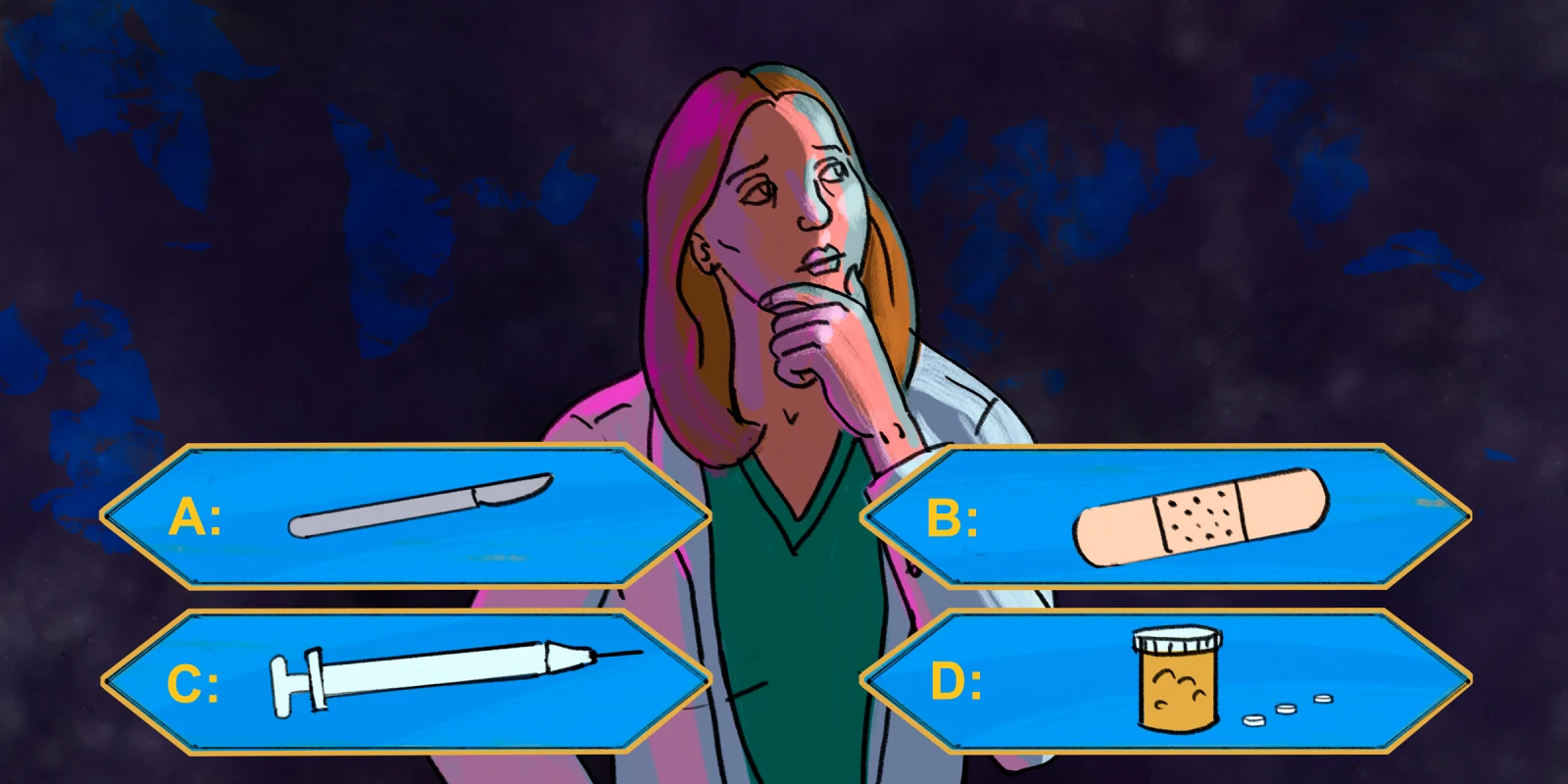

“The best surgeon is the one who knows when not to operate.”
When I heard this statement come out of the chief neurosurgeon’s mouth while I was shadowing in their clinic, I was stunned. But this was not simply a throwaway line. The lesson that day was about restraint: recognizing that sometimes surgery may cause more harm than benefit, and explaining that to patients in a way that they can understand. For various reasons, such as when patients experience degenerative lumbar spine disease and associated pain — as was the case with the patient who prompted the neurosurgeon’s remark — immediate surgery may not be the best course of action; it may not fully relieve pain, or it may introduce further complications in a way that first-line, non-operative treatments such as physical therapy, pain management, or watchful monitoring would pose less risk of. Coming to this decision, and sharing it in a way that’s clear and compassionate, can at times be more important than the ability to perform the procedure itself.
As my neurosurgeon mentor continued teaching, I was struck by the intricacy involved in this kind of care: from walking patients through the clinical reasoning behind a recommendation, to managing expectations about what surgery realistically can and cannot accomplish, to making sure that the physician and patient are truly on the same page before moving forward. I walked out of the clinic that day convinced that this instinct — the willingness to put down the scalpel — is an essential but often overlooked part of identity formation for surgical trainees.
It’s clear that surgery selects for people who are action-oriented. The training culture emphasizes case logs, tracks operative volume, and places a large part of competence on what a person can do with their hands. There is an implicit message in surgical education that your value as a future surgeon is directly proportional to the number of times that you operate. This is not entirely wrong, of course, as the technical skills are the foundation, but when the operative volume becomes the primary metric for a surgeon’s worth, the clinical judgment to recognize when an operation will not serve the patient can become lost along the way. Furthermore, once a surgical diagnosis is made, the entire system can become primed to move toward the OR, a phenomenon that has been described as "clinical momentum.” Trainees and surgeons alike may find it difficult to put a halt to that momentum, even when doing so is the right call.
What the chief neurosurgeon emphasized that day is that finding the right treatment matters more than maintaining clinical momentum. When a surgeon recommends against an operation, the conversation that follows is still high-quality care — it necessitates the same precision and intentionality as any technical procedure. The doctor needs to formulate a prognosis, create a personal connection, disclose information about the acute problem in the context of the patient's underlying illness, establish a shared understanding of the patient's condition, sit with silence and emotion, describe both surgical and nonsurgical options, elicit the patient's goals and priorities, make a treatment recommendation, and affirm ongoing support. These items have been identified by an interdisciplinary panel of national leaders as the nine key elements of a communication framework for seriously ill surgical patients, and each and every one of them requires skill that extends well beyond the OR.
Looking back on that clinic day now, close to a year later, I can see how much it has reframed my thinking. The neurosurgeon showed me that some of the most formative moments in surgical training happen during clinic and in family meetings. They helped me understand that restraint is not passivity, but rather a commitment to charting the best course of action for a patient’s long-term outcomes.
That said, patients themselves may still arrive expecting, and even wanting, surgery as a solution, viewing it as the most decisive and tangible form of care. When a surgeon recommends against operating, then, the recommendation can initially feel like inaction, making it all the more important for the surgeon to earn the patient’s trust by clearly explaining the reasoning and demonstrating that restraint itself is a deliberate, evidence-based decision. Encountering this dynamic early in my medical education has indelibly shaped my understanding of patient trust, informed consent, and humility in conversations about whether or not to operate: I’ve come to learn that the process is not only about signing consent forms for a procedure, but rather about building a relationship in which the surgeon discloses risks, understands what the patient values, and integrates those values into a shared plan.
Surgical training will always rightly emphasize technical mastery, but if we want to train surgeons who earn and deserve the extraordinary trust patients place in them, we need to teach explicitly, early, and often that knowing when not to operate is not a limitation but rather a skill. Like any skill, I hope that it can be practiced, modeled, and valued by the culture that shapes us. At the end of clinic that afternoon, as the neurosurgeon finished their patient notes and I waved goodbye to the team, I realized that I had just watched some of the most important work a surgeon can do, even though it was far from the operating rooms across the street at the main hospital. For the best surgeon is not only the one with the steadiest hands, but also the person whose judgment you trust, especially when the judgment is to leave the scalpel on the tray.
What's the most formative lesson you learned during medical school? Share in the comments!