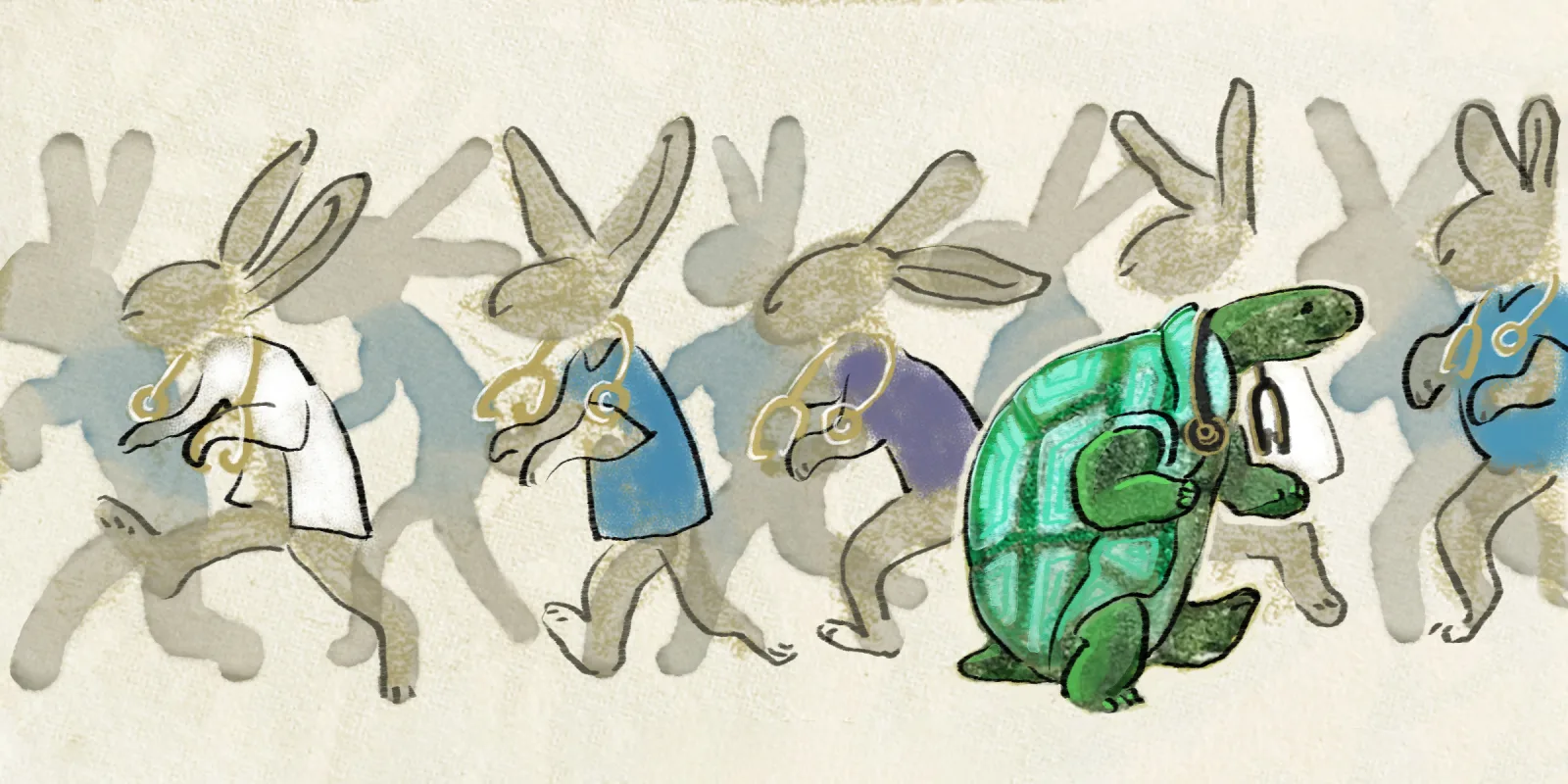
Step into my clinic on any given day, and there’s a good chance I’m running behind. Despite my best efforts, things come up in a busy primary care practice. Whether it’s a true emergency or someone who just likes to chat a little too much, I rarely find myself coming in under the 15-minute mark pre-allotted by my EMR. Most of my patients know this about me already. Many seem to not mind — they know I’ll give them the time when it’s their turn. Others might mind, but don’t complain — or perhaps they’ve already moved on to a speedier colleague. Regardless, I increasingly think of myself as a primary care doctor who is part of a dying breed: a dedicated practitioner of what I call slow medicine.
It’s not that I can’t go faster — I simply don’t want to. For many years as a doctor in the ICU and in the ER, I had to practice fast medicine — making clinical decisions in the moment, as things happened and shifted rapidly around me. I got good at it, but never found it entirely comfortable. It would come out in the smallest moments. I’d spend a couple extra minutes cleaning up after an incision and drainage to chat about the game. I’d muse with a family member about an intubated patient’s favorite movie quotes or card games. I enjoyed these small moments more than the thrill of the pace. Ultimately, I decided these specialties weren’t for me as a result — no offense to those who enjoy them. I simply knew that I needed to slow down if I wanted to be happy in medicine.
Lest you think of me as lazy, let me assure you slow medicine is anything but. Sometimes, slow medicine means an hour-long house call — with the whole family, a six-for-one visit marathon. Sometimes, it means a tough palliative care conversation that spills into your lunch hour, or your evening. Often, it means putting in more (often uncompensated) work to make sure your patient gets the care or the drug or the procedure that they need. Slow medicine doesn’t pay —at least not immediately. Sometimes it does, though — in a kind word, a batch of handmade cookies from a patient, a Christmas card, or a glowing recommendation to a friend. Really, those are perks for the practitioner of slow medicine. The real reward is in the practice of slow medicine itself.
In a world of clock-watching, RVU counting, and instant gratification, efficiency sometimes can feel like the only thing that matters in medicine. It’s important to be efficient, but it also pays to know when to go slow. The old saying about measuring twice to cut once might as well be the motto of the slow medicine practitioner: Put in the work on the front end, and it might save you time later on. I think it’s easier in primary care than other specialties in this regard. I know my patients are likely to come back to see me. But even in other settings, I’ve always been able to find my slow medicine moment: taking a breath with the patient during preop to make sure they’re OK before going under anesthesia, or finding a place to sit down to take a history when the stretchers are lined up in the hall in the ER are also modes of slow medicine. Rather than a specialty choice, I find slow medicine to be a mindset choice as well: It is there to find if you desire it.
There’s tremendous pressure to be anything but a slow medicine practitioner. Many of us are paid on RVU generation, running on a treadmill to see as many patients as possible. Even so, I find that slowing down can speed things up. If I sit and explain, I am saved callbacks and the “door on the handle” bombshell later. If I am economical in my choice of words, the patient, as Osler once said, is telling me the diagnosis. If I explain why an antibiotic is not needed, I will save the next three appointments for upper respiratory infection that did not need an antibiotic, either. Efficiency can be found in many forms. Sometimes spending the time up front can save it later.
It isn’t all perfect, of course. The practice of slow medicine today is difficult, and getting harder. There are days my medical assistant slips me a note in hurried scrawl — 45 minutes behind. There are nights where I get home knowing the notes aren’t done, and they aren’t going to be for a while. Amid a swirl of paperwork, double-booking, and missed phone calls, there are certainly times where fast overtakes slow. Even so, I revel in the practice of slow medicine — the art of being present in someone’s life, even just for a moment, that reminds us how connected we all are.
Do you prefer your medicine fast or slow? Share in the comments.
Dr. Brennan Kruszewski is an internal medicine physician in Hudson, Ohio. He is passionate about transforming primary care. He enjoys spending time outdoors, especially biking the trails of Northeast Ohio. He is active on social media, and blogs at his personal website. Dr. Kruszewski was a 2024-2025 Doximity Op-Med Fellow and is a 2025-2026 Doximity Op-Med Fellow. Opinions expressed here are his own and not the opinions of his employer.
Illustration by April Brust