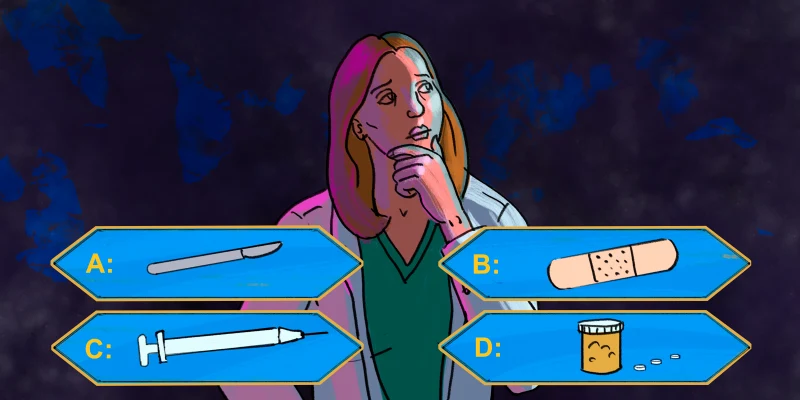

What brings you in today?
How have you been feeling lately?
Can you tell me more?
These are just some iterations of the questions that I have posed to countless patients, both standardized and real, in my first-year longitudinal internal medicine clinic. Though one might think that this formulaic, standard approach to beginning patient encounters limits the more personal aspect of clinical interactions, I have found that it actually serves as a useful launching pad into deeper, more intuitive conversations.
Let me back up. When I first started medical school, communicating with patients felt like stepping into a role that I didn’t fully know how to inhabit. Although I had been privileged to interact with many patients and their families over the years through both clinical research and volunteering at free community clinics, the expectations that came with being a “student doctor” were different. There was a new weight to patient interactions. I had to be empathetic and knowledgeable, natural yet structured, all at the same time. I became more aware of every word that I chose in a conversation as I tried to balance these competing demands.
In response to this pressure, our faculty offered my peers and me a “language toolkit”: phrases, question frameworks, and interviewing approaches to guide us through patient encounters. One of the first frameworks we learned for history-taking was “OPQRST-A,” asking about the onset of symptoms, provoking and palliating factors, quality of pain, region or radiation, severity, timing, and associated symptoms. It took a few days just to learn to remember what each letter stood for, and during early practice sessions, I would find myself repeatedly running through the order in my head, toggling between listening to the standardized patients and mentally trying to organize the flow of my questions. There were many moments where I worried that I might be coming across slightly disjointed and robotic, like I was trying to follow a script rather than actively participating in the conversation.
Over time, however, this shifted. With repeated practice in simulation sessions, the frameworks faded into the background. Now, in the internal medicine clinic, the process is starting to feel much more organic and intuitive. I’m not thinking as much about which letter of OPQRST-A comes next or whether I’ve covered everything in my checklist; instead, I’m considering if the patient was able to fully discuss the issue that they came into the clinic concerned about, and whether I am listening to what matters most to them. I’ve realized that these frameworks were never meant to fully replace our interactions but rather to offer a steady foundation — something that we could refer back to in moments of uncertainty, especially when trying to understand a patient’s complex experience with multiple and overlapping health concerns.
For example, I recently had a patient come into the clinic with mild, intermittent belly pain. Through a mixture of frameworks and open-ended questions, I learned that he was especially concerned about what might be happening, considering his family’s history of colon cancer and the fact that he had not seen a doctor in 10 years. Asking him — and other patients — questions like “Can you tell me more?” and “What has that been like for you?” served as a small yet meaningful bridge.
This is the paradox of medical communication: We learn the rules not to adhere to them rigidly, but to know when to move beyond them when the situation calls for it. Our frameworks serve as enabling constraints in a way, as they provide a steady foundation, but also space for improvisation. If we rely solely on these frameworks, physician-patient encounters can feel mechanical, but if we entirely ignore them, the encounters can feel aimless. Asking the same questions at each visit might seem formulaic, but the fact that the questions are open-ended can still encourage patients to tell us more than they might initially share otherwise, which both helps us guide their treatment and enhances the patient-clinician connection. For example, asking the patient with belly pain what his experience “had been like” allowed me to get a glimpse of who he was beyond his EMR information: He explained that he loved to play soccer with his kids, and that experiencing belly cramps and pains had stopped him from being able to spend as much time with them on the field. I used this information to get us to a goal: Greater adherence to treatment meant more time playing soccer.
In this way, this transition from a structured to an intuitive approach has been one of the most rewarding aspects of my first year. It reinforces the idea that good communication is both a skill and an art, because the technical components can be taught and practiced repeatedly, but over time, the blending with one’s own personal approach is what leads to it feeling much more authentic. Further, this way of communicating has extended beyond the clinic. It has subtly shaped how I show up in my relationships with family, friends, and even new acquaintances. I find myself asking more thoughtful and creative questions in my everyday conversations and listening more closely.
Of course, there is still a long way to go, and I know that my communication strategy will continue to evolve over the years as I encounter more patients and move through more scenarios. I am thankful for this early lesson in understanding that structure can successfully set the stage for spontaneity to emerge. Through these experiences, I am continuing to grow not only as a student but also as a person beyond that identity, shaping how I listen, connect with, and understand others, both in and out of the clinic.