
The hardest ethical moments in medicine happen when love, not policy, collides with expertise.
As a psychiatrist working in psycho-oncology, I’ve spent years helping patients and families navigate terminal illness. What I didn’t anticipate was how often the deepest dilemmas would belong not to patients themselves, but to the physicians who love them.
Because when the person in the bed is your parent, your partner, your sibling — professional distance collapses. What remains is love, fear, and the unbearable weight of deciding correctly. The question is no longer what medicine can do, but whether our impulse to act honors the life in front of us, or our own need to feel useful.
One case stays with me.
He stood in the elevator bay like a man being cross-examined by the universe. Shoulders square. Eyes sharp. Hospital staff nearby, a quiet ring of concern around him. He was a retired professor of medical ethics, in his 70s, newly diagnosed with lymphoma — and absolutely clear that he was going home, against medical advice. I had been called to assess his decision-making capacity. When I stepped off the elevator, he zeroed in.
“Are you the psychiatrist?” he asked.
“I am,” I said.
“Good,” he replied. “Then perhaps you’d like to sit and learn something. I’ve spent four decades teaching autonomy and beneficence. I don’t intend to become an exception to my own teachings.”
This was not arrogance. It was integrity honed over a lifetime. He understood the prognosis. He understood the treatment. He understood the risks. He also understood what he wanted: no chemotherapy, no prolonged hospitalization, no ICU. He wanted to die at home, surrounded by his wife and his books.
The medical team was worried. His children, three adult sons — two physicians and one health policy attorney — were on their way, calling from airports and highways, asking us to “keep him safe” until they arrived. They wanted time to talk him into treatment. Or at least to try.
He agreed to return to his room on one condition: that I sit with him, not as an expert, but as a student. For over an hour, we didn’t discuss capacity forms, suicide screens, or safety contracts. We talked about Kant. About autonomy not as rugged individualism but as the right to author one’s own story. About how modern medicine sometimes confuses protecting life with controlling death. Then his tone shifted.
“I raised my sons to think critically,” he said. “To care deeply. One of them is an oncologist. Another runs an ICU. They’ve spent their lives fighting for other people’s parents.”
He paused, eyes wet but voice steady.
“I want to go home. But I don’t want my last act to teach them that their expertise doesn’t matter. I don’t want them to think I rejected not just the treatment, but them.”
In that moment, autonomy stopped looking like a clean line and started looking like a knot.
We celebrate autonomy in medicine. Rightly so. We have seen what happens when patients are steamrolled by paternalism. But at the end of life, autonomy is rarely a solo performance. It’s relational. It sits at the intersection of love, guilt, culture, and history. It’s a professor wanting to remain ethically consistent and a father wanting to reassure his sons that he trusts their judgment.
His sons arrived hours later: exhausted, brilliant, terrified. They knew the literature. They knew the survival curves. They knew the complications. But none of that knowledge insulated them from the primitive fear of losing their father.
Physicians are supposed to be good at this part. We’ve seen dying before. We know the scripts. We can recite the benefits and burdens of aggressive care. We counsel families on goals of care and “what your loved one would have wanted.”
But when it’s our loved one, those clean frameworks blur. You’re not just a clinician anymore. You’re the “good child” who doesn’t want to give up too soon. The one who lives in another city and flies in late, determined to make decisions that prove your love. The one who thinks: If I say yes to less treatment, will I regret it for the rest of my life?
The sons knew their father valued autonomy. But they also felt the weight of their own need to try.
He had capacity. He could have left. Instead, he stayed. Not because he believed chemotherapy would save his life. He stayed because he wanted his last lesson to land gently. He wanted his sons to feel that they had done everything they could. He chose one more round of treatment as an act of love, not of hope.
He started chemotherapy the next day. Three days later, he was in the ICU with sepsis. Not long after, he died. Between those moments, his physician children learned what no training prepares you for: that loving someone does not protect you from the consequences of trying to save them.
We rarely talk about this in morbidity and mortality conferences, ethics rounds, or in medical training: that sometimes the people most tortured by end-of-life decisions are physicians making them for the people they love.
From the outside, it’s easy to say: He made an autonomous choice. From the inside, physicians often live with a far messier reckoning. Did my training help him or did it only prolong his suffering? Did I fight for his life, or did I drown out the quieter wisdom of letting go?
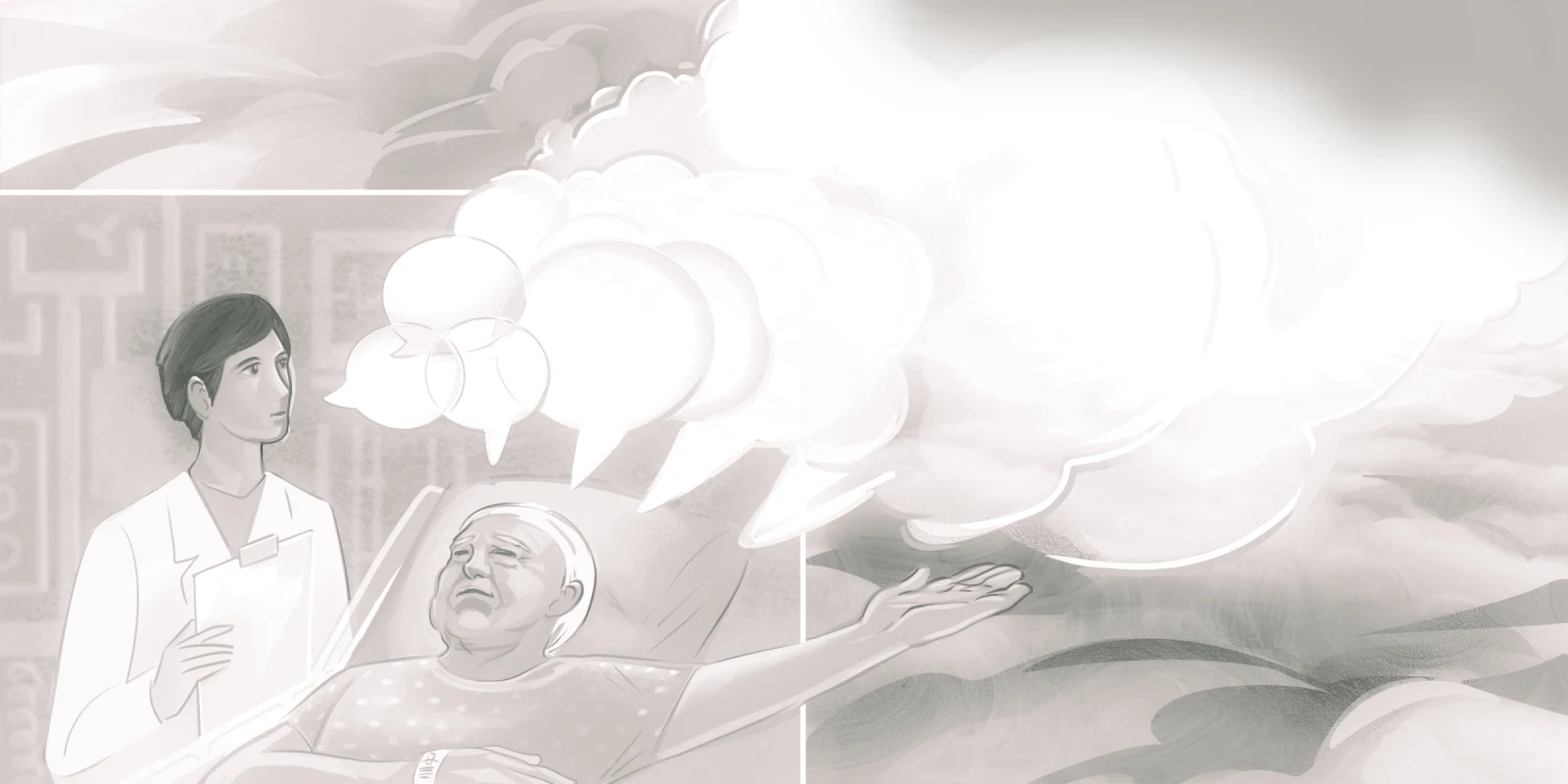
In moments like these, my role is not to decide for anyone, but to slow the room down enough for what matters to surface. To move beyond survival curves and protocols. To ask questions that medicine is often too uncomfortable to ask. To help patients and families step back and ask what still matters.
For the patient: What do you want this last chapter to feel like? How do you define a good day now?
For the physician-child: If there are no perfect choices, which regret can you live with more gently? The regret of doing too much or the regret of doing too little?
For the team: Can we honor autonomy without abandoning families in the name of “It’s your choice”?
The professor’s “last lecture” didn’t happen at a podium. It happened in a hospital bed, somewhere between an elevator bay and an ICU. His lesson wasn’t that autonomy always means refusing treatment. It was that sometimes, choosing freely means choosing in a way that protects the people who will go on living.
He died having given his sons something they may only fully understand years from now: the knowledge that he trusted them, that he listened to them, and that his final choice was not a capitulation, but a gift.
A good death, I’ve learned, is not the absence of pain, or even the absence of doubt. It is the presence of meaning, shared, imperfect, and deeply human, right up to the end.
Fawad Taj, MD is an assistant professor of psychiatry at Case Western Reserve University and a psychiatrist at University Hospitals of Cleveland with over a decade of experience in psycho-oncology, emergency psychiatry, and serious mental illness. His leadership lies at the intersection of mental health, policy, and community advocacy. Dr. Taj is a 2025–2026 Doximity Op-Med Fellow. All names and identifying information have been modified to protect patient privacy.
Illustration by April Brust