
Before my mom got sick, I felt like I was living on borrowed time as a free woman. As a daughter of Vietnamese refugees who found a home in Washington, D.C., I was torn between pleasing my family and craving independence. Despite the altruistic reasons I chose a medical career, there was an undeniably selfish one: freedom from traditionally female obligations. I was excused from toiling away in the kitchen because I had to study.
My studies panned out and I became a psychiatrist in San Francisco. I found a job that allowed me the rare autonomy to pursue my eclectically different interests: medical education, couples therapy, and global mental health.
I had been in my ideal job for two years when a phone call from my uncle changed everything.
“Tin,” he called me by my childhood nickname, a sharp contrast to the nurses who had just greeted me by “Dr. Nguyen.” “Your grandma says your mom has cancer.”
“Grandma has dementia, she must be confused,” I pointed out.
“Grandma said your dad called her,” my uncle pressed.
My stomach dropped. I tried not to panic as I played phone tag with my dad and grandma.
When I finally reached my dad, he cried as he told me how my mom’s laparoscopic procedure to remove a presumed benign ovarian mass converted to an open surgery removing her ovaries, fallopian tubes, uterus, and 60 nodules of cancer that had spread to the peritoneum.
Being a woman was already full of suffering without our lady parts trying to kill us from the inside.
After finishing work, I booked a red-eye. I saw the airport, the doorway for adventure, through tear-filled eyes in a different light. How many other people were traveling for a sick family member or, my mind jumped, for a funeral? I knew my irreplaceable mother would die one day, but this was a truth that I didn’t have to examine closely until now. Now, my mom was the one living on borrowed time.
I called my grandma at the airport. “Tin, your mom is sick,” she said sadly in Vietnamese. “Will you move home?”
The question jerked my thoughts to my own fate. I had moved out of state for college and traveled as far as Nepal for my training. I withstood pleas to move back. I reasoned wanderlust was a common symptom of youth, but my love for adventure sustained. My Vietnamese guilt told me that when it really came down to it, like if my parents were sick, I would finally move back home to fulfill my caregiver role.
Now, it was time to give up my freedom.
I arrived in D.C. the next morning and went straight to the hospital with my suitcase, arriving before 7:30 a.m. rounds with the surgeon. I hugged my mom’s tiny body — How had I missed the signs? — and my dad’s tired one.
7:30 a.m. came and went. I fought to keep my annoyance at bay as my dad monologued the benefits of ivermectin over chemotherapy and my mom pressured me to apply for jobs in town.
At 8:45 a.m., the surgeon arrived. He patiently answered the questions I had prepared. “These are good questions. You are lucky to have her,” the surgeon smiled at my mom.
My mom asked, “Are there any psychiatry jobs open here, doctor?”
“But you said she’s from San Francisco,” the surgeon became stern. “Wait, you can’t use this to make your daughter move back here. She needs to live her own life!”
She needs to live her own life. I was shocked. Like many women, I had learned that my role in the family was caretaker. For my parents’ peer to say this and imply that I would still be a good daughter even if I wasn’t the caretaker was revolutionary.
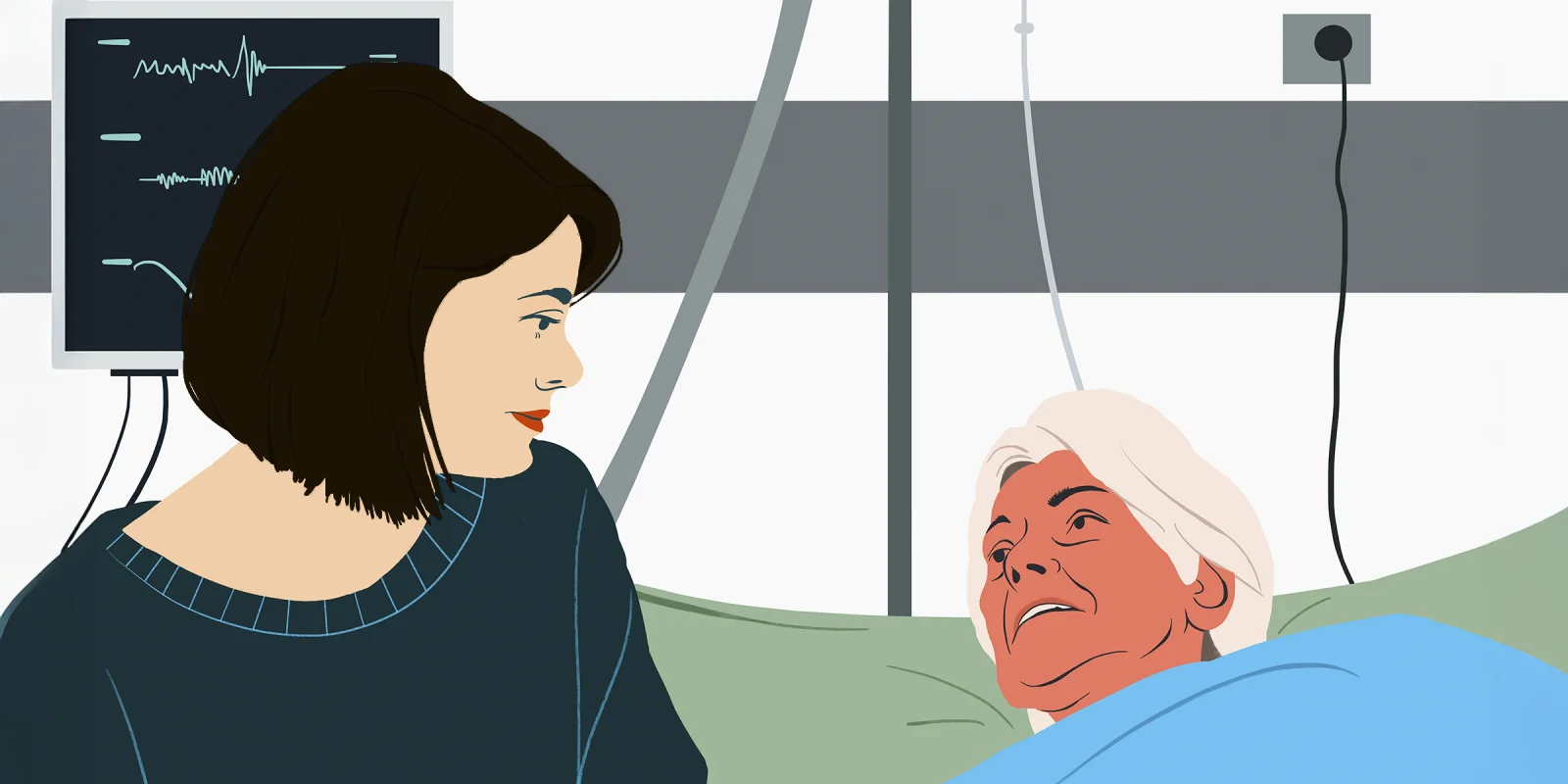
I took my dad’s place and stayed overnight at the hospital with my mom as she recovered from surgery. When she was discharged, I emptied her drain every few hours and navigated medical appointments, sometimes being on hold for more than 45 minutes.
“What will I do when you’re gone?” She asked.
Guilt and resentment battled it out inside my head. I should move back to D.C. She needs my help. What if I don’t have much time left with her? But she has my dad. And I love my life in San Francisco. I survived medical school and residency to earn my dream job. But my mom went from working a tiring job to retiring and taking care of my grandma. Shouldn’t I sacrifice for her?
Yet even though my mom was stuck at home for surgery recovery, she was freer. I watched my mom get physically stronger each day and wondered if the obligation she felt taking care of grandma for years was also lifting. She increased the hours of a personal care aide who already worked with my grandma while discovering my grandma could be alone safely for periods of time.
I realized I didn’t want to become sick myself to take back my time. I would resent my mom if I risked my career and relationships. I wanted to want to take care of her, like during this trip. For now, I would return to the life I had built in San Francisco with more frequent visits to D.C. I could honor both my family and myself.
A few weeks later, I went back to the hospital with my suitcase to meet my mom’s new oncologist with the plan to go to the airport after. My parents and I were bickering about which hallway to go down when we ran into the surgeon.
“Flying back today?” He smiled at my luggage. “I have daughters that live far away, too. It’s not easy, but they need to live their lives.”
I smiled back. Even my mom half-smiled before she asked him questions about her cervix in the hallway. I almost overreacted from embarrassment, but knowing I was about to get some space helped me be a more patient daughter.
As I left for the airport, the feeling of adventure stirred within me and as a result, my zest for life reawakened. It was important that my destiny was my own. After all, I may not be living on borrowed time as a free woman anymore, but I am still living on borrowed time. We all are.
Kristin Nguyen is an assistant professor of psychiatry at University of California, San Francisco, volunteer faculty at VinUniversity, and a couples therapist. She whispers “Cảm ơn trời phật” (“Thank you Buddha” in Vietnamese) every night for her dream career and an even dreamier home life with a husband who is drawn to the kitchen and a cat who is magnetized to her lap.
Image: Amr Bo Shanab / Getty Images