

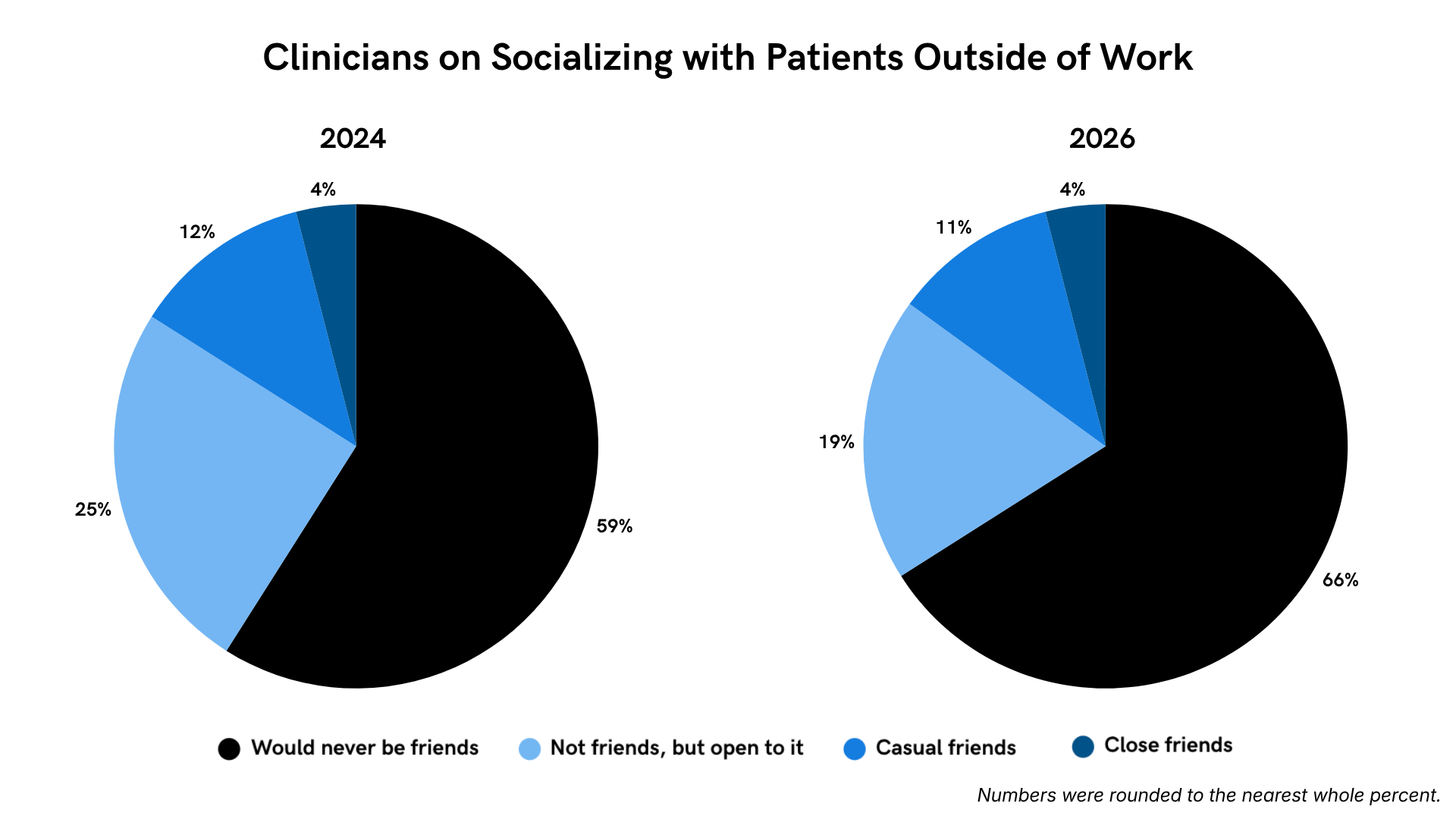
A recent poll by Doximity asked clinicians whether they would socialize with their patients outside of work. Of the 4,185 clinicians who responded to the poll, 66% set hard boundaries between work and personal life, saying they would not socialize with patients outside of work, while only 19% were open to friendships. When the same question was asked in 2024, 59% of clinicians stated they would never be friends with their patients, while 25% shared they were open to it. The share of clinicians maintaining casual friendships with their patients in 2024 (12%) dropped slightly by 2026 (11%).
While the shift away from doctor-patient friendships may seem like a loss, it’s worth noting that inappropriate conduct with patients has disciplinary consequences. In 2025, the Federation of State Medical Boards shared 24,026 alerts with states, which resulted in 2,986 physicians being disciplined. The National Practitioner Data Bank, a federal database that tracks license and conduct actions across clinicians’ professional histories, reported 6,717 Adverse Action Reports filed against physicians, PAs, and NPs in the same year. For clinicians, a single misjudged relationship can hurt a career, so a firm line between the professional and personal may just be a safeguard.
Geographical Breakdown of Doctor-Patient Socialization
The majority of clinicians in all four U.S. Census regions said they would never be friends with their patients in both the 2024 and 2026 polls. However, the picture becomes more nuanced once you look at individual states.
Massachusetts
In 2024, 69% of clinicians in Massachusetts stated they would never be friends with their patients, and by 2026 that figure had risen to 76% – the only state to sit significantly above the national average in both years.
A few features distinguish the state. Massachusetts ranks first in the nation for overall health system performance, and it holds one of the densest concentrations of prestigious teaching hospitals in the country, clustered in and around Boston. These conditions could reinforce a culture of professional distance, though the poll alone can’t confirm the link.
Part of the state’s increase is attributable to its NPs, who grew stricter between the two polls – from 67% in 2024 to 88% in 2026. NPs made up a larger share of the state’s respondents in 2026 than in 2024, so some of the shift reflects who answered the poll rather than a shift in attitudes. But the same rise was observed among NPs nationally, suggesting a genuine shift within the profession rather than just a quirk of the Massachusetts sample.
That profession-wide shift plays out against a specific regulatory backdrop. The Massachusetts Board of Registration in Nursing’s Standards of Conduct requires every licensed nurse to establish and observe professional boundaries with patients, and failure to comply is grounds for disciplinary action. Nationally, nursing boards have paired these long-standing rules with increasingly specific guidance on social media, treating informal online contact with patients as a potential boundary violation. For NPs, in other words, firm boundaries are written into the terms of licensure, a professional norm that may carry into how they answer a question about friendship.
Florida
On the other end of the spectrum, Florida clinicians stayed significantly below the national average in both years, with only 51% stating they would never be friends with patients in 2024 and 60% in 2026. Florida’s openness is driven by its youngest clinicians. Those aged 44 and under were consistently more willing to befriend patients than their counterparts elsewhere in the country – 59% ruled out friendships in 2026, compared with 75% nationally. That gap held in both years.
The poll can’t explain why Florida’s younger clinicians differ, but the state’s physician workforce has a few distinctive traits. More than one-third of Florida’s doctors trained at medical schools overseas, the third-highest share in the country. That means many of the state’s younger doctors were trained differently than the older, mostly U.S.-trained physicians around them, which could shape how they approach patient interactions.
A second factor is geography. Florida faces a documented physician shortage, and many rural counties have fewer than 10 physicians per 10,000 people. In rural communities, where the physician could be a neighbor, drawing strict boundaries may be impractical. For some, socializing with patients isn’t a choice so much as a fact of small-town life. “In a small community, this situation is inevitable. I have seen a large percentage of the population so many patients are friends,” shared Thomas Freenock Jr., MD, who practices in a Pennsylvania community with less than 5,000 people.
California
Notably, California had a different trajectory. Unlike its peers at the strictest and most open extremes, California had the largest increase of any state. In 2024, 57% of clinicians stated that they would never be friends with their patients; just under the national average. By 2026, that figure jumped to 70%, a 13 percentage-point rise that pushed the state above the national average. The increase wasn’t confined to one group. Nearly every cohort hardened at once, suggesting a change in the practice environment rather than in any one type of clinician.
During this time, California’s regulatory landscape changed. On January 1, 2024, Senate Bill 815 took effect, overhauling the Medical Board of California’s enforcement process. The law created a Complainant Liaison Unit to help the public file and track complaints. For the first time, the board was required to interview the patient or their representative before closing a quality-of-care complaint, giving patients a more direct role in physician oversight.
Around the same time, major California health systems began billing for patient portal messages, turning casual digital contact into a documented, billable transaction. With a single complaint now triggering a mandatory patient interview and routine messages now billed, a clinician’s decision to keep patients at arm’s length outside of work starts to look less like coldness and more like caution.
Not All Clinicians Hold These Boundaries
While most clinicians prefer never to be friends with their patients, not all do. In 2026, roughly one in three respondents (34%) still reported at least some openness to patient friendships, including 15% who said they already count a patient as a casual or close friend. Two years earlier, that group was larger, at 41%. The dominant trend is toward maintaining distance with patients, but it is far from universal.
Ultimately, where a clinician works shapes whether they keep patients at a distance or let them in off the clock. But drawing that line more firmly doesn’t have to mean medicine has lost its heart. Perhaps clinicians are learning that by protecting their personal reserves, they preserve the warmth and stamina that let them return each day and care for their patients at their best.