
This lyric essay is part of the Medical Humanities vertical on Op-Med, which showcases creative writing by Doximity members. Do you have a comic, poem, work of lyric prose, or flash fiction piece related to medicine that you’d like to share with the community? Send it to us here.
There are doors in the hospital and in the clinic I do not open right away.
My hand rests on the handle for a moment longer than necessary. Not because I do not know the medicine. Not because I am afraid of the conversation. But because I know that whatever happens on the other side of that door will linger in the patient, in their family, and if I am honest, in me.
Sometimes it is a patient who has already decided I am not to be trusted. Sometimes it is a family that is about to hear a sentence that will divide their lives into before and after. Sometimes it is a room filled with exhaustion, anger, fear, and the quiet disappointment of people who have been failed too many times by systems that were supposed to help them.
In those moments, before I go in, I pray.
Not for a miracle. Not for the outcome to go my way. Not even for the conversation to be easy.
I pray for wisdom. For patience. For restraint. For the ability to stay fully present and fully human in a profession that quietly trains us to move fast, stay distant, and protect ourselves with emotional armor.
I imagine many secular readers hear the word prayer and picture something intrusive or inappropriate. A doctor imposing beliefs, crossing boundaries, or stepping outside the work of science. That is not what this is.
This prayer never leaves my lips unless a patient invites it. It never enters the chart. It never becomes part of the clinical plan. It is not about changing them. It is about governing me.
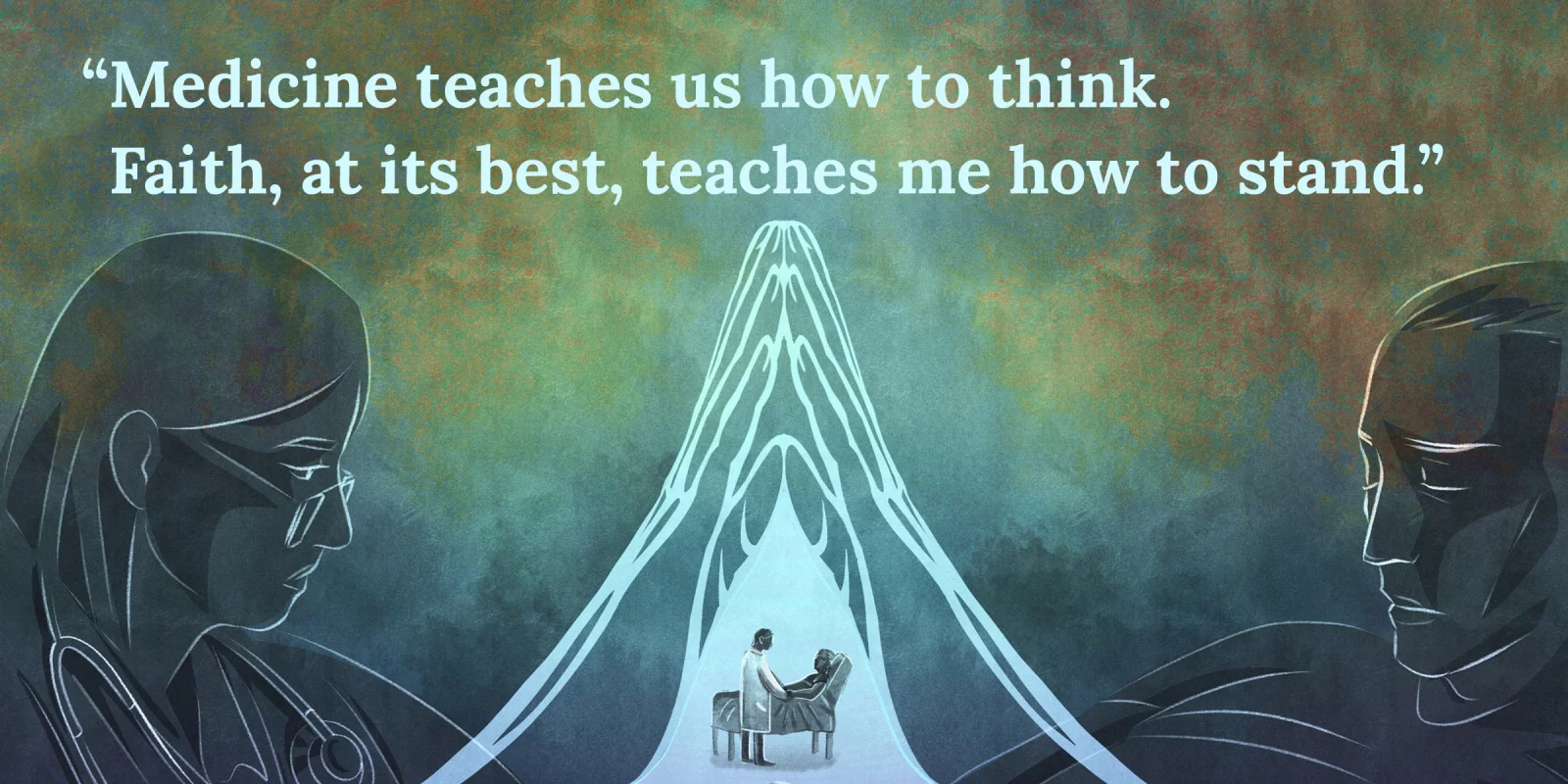
Medicine teaches us how to think. Faith, at its best, teaches me how to stand.
There is a particular kind of erosion that happens in clinical work. It is subtle. You start by wanting to help everyone. Then you learn about efficiency. Then about documentation. Then about throughput. Somewhere along the way, without noticing, you begin to protect yourself by becoming a little less reachable.
You still do good work. You still care. But you learn to keep a small distance. Just enough to survive.
Before certain rooms, I know that distance will cost something. It will cost this patient the experience of being truly seen. It will cost me something harder to name. A small loss of the kind of physician and person I am trying to remain.
So I pause.
Sometimes the prayer is as simple as: Help me not to rush.
Sometimes: Help me not to become defensive.
Sometimes: Help me tell the truth without becoming cruel.
Sometimes: Help me remember this is someone’s whole life, not just my next task.
Faith, in my daily practice, is not a substitute for clinical reasoning. It does not change lab values or reverse pathology. It does not replace evidence or training.
What it changes is me.
There is growing research suggesting that practices like prayer and contemplative reflection are not merely emotional comforts but can measurably influence attention, emotional regulation, and empathy. Neuroimaging studies in what is sometimes called neurotheology show that spiritual practices engage brain networks involved in compassion, self awareness, and regulation of stress responses, the same capacities physicians rely on when navigating difficult encounters. Studies of physicians themselves have also described what researchers call sacred moments, brief experiences of connection with patients that often arise during vulnerability, suffering, or shared humanity. These moments are associated with greater meaning in work and protection against burnout.
None of that surprises me.
Because when I pause to pray before entering a room, I am not changing medicine. I am changing my posture toward the person in front of me. Prayer slows me down. It interrupts defensiveness. It widens my attention so I can notice the person and not just the problem list.
It reminds me that the patient in front of me is not a problem to solve but a human being to honor. It reminds me that my tone matters. That my posture matters. That how I sit in a chair matters.
It reminds me that power should always be handled with care.
There is a misconception that faith in medicine is about influence. About what the doctor is trying to get the patient to believe. In my lived experience, it is mostly about discipline. About what kind of person I am becoming under pressure.
The hospital and the clinic are places that can harden you without asking permission.
You see too much. You move too fast. You learn to function while carrying other people’s worst days. If you are not intentional, you start to flatten things. Stories. Emotions. Even yourself.
My faith gives me a way to resist that flattening.
It gives me a way to return again and again to the center of why I entered this profession in the first place.
Not to save. Not to fix everything. But to serve well.
I do not pray before every room.
But I pray before the ones that could change me.
Dr. Onaola Adedeji is a family medicine resident and passionate leader who blends medical expertise with faith-driven purpose to inspire and empower others. Off the clock, she’s likely chasing a runner’s high, whipping up something delicious in the kitchen, or getting lost in a deep, soul-stirring conversation. She can be found on Instagram @onaolaadedejimd. Dr. Adedeji is a 2025–2026 Doximity Op-Med Fellow.
Illustration by April Brust