
The umpteenth argument with my 12-year-old daughter over buying — or rather, refusing to buy — a smartphone reached a crescendo in our backyard one summer. I escaped into the house, she marched in my shadow, and I beelined to the bathroom, hiding inside to reload my arguments. Her words breached the barrier: “You’re killing my life!”
As a child and adolescent psychiatrist, my days consist of treating depressed and anxious youth; it is an occupational hazard to be on high alert for warning signs in my children. Even before Jonathan Haidt published his anti-smartphone manifesto, "The Anxious Generation", I needed no convincing that smartphones were the enemy, comparing it to the hazards of alcohol on the developing brain.
My own experience reflected Haidt’s conclusions. At the ripe age of 40, I’d created an Instagram account to network for my writing career. Nearly three years in, I’d accumulated a decent following of writers and readers, and in spite of overwhelmingly positive engagement, I deleted my account. The emotional and cognitive drain proved too much. If I’d felt that way in my 40s, what was I sentencing my children to?
I finally capitulated with my 12-year-old, starting with a no-internet phone, which progressed to a smartphone in eighth grade with a strict “no social media” rule until high school, when she taught me how to activate parental controls and obeyed my “no phone at bedtime” rule.
I waited for signs of demise: an eating disorder from too much social comparison? Isolation and anxious rumination from FOMO? Instead, she spent increasing amounts of IRL time with her friends, got her driver’s license, excelled in academics and extracurriculars, and mostly used her phone to stream movies and television shows. Long after I grew lax in the bedtime rule, she maintained the boundary herself.
Maybe I’d been wrong.
Smartphone apologist, I am not. However, after observing my daughter’s ability to outperform her mom in smartphone boundaries, I searched for other clues to explain the mental health status of America’s youth.
A lesson in human evolution offered the strongest foundation of understanding this dilemma. We are wired to seek safety, community, and comfort, and our expression of these three pillars has shifted rapidly in recent generations.
Parents in my office and in my own social circles lament how the world isn’t as safe as it was when we were kids. Statistically speaking, however, the world is safer for our children by several measures including accidents, kidnappings, and crime — and though firearm deaths are increasing for youth, the overwhelming majority of gun-deaths occur in the home and not in schools. Yet, I deploy a self-induced pep talk when my school-aged children ask to play unsupervised at the park around the block. My mind spins. What if they’re hit by a car? What if a nefarious individual uses a puppy to lure my highly sensitive son into an unmarked van?
Jennifer Senior, author of "All Joy and No Fun", describes how several generations ago, children were seen as vital to economic stability. Or as my North Dakota farm-raised mother would quip when I complained about chores: “I had kids so I could put them to work.” Children now, instead of vital to a family’s economics, are central to a family’s emotional stability. The cognitive burden for parents to protect their children — not only from perceived physical threats, but psychological threats — leads to an unsustainable hypervigilance. This is what birthed the term helicopter parent, along with its insidious twin, the snowplow parent (removing all of a child’s challenges).
Because technology has improved access to safety, community, and comfort, it has ironically cost us our mental health, something that Michael Easter and Anna Lembke investigate in their complementary books, "The Comfort Crisis" and "Dopamine Nation." We don’t become less distressed as we gain comfort and safety, we simply move the bar on what we consider stressful: boredom, the A-minus, the person who skipped their turn at the stop sign, the too-long line at the grocery store checkout, a webpage that won’t load quickly. Now pair that with unprecedented means of immediately reducing or eliminating this distress through distractions, densely processed food, online shopping, social media scrolling, ChatGPT, highly concentrated THC, and the list goes on. We also need this form of unhealthy stress reduction in increasing amounts to achieve the same level of relief. And it’s literally at our fingertips.
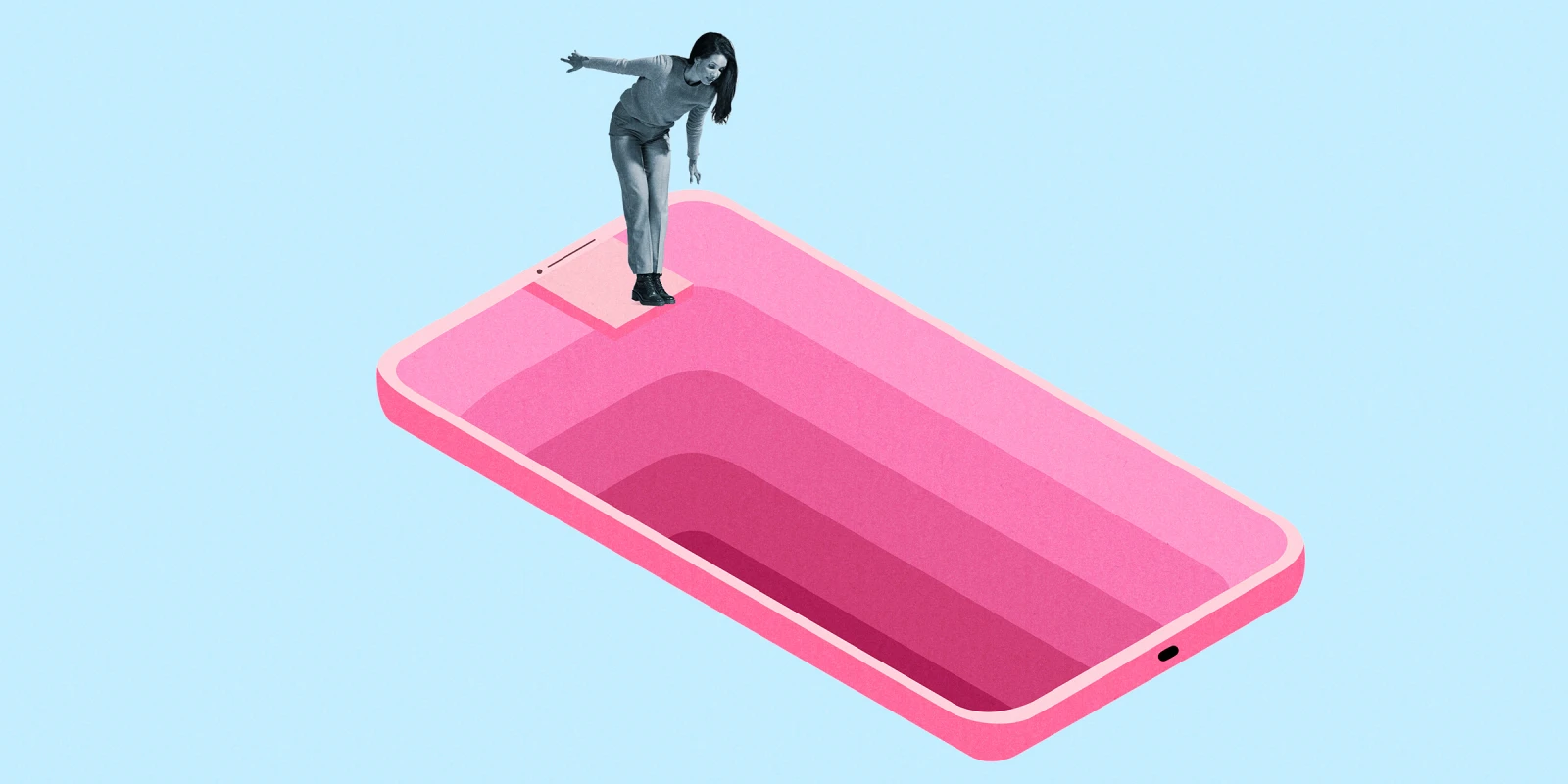
But, it may be easier to think of the smartphone as a mirror. If a teen is relatively well-adjusted, utilizes healthy coping strategies, and has access to supportive adults who mitigate their own anxiety rather than projecting it, they tend to utilize platforms and social media for good: facilitating gatherings instead of replacing them, encouraging and advocating instead of bullying. They tend to be critical thinkers, able to ask the question we all should be consistently asking: Am I using this tool, or is it using me?
The solution is paradoxical. To raise flexible children, able to someday ask themselves that question, we have to regularly prescribe distress. So what can those of us in medicine do? Clinicians can prescribe unplugged nature retreats, meditation practices, even cold water therapies, to name a small sample of rebirthed interventions that are gaining attention.
Yet I often get placating nods when discussing the science behind these suggestions, especially when families want in the moment tips. Take for example one of the most common presenting problems in pediatric mental health: school avoidance. I am often presented with the question: “What are we supposed to do?” This was the tearful plea from two parents in my office recently after their son huffed from the room when arguing about school attendance. “We can’t physically drag him out of bed. But this is his future!”
There is data to support that modern school demands significantly impact youth mental health. My child psychiatry colleagues will attest to this dip we experience in both outpatient and inpatient numbers when school is not in session. Education is good and necessary, but the weight that is placed upon it is often unnecessary.
What is the balance? I believe school ought to be less about the grades and more about empowering children to navigate the challenges and explore their curiosity. While there is no singular recipe to treat school avoidance, with this particular family in my office, the teen had demonstrated a true desire to attend school, and was attending more days than not. He avoided school because of learning challenges related to ADHD.
I assigned a very uncomfortable and counterintuitive distress prescription. Not for the teen, but for the parents. “Stop,” I said. “No more bargaining, fear tactics, or yelling. Check on him silently. If he misses the bus, offer a ride. Tell him when you’re leaving, and then leave. You have to encourage and empower him to make the choice, right or wrong. How else will he discover what works for him?”
Modern parenting is the hardest job today. But let’s remind families that it’s not because of external dangers or smartphones. It's hard because parents have to consistently make choices that go against their biological instincts to protect children from discomfort and pain, including their own. No one builds self-esteem, flexibility, and confidence with exercises on positive self-affirmations. Positive affirmations are the fuel that dares humans to do the hard and challenging things.
Lives built on comfort and distraction are built on shaky ground. Let’s help families build lives of discomfort. We may discover more resiliency, more responsiveness — and maybe, just maybe — a little more happiness.
What was the last distress you prescribed for yourself or a patient? Share in the comments.
Rebecca Krill, MD is a Minneapolis-based pediatric psychiatrist and department chair for HealthPartners and Park Nicollet outpatient mental health department. She tames her busy days and mind through writing, unplugged nature runs, and Britney Spears on repeat. Dr. Krill is a 2025-2026 Doximity Op-Med Fellow.
Image by Klaus Vedfelt / Getty Images