
A highly respected priest was a repeat patient, and one whose inappropriate behavior never changed. “You are meant to be home, married, and having children — not working in a hospital,” he said to me once. He went on to comment that I was not "feminine enough" and should work harder to attract men — more specifically, a husband. He grabbed my arm, pulled me close, then put my face next to his as he "prayed for me.” Clearly, someone has forgotten the basics of respect. Just another day on the job — toxic as it may be, some days.
A systematic review conducted in 2018 found that out of 331,544 participants, 61.9% of clinicians reported any form of workplace violence, 42.5% reported non-physical violence, and 24.4% reported physical violence. Additionally, 57.6% reported verbal abuse as the most common form of non-physical violence, while 33% reported facing verbal threats, and 12% experienced sexual harassment. Between 8% and 38% of healthcare workers are affected by some form of physical violence during their careers.
Terrifying as those statistics sound, take a step further and consider what it means to be a woman in the medical field. A New England Journal of Medicine survey of medical residents indicated that 73% of the women had experienced some form of sexual harassment at least once during their training. Unsurprisingly, only a very small handful of women actually reported the abuse, as they did not have confidence that their institution would provide support.
Studies show that for years, these acts against healthcare workers have been ignored, minimized by hospital administrations, and considered part of the confidentiality agreement medical workers are to abide by. No country in the world currently has any laws to protect medical workers from these acts. The U.S., a country that considers itself at the top of the healthcare industry, lacks the resources and studies into this topic compared to European and Asian countries.
Patients come to us when they are vulnerable and expect to be treated with decency and care. As clinicians, we fulfill this basic request without second thought. As the caregiver, we simply expect respect in return. Instead, we fear abuse.
I wish I didn’t have personal experience to further add to the statistics. Only last week, I saw a patient in the ED. He seemed kind and tried to be humorous during our interaction; however, he quickly flipped a switch. While trying to complete the motor exam, he grabbed my left hand and asked where my wedding ring was. Not wishing to share personal details, I brushed the question off with a witty remark about preferring to go home to my dog.
He didn’t stop there. Instead of describing and pointing to the location of his back pain, he chose to put his entire hand on my buttocks and grab. This was not an indication of location. This was sexually inappropriate touching, plain and simple. But I just had to ignore it, smile, and do my job. I made a comment about "keeping our hands to ourselves" and left in a hurry. I told myself he was just another creepy old man and tried to forget. I felt violated, dirty, and ashamed that I permitted this type of behavior, as though a giant scarlet letter was plastered on my chest. But what could I do? The same patient made lewd remarks to my fellow colleague, too. It wasn’t just me. It was all female clinicians.
No one has empowered us to speak out against these actions. I spoke of this encounter to several managers and physicians above me — only one volunteered to speak to the patient — others laughed. According to the National Institute for Occupational Safety and Health (NIOSH), healthcare incidents are not reported for several reasons, including: a cultural perception of considering it “part of the job,” poor or non-existent policies or procedures, overly complex reporting procedures, fear of victim blaming, believing the incident was not “serious enough,” a bias of not reporting unintentional violence or abuse, such as by dementia patients, and a belief that reporting will not change the system. Not only is there no mechanism to report this, but I know most just ignore it. Most often, managers fail to address the issue or protect staff out of fear of upsetting the patient and receiving poor Press Ganey scores.
Sometimes it’s not just words. There are patients who rip their gowns off or lift them up to expose themselves. Some physically place their bodies in a threatening position or strike us.
Many patients view healthcare as a service area where “the customer is always right." To them, this behavior is fine and acceptable. They are the patient. They claim innocence and attribute their behavior to infirmity and helplessness. They view us as caterers to their every whim, leaving decency and decorum at the door. But we are here to save your life and care for you when you are ill, not tolerate your abuse.
And yes, other professions do face abuse in their working environments. Women on Wall Street have faced similar abuse, discrimination, and silencing by demeaning clients and colleagues. Many customer service roles, law enforcement, and social workers face verbal and physical abuse daily. But there is one significant difference: for these industries, there are consequences. Those working in the healthcare industry, which lacks a reporting mechanism, are five times more likely to experience some form of workplace violence than those in other industries.
While further education on how to protect ourselves is necessary, maybe we also need to start educating society on appropriate behavior and focus less on first-class demands. We set clear boundaries — yet we are still verbally abused, hit, touched, grabbed, and forced to listen to derogatory comments.
Clinicians should not be afraid to come to work, and we should not be afraid to speak up for ourselves. Management needs to take a stronger stance, even if this means taking a hit to a satisfaction score. Too many “free passes” are given to those who act violently or inappropriately toward clinicians. We are programmed to shrug it off, provide an excuse, or ignore it out of fear of retaliation.
Interventions for healthcare abuse, whether physical, verbal, or sexual, require a focus on the needs of the victims — the workers. It is time we all stand together in support of our fellow coworkers on the front line of healthcare. No longer will we shrug or laugh off this inappropriate behavior and simply accept that it happens daily. We will say no. It is time for consequences. Maybe we can bring back the preschool lessons at the time of admission — keep our hands to ourselves, say please and thank you, and you get what you get, and you don’t get upset. Even a kindergartener’s behavior is better. Let's start with the A,B,Cs.
Kristen Cellary is a senior neurosurgical physician assistant in Camden, NJ. She has worked in the field of neurosurgery since graduating from the University of the Sciences in 2016. Prior to becoming a PA, she earned her MPH degree with a focus in health literacy from Thomas Jefferson University and in 2022, she graduated with her doctorate of medical science from the University of Lynchburg. She spends her days in the OR, seeing consults, and caring for patients perioperatively. Outside of work she enjoys running, reading, and her dog Bailey, and is a classic “Disney adult.” She is a 2025–2026 Doximity Op-Med Fellow.
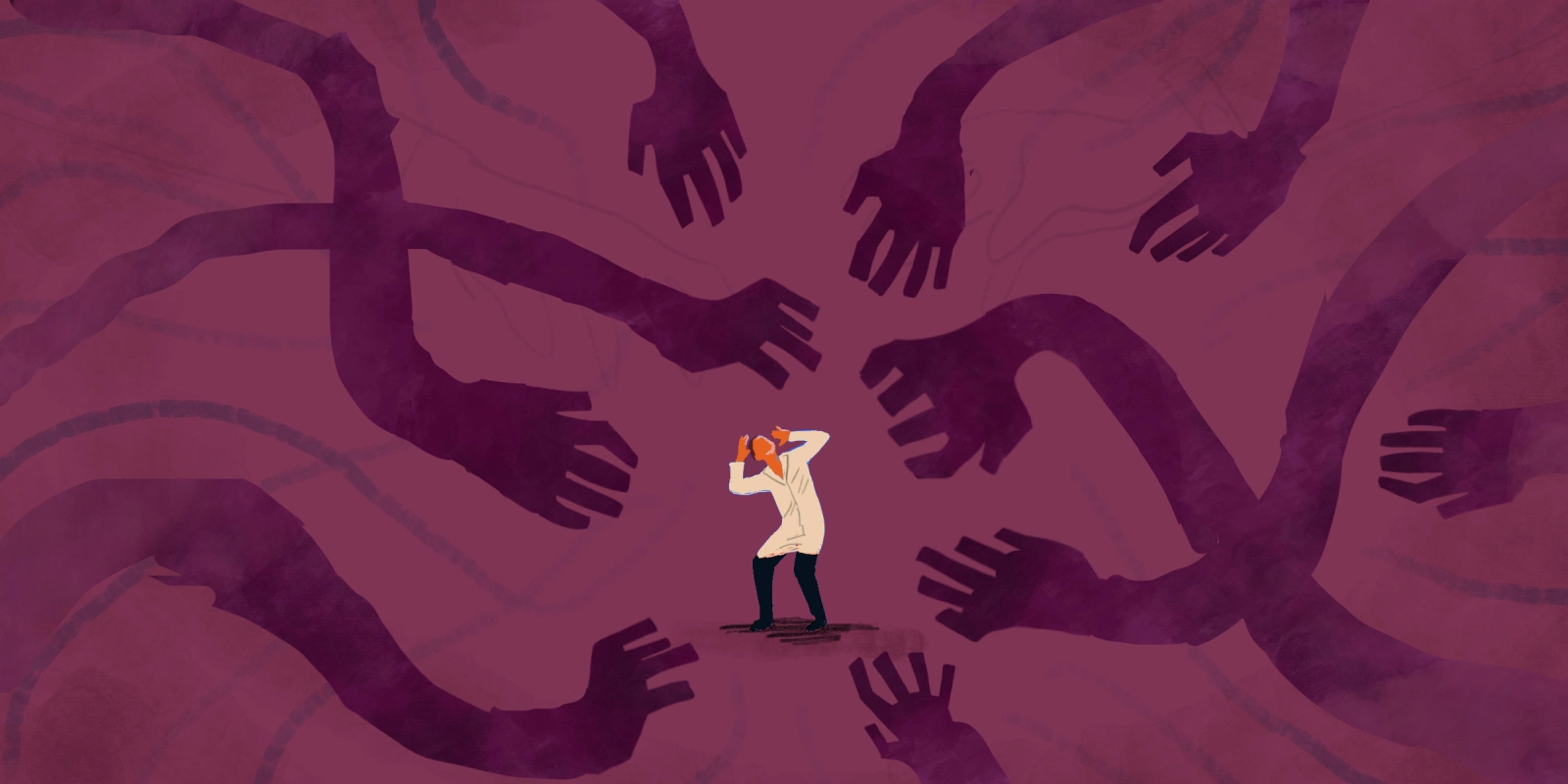
Illustration by Diana Connolly