This poem is part of the Medical Humanities vertical on Op-Med, which showcases creative writing by Doximity members. Do you have a poem, work of lyric prose, or flash fiction piece related to medicine that you’d like to share with the community? Send it to us here.
It is a calling to stand,
to stand for hours without sitting.
Holding the smallest vessel –
the tiniest hands’ first grip
the lungs’ last release.
To stand through the war zone that is training.
Endurance built, year upon year
Obedience layered thick, a hierarchy swallowed whole.
Until you spit out knowledge
And choke on sleep
Until criticism becomes a second skin.
It is a calling to stand, young, hopeful
before you have even fallen into your own name.
You wear your new title, healer, with borrowed confidence.
There is a terror in knowing
every patient is a calculus of risk.
That omission can kill.
A constant wondering
Sound, shadow, figment, or fatal
You carry the question, have you missed something?
Because you were tired.
Because you were human.
You replay encounters as if they are evidence.
Cross-examining yourself in the dark
And the verdict is always
Not enough.
There is no off switch for this gift
a weighted vest fastened to your skin.
Cortisol floods. The body adapts.
At a cost.
Vigilance rewrites the nervous system
Blood pressure climbs.
An anxiety that is not dramatic
Flickers, building with each near miss.
Physician, heal thyself,
but there is no slot on the schedule.
So you stand.
Shove deeper.
Stand taller.
Pretend.
A game of hide and seek
where you are hidden
and there are no seekers.
At bedsides where hope thins
you are the steady one.
Fluent in composure.
Translating catastrophe as if it were your native tongue.
You absorb the impact.
There are other patients to see.
No scheduled pause for shattering.
No place to chart the grief.
They call you hero.
A word used easily, as if it weighs nothing.
No one sees how the cape tightens
at your throat
as you pump life back into failing hearts,
breathe into chests that already let go.
Keep standing, don’t sit.
Because heroes do not admit to dread.
Heroes do not falter.
Forsake the oath.
Heroes do not say I am afraid.
I cannot keep doing this.
Not to a system that runs on sacrifice.
There are moments when what once felt like triumph
strangles and betrays.
Constricting your breathing
a fight for air.
And a whispered thought from the adversary in your mind
barely audible.
A door marked exit.
To hang the burden up for good.
To leap beyond the constant demand.
To swallow a silence deep enough to finally sleep.
So you hang
or jump
or swallow
Clawing at what suffocates you.
How long can one divide themselves
until nothing remains?
In the quiet, you stand with the knowledge
that you can call the code for everyone else
but not recognize your own flatline.
What remains is a paradox.
The training that taught you to save
did not teach you to ask,
when you need saving.
No team bursts through the door
When the healer is the one collapsing.
Yet hope remains, a flutter in a paralyzed mind.
To grab hold of, to choose peace.
For if there is saving, it begins with the self.
Untying what binds.
To redeem.
To silence.
The thought of exiting with this truth.
That the healer is allowed to be unwell
Flawed.
Finite.
That the white coat can be set down
without shame.
Discipline and denial
not a measure of a life.
May this be your permission
To sit.
To breathe.
To weep.
To mend.
For you are not divine.
You are human.
And worthy of the care you give.
An Interview with the Author
What was your inspiration for this piece?
My inspiration for this piece is the loss of a friend and fellow physician to suicide. Her beautiful, vibrant spirit is deeply missed. Through this poem, I hope to acknowledge the tension that many clinicians carry by giving voice both to the beauty of medicine and to the burden it can bring. I imagine an alternative ending, one in which the physician chooses themselves. In that version, they grant themselves permission to not be okay, to rest and to reach out for support when the weight of the work becomes overwhelming.
How long have you been writing creatively? What got you started?
I have been writing creatively since childhood. Reading and writing have always served as an escape for me, a way to step away from the conditions around me.
Why did you choose this medium? What interests you about it?
I chose poetry for this piece as a way to honor the paradox of the healer’s gift. I felt it was a better medium for capturing the complex emotions involved, allowing me to focus on imagery and feeling rather than on statistics or arguments.
How does this submission relate to your medical practice?
This submission highlights the journey to becoming a physician, with the breaking down and rebuilding of the self that occurs through the process. It brings to light the realities of medical practice. Physicians have a suicide rate over double that of the general population, with female physician suicide rates estimated to be 250%-400% higher than those of women in other professions. Suicide is the second leading cause of death for residents. This piece focuses on how the title of healer can be both a gift and a burden. Finally, it provides hope, giving permission for the doctor to choose themselves, and the weight of medicine to be set down.
Dr. Nicole Hight is a pediatrician based in Atlanta, GA, who completed her medical education at Emory University and her residency in pediatrics at Levine Children's Hospital where she also served as Chief Resident. Her past roles include serving as Chief Medical Officer at CW Williams Community Health Center, Medical Director at Novant Health Medical Group, and pediatrician at Arboretum Pediatrics. She has multiple publications in Op-Med, covering topics such as pediatric care, youth sports, the evolution of medicine, and personal insights from her breast cancer diagnosis. Dr. Hight was a 2024–2025 Doximity Op-Med Fellow and continues as a 2025–2026 Doximity Op-Med Fellow.
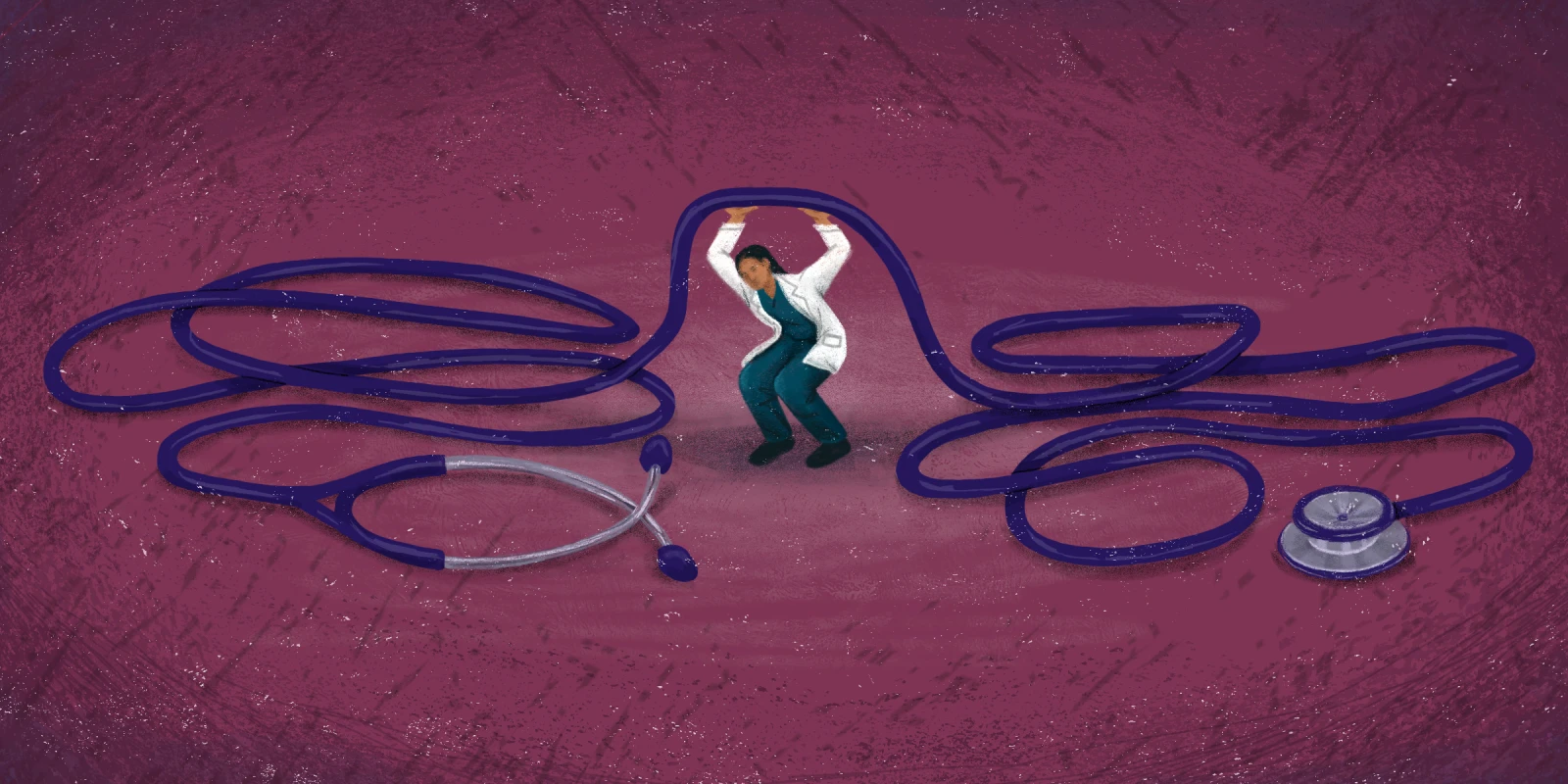
Illustration by Diana Connolly