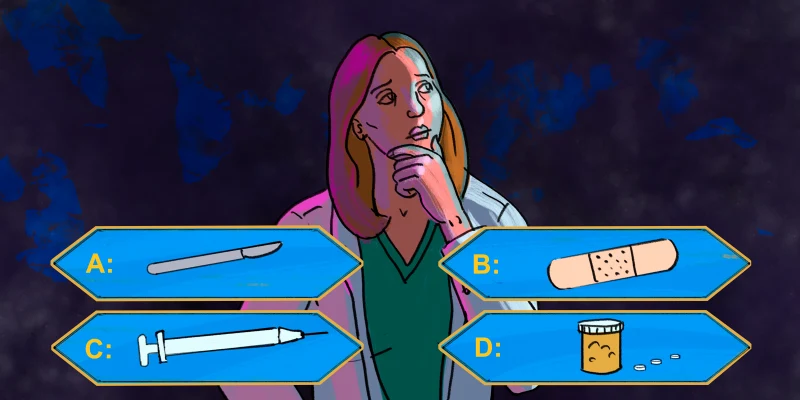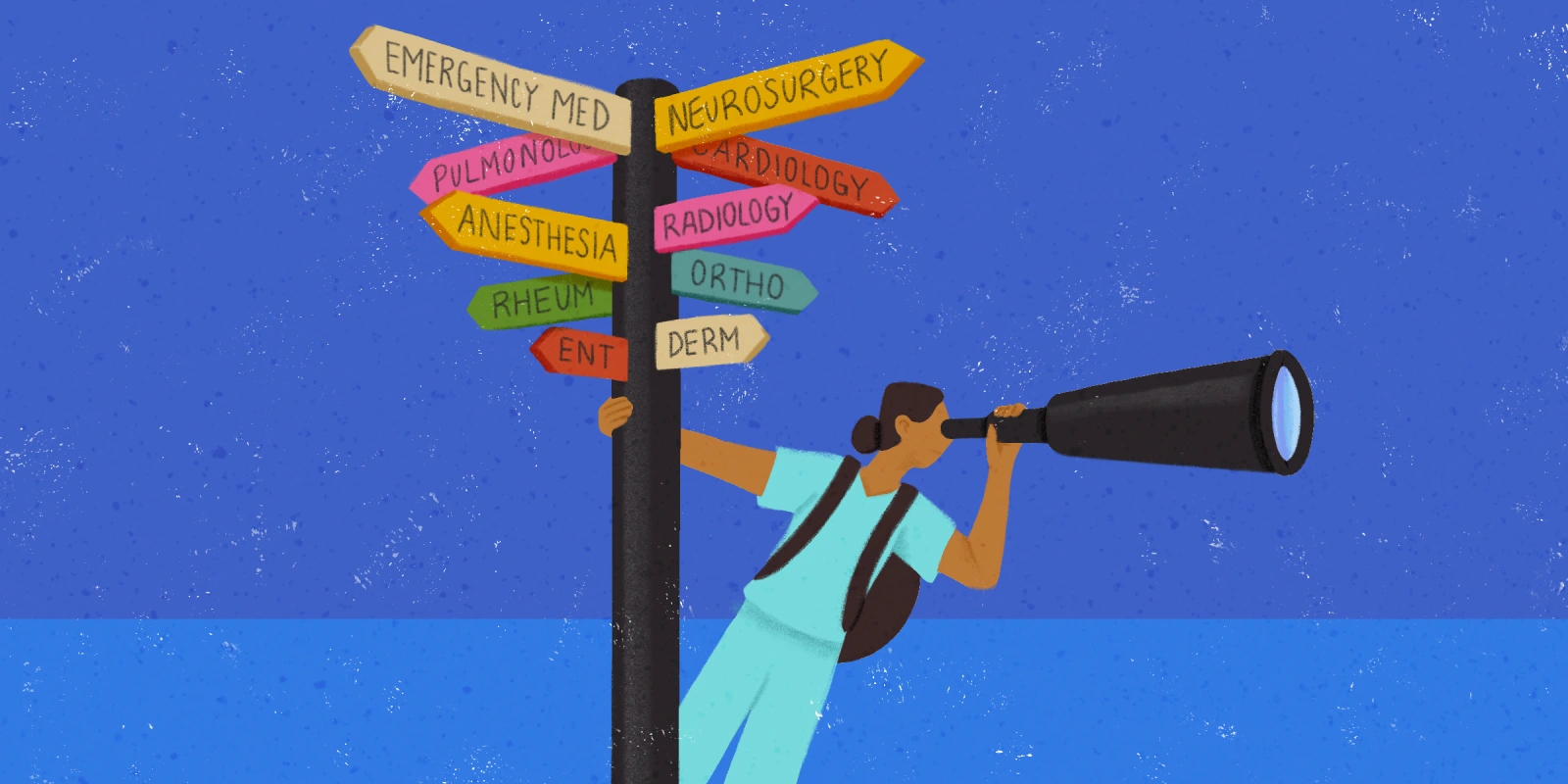

Medical education increasingly seems to suggest that students decide on the kind of physician they want to become quite early on. By the end of our pre-clinical years (or perhaps even earlier), we are encouraged to demonstrate a commitment to a specific specialty, either by shadowing, or by research and extracurriculars. As a medical student interested in neurosurgery, this early focus has become practical and even necessary in a sense as I look ahead to the competitive residency landscape. At the same time, it’s hard not to find this hyper-specialization limiting.
In my medical school, my classmates and I have a running joke that gently pushes back against the trend of early focus. When we sign up to attend on-campus simulation sessions or skill-building workshops that fall well outside of our intended fields — such as dermatology wound care clinics, emergency medicine point-of-care ultrasound talks, or fundamental anesthesia airway and intubation workshops — and see one another there, we laugh and refer to ourselves as aspiring “Renaissance scholars” (a playful reference to the idea of the intellectually versatile “Renaissance man”). The phrase captures our aspiration to build a strong foundation not only in the specialty that we hope to pursue, but also across the full spectrum of clinical medicine. For us, this training period is not just about leaning into our chosen specialty; it’s about becoming well-rounded, curious, adaptable, and engaged with the full scope of patient care.
Although the temptation is strong to spend our time optimizing for a future residency application, I urge my fellow med students to take a step back and focus on the opportunities medical school can afford us that the rest of a life in medicine cannot. As my teachers often wistfully remark, med school is the last true occasion that we have to experience the full breadth of the physician profession. Once we begin residency, our training understandably becomes more siloed. If I match into neurosurgery, for example (fingers crossed!), my formal interactions with the dermatology or ob/gyn worlds will likely become far more limited, filtered mostly through consults and patient handoffs rather than firsthand experience. As a result, the time to explore widely, ask naive questions, curiously practice unfamiliar tasks, and learn about how different disciplines think is now.
Notably, taking advantage of this relative freedom doesn’t equate to being unserious or even undecided. I personally know that I’ll be pursuing neuroscience. And yet, some of the most enriching experiences of my first year of medical school so far — from learning how to read an EKG to managing a complex wound — have occurred in settings seemingly unrelated to that path. Not only that, these experiences have sharpened my clinical reasoning skills, made me more comfortable with uncertainty, and, most importantly, reminded me that no specialty exists in isolation from the rest of medicine.
Ultimately, even though medical school offers us an environment where exploration is possible and built into the structure, it’s up to us to take advantage of it. Choosing to be a Renaissance scholar can feel daunting on the one hand and unproductive on the other, but I believe it has lasting benefits for a life in medicine. When we encounter diverse clinical presentations that draw on knowledge from across specialties, for example, it makes us move beyond narrow pattern recognition tied to a single field toward more flexible and integrative thinking. This becomes especially handy when we encounter patients with complex histories or presentations that do not fit neatly within one specialty’s boundaries, or even in time-sensitive and resource-limited settings where we may not be able to immediately consult with colleagues.
Further, when we learn how to perform general and focused physical exams, interpret EKGs and chest X-rays, and respond to critical situations, we are building competencies that matter regardless of specialty. A neurologist who is able to recognize dermatologic manifestations of a systemic disease, or an oncologist who is comfortable using a point-of-care ultrasound, can bring added value to care teams. Even if we do not utilize these cross-disciplinary skills on a day-to-day basis, physicians who can “speak the language” of multiple specialties when needed can become better collaborators. Having increased familiarity can help us understand our colleagues’ perspectives, anticipate their concerns, and communicate more effectively.
Cultivating curiosity outside of our intended field does not mean abandoning our focus or long-term goals. Rather, when we see ourselves first as well-trained generalist physicians and then as specialists, we acknowledge the reality that our patients do not present as specific organ systems or residency categories. I believe that there is an important mindset shift that comes with this perspective in medical school. Seeing ourselves as expert generalists first reframes medical school not merely as a stepping stone toward specialization, but as a formative period in which we work to build the core competencies of being a physician. Before we are neurologists, surgeons, pediatricians, or psychiatrists, we are clinicians who are responsible for caring for whole people. This mindset may be especially valuable in the pre-clinical years, when much of our learning is abstract and future-oriented. Engaging in hands-on training experiences in unfamiliar areas grounds our knowledge in real clinical contexts and helps counter the anxiety that can come with feeling unprepared or behind. Instead of asking, “Is this relevant to my future specialty?” we can ask: “What can this teach me about caring for patients?”
At the end of the day, we will never be able to master everything, but the goal of being a Renaissance scholar is to foster a mindset where we can be open to learning anything. By taking advantage of the breadth of the medical school training environment, we can prepare ourselves to be more thoughtful and adaptable physicians, regardless of where we ultimately end up. As we move toward increasingly specialized roles, holding onto our sense of broader curiosity may be one of the most important lessons that we carry with us.
What experiences from med school have been most enriching for you, regardless of where you ended up? Share in the comments!
Chinmayi Balusu is a medical student at the Kaiser Permanente Bernard J. Tyson School of Medicine in California. She is passionate about medical humanities, public health, and neuroethics, and hopes to pursue a career in neurosurgery. In her free time, she enjoys reading, practicing taekwondo, and watching South Indian (Telugu) movies. She tweets at @chinmayi_balusu. Chinmayi is a 2025–2026 Doximity Op-Med Fellow.
Illustration by Diana Connolly