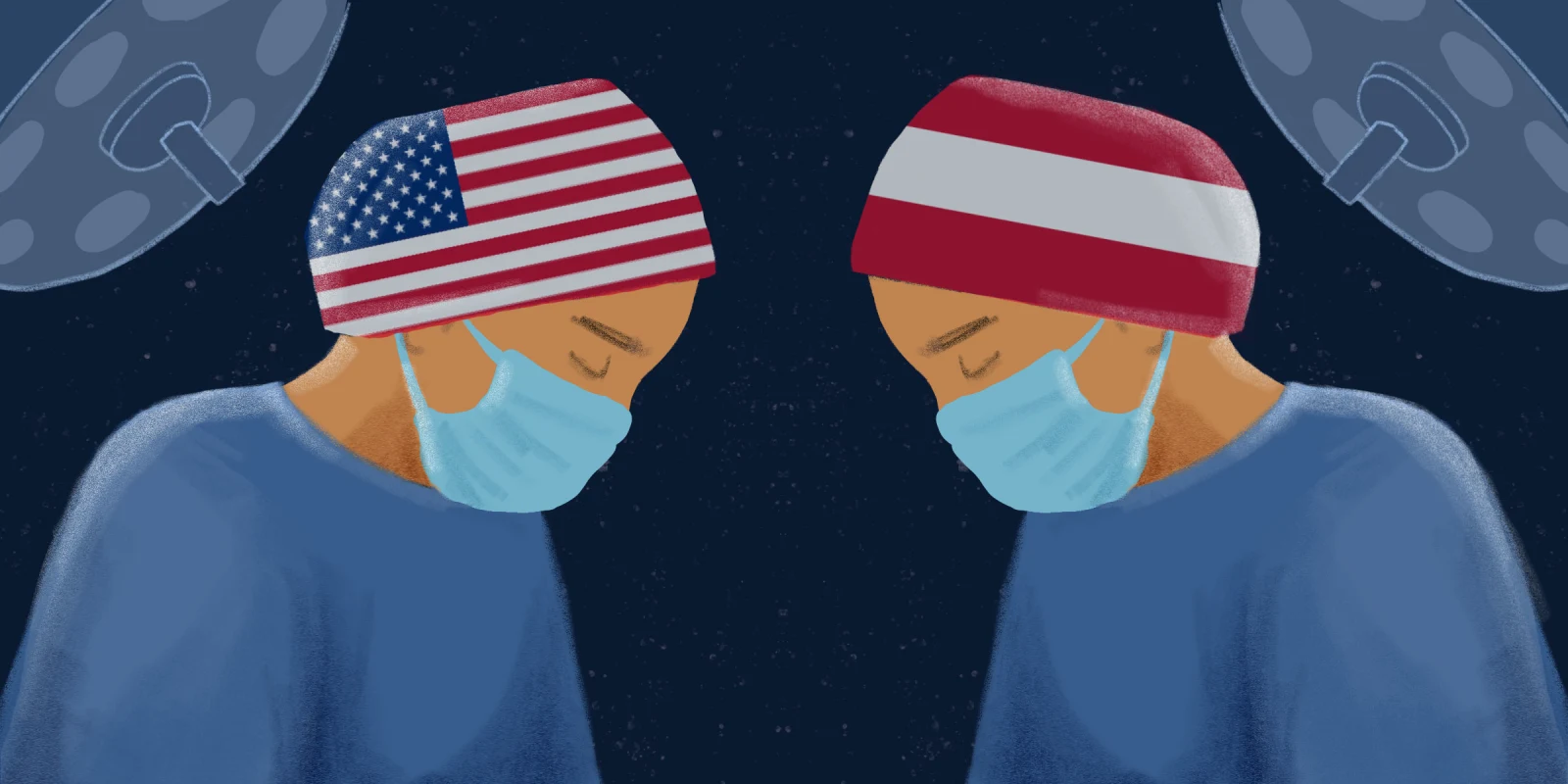

I recently arrived back in the U.S. from a sub-internship rotation in anesthesiology at a university hospital in Austria. Before heading abroad, I’d expected to enjoy the Viennoiserie in the hospital bakery and learn airway management and regional blocks. What I did not expect was a sustained meditation on what a healthcare system’s values look like when translated into daily practice. The contrasts I noticed between the Austrian and American ORs were not always dramatic, but they certainly led me to think more deeply about how medicine is practiced in the U.S.
The first thing I noticed about the Austrian OR was the pace, or rather, the deliberateness of it. In the U.S., a high-volume academic center can feel like a relay race. Attending anesthesiologists supervise several rooms simultaneously, residents run from induction to induction, CRNAs preside over cases, and the pressure to “turn the room” is constant and unspoken. Efficiency is a virtue; downtime is a liability. In Austria, the structure was similar: A supervising attending monitored about four ORs simultaneously and there was an attending or a resident assigned to each OR and present for the entire case. And yet, the atmosphere was much calmer than that of the U.S.: The Austrian physicians talked me through every decision, corrected my technique without urgency, and answered my questions patiently. Their OR felt, in the best sense, like a classroom. I watched a difficult intubation managed with an unhurried confidence that I have rarely seen stateside, where the clock is always running. It was hard to discern the source of this calmness — though the social insurance model, in which cost is not factored into the treatment equation and is therefore not an added stressor, may play a role.
Another significant divergence from U.S. norms lay in the expectations clinicians had of medical students. In Austria, I was a welcome observer and occasional participant, handed a laryngoscope when the attending judged me ready, asked thoughtful questions during cases, and invited to assist in procedures. At the same time, I was not expected to pre-round on a list of patients, present during rounds, or write notes worthy of hospital and insurance billing departments. The Austrian system seemed to treat the clinical year of medical school as a period of supervised observation with gradually increasing responsibility. Back home, fourth-year sub-interns are frequently functioning as intern-equivalents: suggesting medications, fielding calls, and making real-time decisions that residents or attendings then co-sign. I could see the benefits of each system, as the Austrian way allows students to learn without judgment or pressure. The American way pushes students to dig deeper into the complexities of navigating healthcare earlier on in our careers, making us capable and adept early on.
A further difference between American and Austrian medicine was the degree of work-life balance. In Austria, my days started at 7:30 a.m. and ended at 12:30 p.m — a far cry from the long working days for U.S. students. In speaking to Austrian medical students, one told me that she only worked in the hospital four days per week and her days were much shorter than the average U.S.-based medical student. This goes for residents and attendings as well: the European Working Time Directive legally caps residents in Austria at 48 hours per week, and attendings at 60 hours per week. Despite this, I heard from many anesthesiology attendings and residents that they regularly worked significantly longer hours that were more on par with U.S. physician and resident working hours.
Then there is the question of access, which was arguably the sharpest point of contrast between the countries. As mentioned above, Austria operates on a social health insurance model through which nearly the entire population is covered, and patients do not receive an itemized bill after a hospitalization. The concept of a patient refusing a recommended procedure because of cost is not part of the clinical calculus there. In the U.S., I have participated in conversations where the care plan was shaped, explicitly or implicitly, by what the patient could afford or what their insurer would authorize. The Austrian system has its own inefficiencies, such as long waits for certain specialists, and occasional resource constraints, but the baseline assumption is that a person who needs care will receive it.
This experience ultimately clarified what I value in medical training and what I hope to carry forward into my own practice. From Austria, I take the lesson that learning thrives in environments where time is protected, questions are welcomed, and patient care is not constantly subordinated to throughput. I hope to model that for future students and colleagues: to teach deliberately, to slow down when it matters, and to create space for curiosity without fear of inefficiency. At the same time, I recognize the strengths of the U.S. system, which are its rigor, early autonomy, and emphasis on clinical ownership, and would not want to lose those qualities. The challenge, then, is not to choose one system over the other, but to integrate the best of both.
What I would like to see more of in the U.S. is a structural commitment to protected learning time, reduced administrative/charting burden on residents, and a re-centering of care around patient need rather than billing complexity. Expanding access to care must also be a priority. While Austria’s system is not without tradeoffs, its baseline assumption that patients should receive care regardless of cost is something worth striving toward. In the U.S., there are already organizations such as the Primary Care Collaborative and the National Association of Community Health Centers working toward these goals, including advocating for universal coverage models, value-based care, and primary care expansion. Efforts to reduce documentation burden, invest in team-based care, and pilot alternative payment models all represent steps in this direction, though progress remains uneven.
The urgency for reform in U.S. medicine is multifactorial. A growing physician shortage, particularly in primary care and rural areas, threatens access to timely care. Most of the patients I saw in Vienna were miles healthier than those I frequently see in the U.S., regardless of age. Even those deemed “extremely sick” by anesthesiologists in Vienna seemed somewhat healthier than many patients in the U.S. The U.S. system remains heavily weighted toward intervention rather than prevention, contributing to higher long-term costs and worse population health outcomes. Administrative complexity and burnout further strain the workforce, creating a cycle that is difficult to break. These pressures are not abstract; they shape the daily experiences of both patients and clinicians.
Neither system is a utopia. Both systems produce extraordinary research, attract global talent, and can mobilize resources when needed. The surgery cases I watched in Austria were excellent; the surgery cases I have watched at home were also excellent. The science is not so different. What is different is the scaffolding around the science. The culture, the training length, the pace, and the expectations placed on learners all contribute to such an environment.
This rotation was made possible by the Max Kade Clinical Clerkship at the Medical University of Vienna.
Have you ever practiced medicine abroad? What did you learn? Share in the comments!
Sidhvi Reddy is a fourth-year medical student in Birmingham, AL. She enjoys reading, traveling, cooking, and trying out new restaurants. Sidhvi is a 2025–2026 Doximity Op-Med Fellow.
Illustration by Diana Connolly