
Before I was a doctor, I was an athlete. I think many of us in the medical field are athletes before we are physicians. It may have started with youth soccer or high school basketball. For me, it was tennis, then triathlons, and collegiate track and cross country running. I loved every sport, or in the case of triathlons, all three of them. It’s been two decades since I first picked up a tennis racket, and I’ve been thinking of how being an athlete first informed my medical training and clinical practice in EM.
Rehearsal
When I think of sports, and running or endurance sports in particular, there is no substitute for practice. Sure, there is a degree of innate ability, but beyond that, the scope of one’s abilities relies on commitment to the sport. The same holds true for medicine. Though we take numerous tests to determine preparedness for independent practice, residency is ultimately where we put in our hours and get our repetition. In EM, this meant seeing as many patients as possible in my nine-hour shifts, and working long hours on the critical care units and in the trauma bay, seeing patient after patient. My only 24-hour rotations in residency were on a trauma unit where patients arrived nearly every 30 minutes, day or night, in varying degrees of distress and physiologic decompensation. As residents, we took turns leading each trauma resuscitation, following ATLS (Advanced Trauma Life Support) until it was second nature. While I do not generally endorse 24-hour rotations, it was only after I had been on my feet for 25 hours (being the unfortunate recipient of a Daylight Saving shift) and was able to, in the same rote way one might button a shirt in the dark, care for an unstable patient who had just fallen 20 feet from a roof, that I understood I was training muscle memory and recognition in the race to save lives.
Humility
While there are no shortcuts in sports, one of the quickest ways to get better is playing with people slightly above your skill level. In high school, that meant trying to keep up with the varsity track team as a freshman or completing pool workouts with actual swimmers, not just triathletes like myself, who viewed the swimming portion as a test of one’s resiliency to drowning. More often than not, it meant running behind the pack or being put in the slower swimming lane — that is, until I got faster. The reality is, after decades in school, you are no longer surrounded by people who have made it their career to teach you. However, there are teachers all around you, if you look, and have the humility to ask. One of the gifts and challenges of my job is my reliance on colleagues in other specialties. While I believe this goes for all specialties, it is particularly applicable in EM, where our “specialization” is recognizing a broad swath of medical conditions that can lead to significant morbidity or mortality. Overwhelmingly, I’ve found that if I ask for clarification on a diagnosis or treatment plan, my colleagues are happy to oblige. It leads to better consultations, improved patient care, and lifelong learning — as long as I keep asking.
Resiliency
I sat on the side of the road, 20 miles into a 56 mile bike ride with 1.2 miles of swimming behind me and a half-marathon ahead of me, waiting for my dad to return with a new tire. I watched as my competitors sped past me on their fully pressurized, untarnished bike wheels. Mine had hit a small nail and lay deflated like a dead snake. What’s funny is that I remember this event, and then I remember completing my first half-Ironman — in complete isolation from each other. That is to say, the success of finishing clearly overshadowed any setbacks I had along the way.
Clinical practice, and perhaps in particular an EM shift, can be a lot like a race. You train for it, with years of residency and clinical practice, and prepare as well as you can for your best performance — day after day. And yet, ride enough bikes, care for enough patients, and inevitably, there will be less-than-desirable outcomes. So we keep training, keep studying, keep improving in incremental ways day by day, and hope not for fewer metaphorical road blocks, which we cannot change or foresee, but for more agility to move around them and keep riding.
Teamwork
Even in sports where success seems contingent on individual performance, early on, I realized that it was a collective effort that helped me reach those goals. In tennis, the quality of a practice session depends on your coach and training partner. Though cross country appears on the surface to be an individual sport, there are innumerable track workouts and early morning training runs that would have felt insurmountable if not for my teammates' company. Sometimes, being single coverage in a rural community hospital can feel like an individual sport, too. That is, until I think about the last time I started an IV or primed a line. It’s the sickest patients that make me most grateful for the team of nurses and technicians that I work with. Every cardiac arrest is a chance to put our teamwork into play: with predetermined roles such as leader, timekeeper, and compression monitor, it’s like a run on a football field we’ve rehearsed numerous times, where winning means saving a life.
Gratification
In other words, what keeps you coming back. If training for medicine or sports is a black sky, then these moments are the stars. The last time you finished a race. Had a satisfying practice coming off an injury or illness. Lifted a weight that you had once thought too heavy. Had a good patient outcome. Had a patient thank you. Had a patient remember you. Felt like you changed someone’s life for the better. Felt like a good doctor. Inevitably, there are moments, days, and even months during residency training where you forget why you do what you do, feelings reduced to a spectrum from tired to hungry. However, these moments comprise constellations you can trace across a career made visible by the canvas of an ink-black sky.
If you were an athlete before you were in medicine, what did you learn? Share in the comments.
Liana Meffert is an emergency medicine physician in Wisconsin. Her writing has been featured in JAMA, The Lancet, The Maine Review, SWWIM, and X-R-A-Y, among others. You can find more of her work at LianaMeffert.com. All views expressed are her own. Dr. Meffert is a 2025–2026 Doximity Op-Med Fellow.
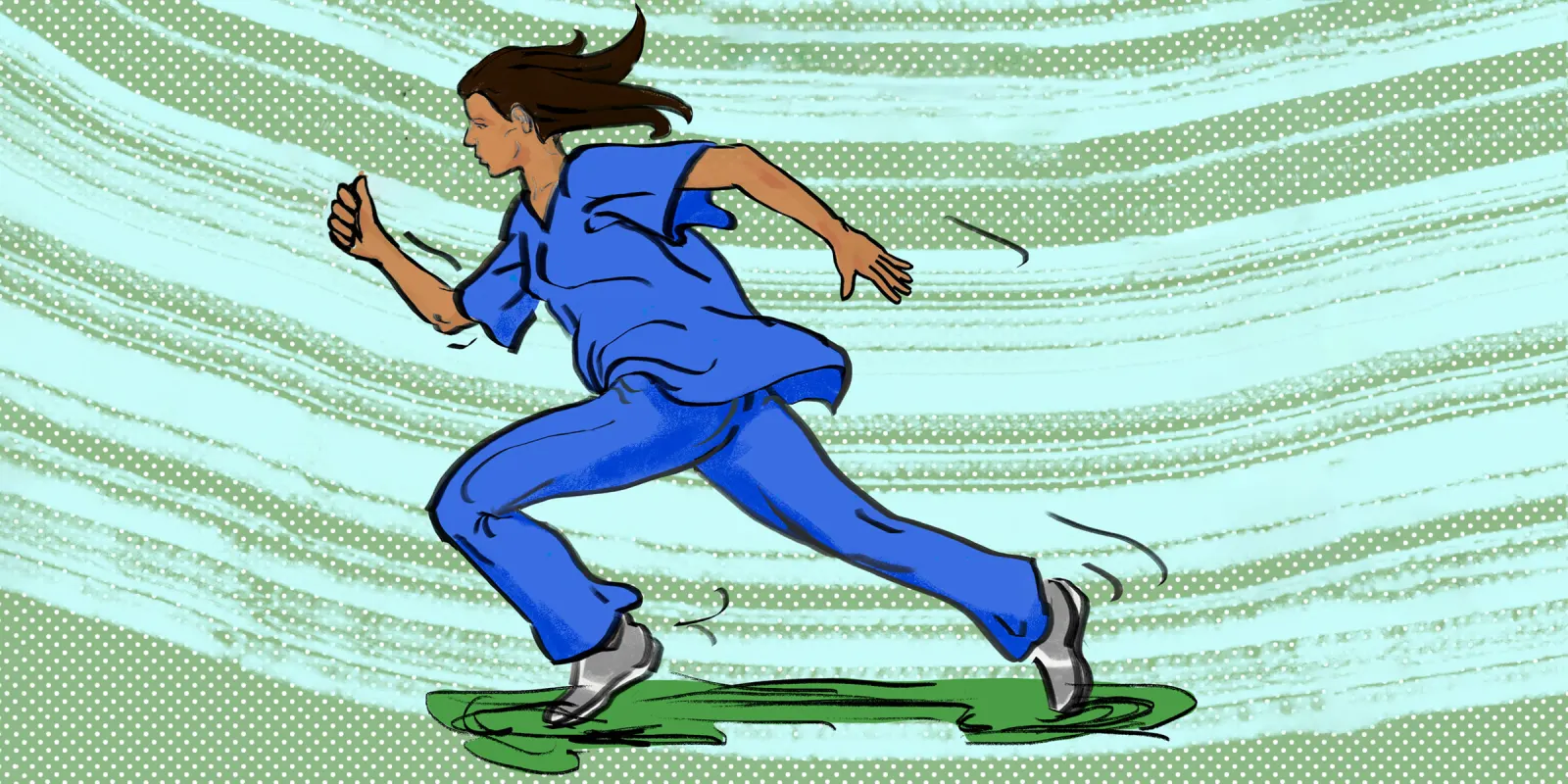
Illustration by Jennifer Bogartz