
The habits that made him an excellent physician were hollowing him out. He still believed that if he moved fast enough, nothing could catch him.
I had seen his posture before. In patients. In colleagues. In trainees. In myself. It was a posture medicine had taught both of us to admire: be quick on your feet, think ahead, anticipate. Control is competence. He had learned, through repetition and reinforcement, that time bends to those disciplined enough to control it. His career was built on that belief. So was his identity. He was there because advanced cancer was steadily eroding a belief he had never taken the time to examine.
In psycho-oncology, I see this often. One day, life moves forward predictably. The next, the horizon closes. The calendar turns. The clock ticks. But inside, time behaves differently. The future shrinks. Time is being rewritten.
What happens to the assumption of endless tomorrows? To the belief that effort guarantees outcome? To the idea, reinforced by medicine, that moving faster makes things safer?
In terminally ill patients, those questions often arrive abruptly. I have seen versions of that reckoning in hospitals and clinics unfold much more gradually. Sometimes we call it exhaustion. Other times we call it work-life imbalance. By the time we name it, the shift has often already occurred. Presence deferred for duty, meaning postponed for service, life treated as something we will return to later.
He was not unique. He was in the middle of it. But he did not fall apart. He did what medicine trains us to do.
“I don’t have time for a lot of talking,” he said, leaning forward. “I need to know what’s next. How fast can we fix this?” His eyes burned with fear wearing the mask of fury. “I’ve got two young daughters, a wife working full-time, a mother who depends on me. I can’t slow down. I can’t waste time. I need solutions. I need to turn this around right now.”
It’s always striking how illness exposes the deeper architecture of a person’s life. People often misunderstand anger in terminal illness. It’s rarely hostility. It’s grief’s first language. It’s the psyche refusing to accept collapse. It’s the last defense against the unbearable truth that control has limits. He wasn’t just grieving the potential loss of years; he was grieving the collapse of an identity built around control.
The urgency was not foreign to me. I have heard it in hospital corridors, in faculty meetings, and in myself. In trainees who cannot step away. In colleagues who measure worth by productivity. The language is different, but the architecture is familiar.
The question — if productivity disappears, what remains? — is not unique to patients. Anyone trained in modern medicine knows it intimately, even if we rarely allow ourselves to ask it out loud. When the language of performance begins to fail, the search for meaning can feel disorienting. It becomes easy to focus on what is broken.
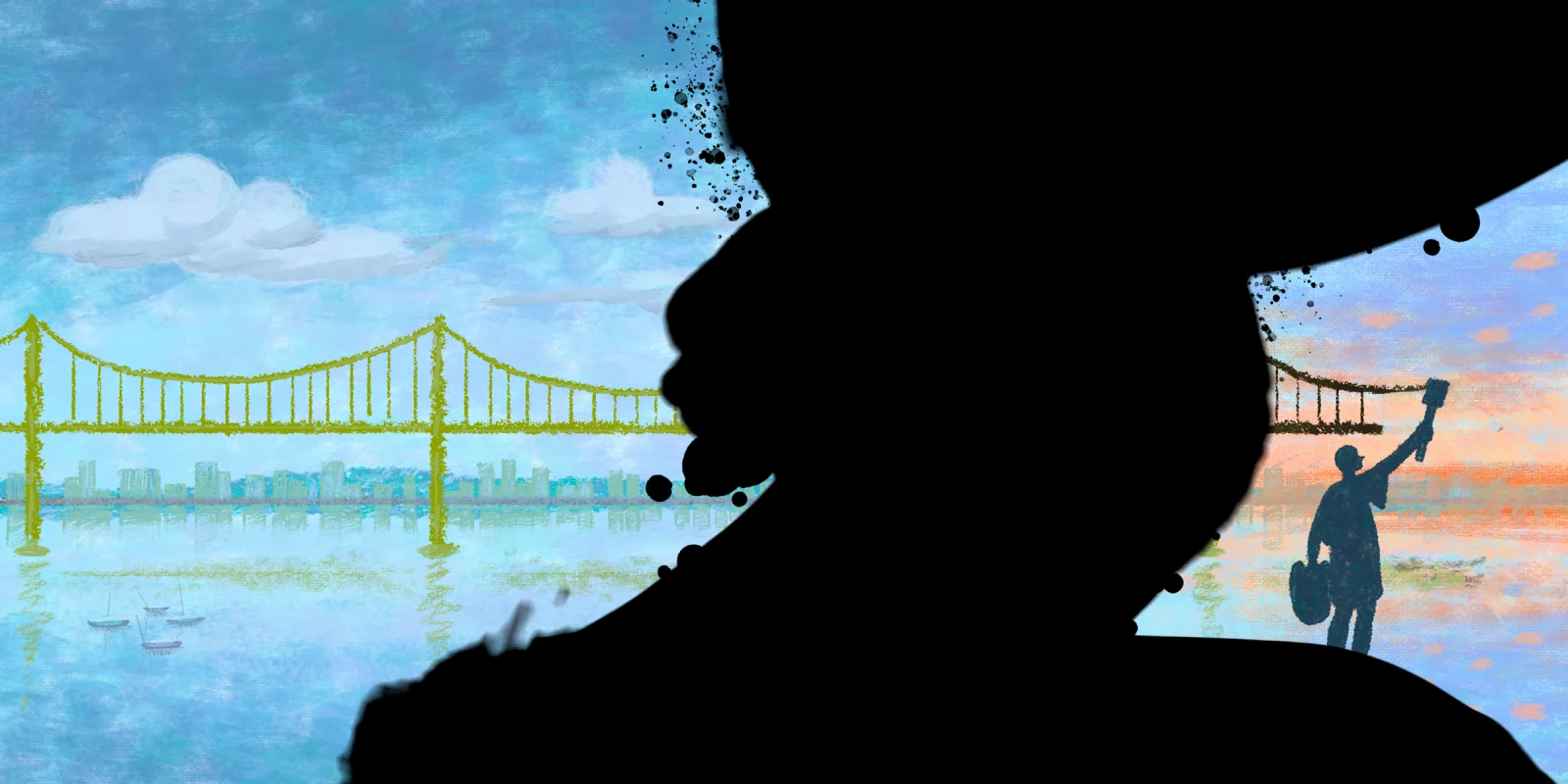
But would we ever stand before a Van Gogh and reduce it to a single dark stroke? Imagine a life as a painting. A canvas holding bright colors and dull ones. Bold strokes beside careful detail. Some parts demand attention at once. Others reveal themselves only if you stay.
Now imagine a blot interrupting the composition. Dark. Irregular. Impossible to ignore.
It would be a tragedy to stand before the painting and see only the blot. And yet illness invites exactly that, collapsing a life into a diagnosis, a prognosis, a shadow that eclipses everything else. While you are alive, the painting is unfinished. The brush remains in your hand. You may not be able to erase the blot. But you still choose what surrounds it. Where to add a few more strokes. Which colors to choose. Where to deepen contrast. Where to leave space.
That agency matters more than we often realize.
This is where medical training often stops looking at the whole picture. We focus on the blot, name it, measure it, treat it, and track it. Far less attention is given to the rest of the canvas, or to the person still holding the brush. Because meaning is not found by denying the blot. It emerges in the space that remains around it, in the choices that are still possible even as the future narrows.
When illness strips away control, what remains is the freedom to choose how one meets the moment. Many patients arrive believing their role has ended, that the remainder of their lives will be managed by doctors, treatments, scans, and schedules. The work, instead, is in realigning agency, attention, and presence.
A few sessions later, something subtle shifted. He still carried anger, but it no longer snapped at the edges of his words. The thunder of his emotions moved farther in the distance. The desperation softened into something more contemplative.
“You know,” he said one morning, “Yesterday … I sat with my daughters. And for once, I wasn’t thinking about how much time we had left. I was just … there.”
In another session, he told me about the way one daughter pronounces the word cinnamon — still with an extra “m.” Or how his younger one presses her cheek into his chest when she hugs him. “I didn’t know moments could stretch.” He smiled faintly.
These are not grand gestures. They are small, deliberate acts of orientation. Over time, they alter the painting not by removing the illness, but by changing how it is held. Years later, the same painting can look different. The blot may no longer dominate the view. It may not only tell a story of loss, but of intention, dignity, and meaning forged under constraint.
This is the quiet truth. Meaning is not erased by suffering. It is often concentrated by it.
From the earliest days of training, medicine rewards urgency, efficiency, and mastery over time. We learn to measure time relentlessly, to compress it, to conquer it, and to move through it as quickly as possible. Time stops being something we live inside. It becomes something we manage. The cost of that orientation is not immediately obvious. It becomes visible only in certain rooms, with certain patients, where time can no longer be optimized and effort no longer guarantees outcome.
In medicine, we learn quietly and thoroughly that time is an adversary to be conquered. We compress visits. We move briskly from problem to problem. We are evaluated on throughput, documentation, inboxes cleared, and metrics met. Presence does not register on a dashboard. Attention does not scale. Silence looks inefficient.
Over time, clinicians begin to experience their own days the way the system experiences a clinic schedule: as a sequence of tasks to survive. Meaning gets deferred. Presence gets postponed. Always to the next visit. The next note. The next task.
But paradoxically, the care that feels slower in the room is often the care that spares the most suffering. Not because it is sentimental, but because it is attentive. Because it allows values to surface. Because it recognizes that time lived well is itself an outcome.
Presence rarely announces itself. It arrives in small permissions: to pause, to notice, to remain. A slowing of internal speed. A widening of awareness. A softening of urgency. Patients facing mortality often say that illness simplifies life, not by diminishing it, but by stripping away the unnecessary. What remains is what always mattered.
The unsettling question is whether medicine needs a terminal diagnosis to learn the same lesson.
Fawad Taj, MD is an assistant professor of psychiatry at Case Western Reserve University and a psychiatrist at University Hospitals of Cleveland with over a decade of experience in psycho-oncology, emergency psychiatry, and serious mental illness. His leadership lies at the intersection of mental health, policy, and community advocacy. Dr. Taj is a 2025–2026 Doximity Op-Med Fellow.
Illustration by Jennifer Bogartz