
I have been thinking lately about the quandaries we face as physicians — the life‑and‑death decisions made for patients, with patients, and with their families too. Often we are appreciated for our expertise and our skill, but sometimes even that is called into question. I vividly remember, as a family medicine resident, giving appropriate wait‑and‑watch advice with OTC measures for a benign condition. The patient said, “I have never been to the doctor before and they didn't do something for me.”
Since that experience, I have had the honor of training medical students and medical residents, and because of that visit, I emphasized that the most important work they were doing for their patients was between their ears. Ultimately, even if they were not writing a prescription or offering therapy, they were still doing work. However, it was their bedside manner that built trust.
But even the best communicators with the most amazing bedside manner still have those days when patients are angry — angry because they’re sick or because they’re scared; angry because you didn't give them what they wanted, or angry because you did give them what they needed but they didn't want it. Then, to complicate things, we have social media influencers and pharmaceutical ads that plant ideas in patients’ heads that are difficult to root out, let alone constructively discuss.
Perhaps even more difficult than all of this is the fact that sometimes treatments don't need to be given, and sometimes they do. At times, the decision to treat is absolutely clear — it must be administered — yet sometimes it is not. And sometimes we treat folks just to help them feel better, to ease the symptoms. Treatments themselves also come with lasting consequences, many of which are good, some of which are equivocal, and some of which are not so good. Yet even when the side effects may be severe, we still must give the treatment because the patient is better off with it than without it, even if we would love for them to be able to do well without the treatment in the first place.
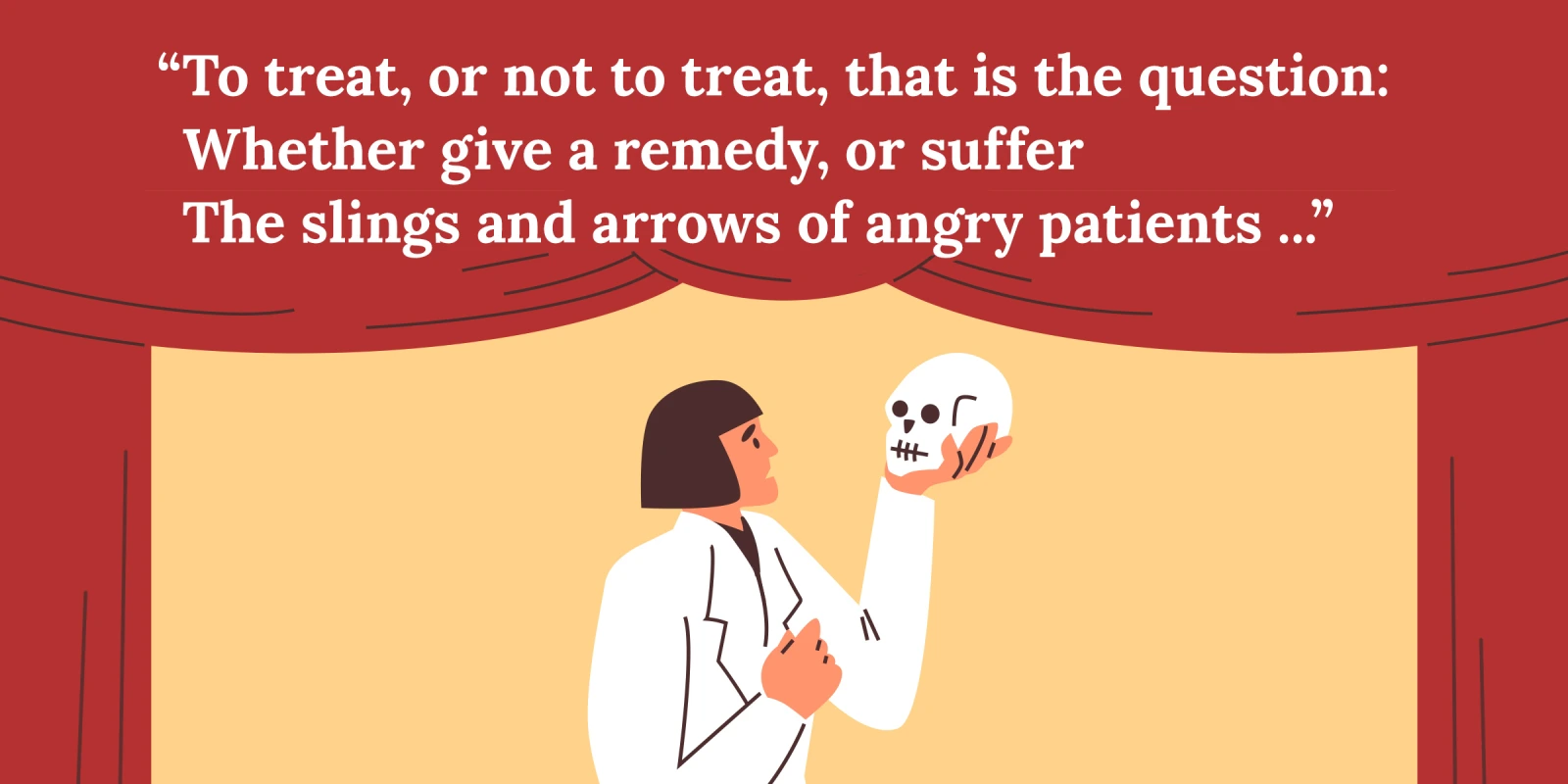
It is from this soul space that I wrote the following, in the spirit of William Shakespeare:
The Doctor's Soliloquy
To treat, or not to treat, that is the question:
Whether give a remedy, or suffer
The slings and arrows of angry patients,
Or to take arms against a sea of parents
And by not giving, thus anger them.
Or give — and gain a moment’s rest at day’s end.
The weakness and the thousand ailments
That flesh is heir to — is a drug the cure?
Devoutly to be wish’d?
Not that which cures, but that which calms;
To calm, perchance all day — ay, there’s the rub:
For even in that peace, trouble may abide,
While we shuffle through the pill’d expanse,
This must give us pause: there are the effects
That makes calam’ty of many a dose.
For who would bear the whips and scorns of harm —
When treatment goes awry, and allergies insult,
The pangs of nausea and the void’s delay,
The laboring of breath, and eruptions
That bubble forth upon the supple peel?
Yet though he might his wanted comfort make
Without antidote, Why should they burdens bear,
To grunt and sweat under a weary ill,
When relief may come from but a pastille?
The discover’d ministration now made known —
Now grown familiar, puzzles no more.
And aids our bearing those ills we have
And perchance others we yet know not of.
Thus therapy makes convalescents of us all,
And thus the native hue of cessation
Is paired with that pale cast bestowed by age —
And the relieved, with joy at this grand moment,
Their fate, for but a moment, turned away,
Gladly do they greet another day.