
The year was 2008, and we were gathered on the fourth floor of a teaching hospital in western Nepal. For a group of third-year medical students, time seemed to pause as the professor scanned our faces and asked, “Who is ready to examine the patient?”
The open ward hummed with the noise of ceiling fans recirculating the warm summer air, carrying the faint smell of chlorine. A student had just completed presenting a detailed history of a patient with shortness of breath and cough; a history carefully crafted, then systematically questioned and refined by the very professor who now waited for a volunteer. With his slightly thinning gray hair, round gold-rimmed glasses, and calm, kind demeanor, the professor had nothing intimidating about him. Seated about 6 feet from the patient, he was surrounded by 15 nervous students, fully aware of our collective unease. He said, “Ranju, why don’t you go through the exam?” Stepping forward, I began to examine.
The man — a lean, sun-darkened farmer in his 50s — sat shirtless, mildly amused by the spectacle. He was there with consent and looked comfortable. And so began a dialogue; Socratic questions, probing, detailed, and unhurried. With each pause, our professor gently steered our gaze: “Look again — are the ribs normal?” Our observations expanded: a prominent intercostal space, a barrel-shaped chest, subtle signs of chronic lung disease. We moved through palpation, percussion, and auscultation, layering signs until the diagnosis: COPD with left-sided pleural effusion.
These case-based teachings shaped the foundation of my clinical learning. They formed mental maps; starting with the patient, integrating basic science, anatomy, and pathophysiology, differential diagnosis, and returning, always, to the bedside — the cultivation of critical thinking. The art of questioning, of revising one’s hypotheses in light of new findings, of applying knowledge to solve a real person’s problem — that was the essence of clinical education as I knew it.
This archetype of clinical teaching — teacher, patient, learner, and the shared pursuit of diagnosis — was emblematic of 20th-century medicine. It grew from a key milestone in medical education like the Flexner Report of 1910 (though the report had some negative impacts and still has longstanding repercussions on health equity and equitable training opportunities) which improved medical education and clinical training standards. Students learned by observing, imitating, and gradually participating, with the implicit promise that time and exposure would forge competence. By the end of the 20th century, the landscape of clinical education began to shift, medicine became more complex, more technological. Competency-based frameworks emerged. The ACGME core competencies and CanMEDS roles reflected this shift. But simulated interpersonal skills and examination are not the same as the real patient experience. ACGME requirements of directly observing clinical skills is not enforced; it is left to the program, and to the individual filling out the form. It is rarely done systematically with all trainees. It has become an assumption that everyone can perform these skills.
In the 21st century, technology has transformed our teaching tools as well, the least of which being PowerPoint replacing chalk talks. Simulations offer safe spaces to learn procedures and manage emergencies. The increasing demands of clinical productivity and documentation have placed new pressures on faculty, often reducing the time and attention they can devote to teaching. Today, we are well-versed in adult learning theory and andragogy, and many universities offer faculty development programs built around fixed curricula. Our teaching objectives are "SMARTer," but this ocean of teaching methodology still risks missing the deeper goal: cultivating critical thinking and connection. And now, as AI gains ground in education and clinical care, I wonder: Will reasoning itself be ceded to algorithms?
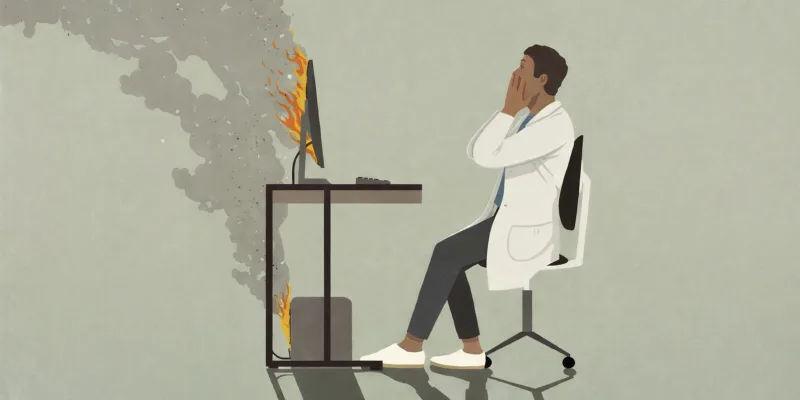
As I moved through my career and across continents, I realized new technologies were both friend and foe. The tactile, human connection of bedside teaching sometimes gave way to the sterile glow of screens. These days, the patient is "known" to the student before the exam begins, since they scan the chart before they go to see the patient. This "inverted" patient experience makes a fresh history rare. A similar bias enters the physical examination part (if it is done at all) with findings being reported only if previously recorded in the chart. Indeed, poor bedside examination skills are so common that they are the new norm. The intern who once called a consultant for a consult now sends a message through the EMR. When a dialogue is replaced by typed recommendations, I think about the missed opportunity for an intern to learn. And here is how apprenticeships have changed in this era — in a similar COPD patient, now imaging is done promptly but without knowing what an S3 gallop rhythm or what a loud P2 is. Recently, a fourth-year medical student in my hematology clinic was thrilled to do a lymph node exam and palpate a spleen in a patient for the very first time.
I am concerned about the future of medical training — about the missed bedside learning opportunities, lack of critical thinking from the point we lay eyes on a patient, missed interpersonal relationship between patient and doctors, and in between specialties, and human-focused communication and collaboration. I am concerned about losing the very art of medicine: a human connection.
The pedagogy of clinical medicine stands at a crossroads with unprecedented tools. Will technologies take away the art of medicine and the ability of the new generation physicians to think deeply? Is the power of debate and the exchange of point-counterpoints replaceable by EMR and algorithms? The answers will not come from any single reform. They will require reflection, collaboration, and a renewed commitment to the art of clinical teaching that unites science, compassion, and the shared pursuit of wisdom at the bedside and beyond. The philosophy of medical education is rooted in critical thinking, and the heart of medical education lies in reasoning, judgment, and thoughtful action. The modern technologies have their pros but the risks they pose to training the next generation are undeniable. When we are aware that technologies can fail, and the analysis/reasoning/output of AI can be flawed, we can teach our next generation to be independent critical thinkers. We work together with AI, but should not be dependent on it. Moreover, the emotional connection of the doctor-patient relationship will never be replaced by AI, and we thus are responsible for training future doctors who are empathetic with independent reasoning capacities.