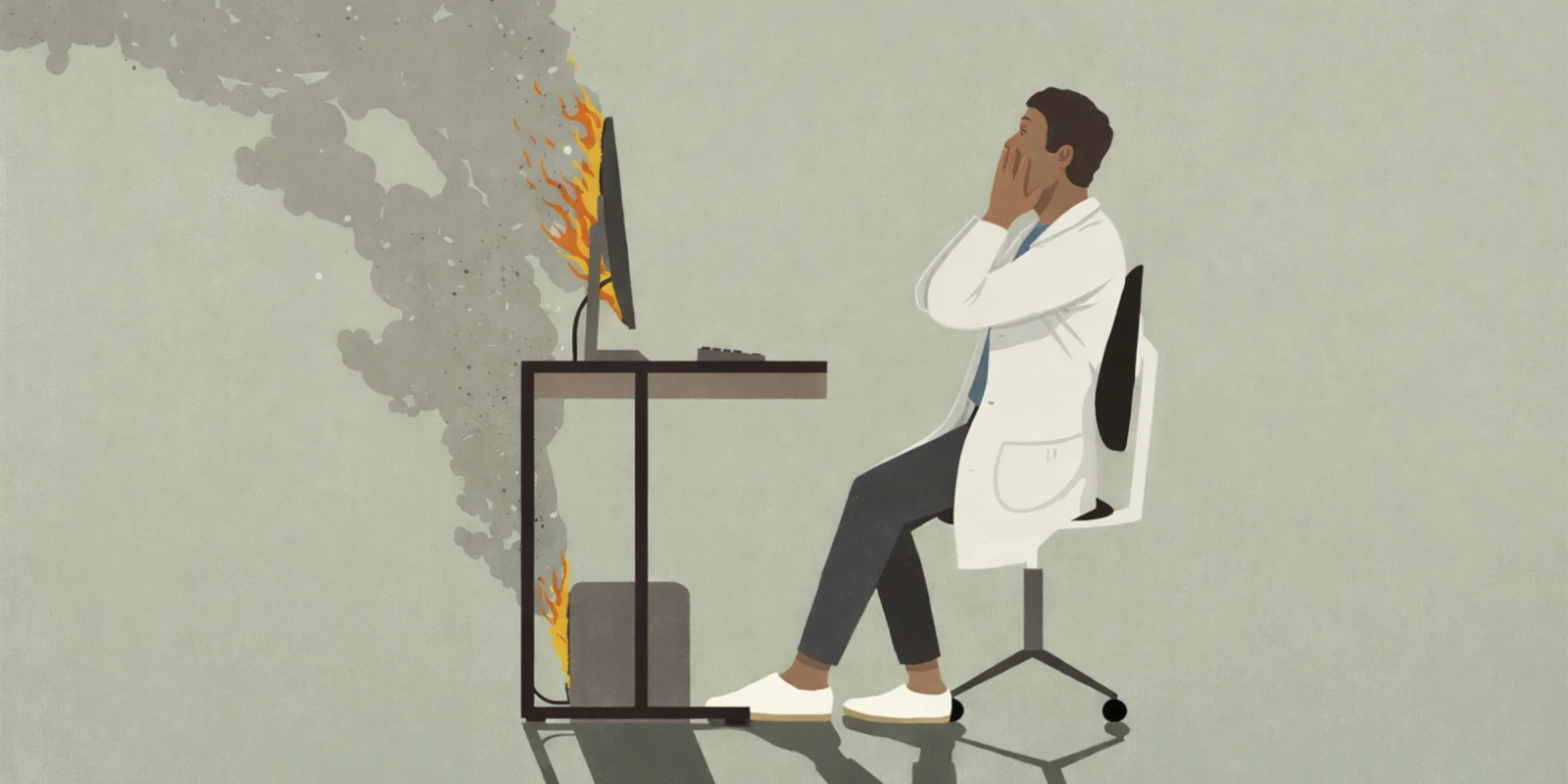

EHRs were supposed to be tools that would improve our work, but instead they have transformed physicians into data-entry clerks in a bureaucratic clinical-industrial complex, with evidence showing screen time exceeding patient-facing time. And here (yawn) is yet another essay decrying poorly designed EHRs.
But my gripe is how the EHR, specifically computerized provider order entry (CPOE), has eroded delegation.
Nearly every hospital and physician practice now uses an EHR, and physicians report that they spend more time interacting with computers than with patients. The increase in workload is commonly attributed to excessive documentation requirements, extensive checkboxes, and poor software usability. However, the slow disappearance of delegation has also increased the physician workload. The physician has become the bottleneck for numerous tasks previously handled by office staff.
Rather than enabling physicians to practice at the top of their license, the modern EHR requires them to perform work that was historically — and appropriately — distributed across the healthcare team. The physician is now standing alone, shackled to the computer, doing everything themselves.
Before EHRs, physician offices functioned as coordinated teams. A physician saw and examined the patient, and then made clinical decisions. Trained staff carried out many of the physician's intentions and orders. Paper charts encouraged team-based work.
A nurse might telephone a prescription to the pharmacy after receiving verbal instructions. The receptionists and medical assistants prepared laboratory requisitions, scheduled imaging studies, and contacted outside facilities. Referral coordinators and back-office staff assembled records, completed insurance forms, and communicated with specialists. Receptionists managed appointment logistics and ensured paperwork reached the appropriate destination.
None of these activities required the physician to personally interact with multiple systems. The physician's expertise remained focused on diagnosis, treatment planning, and patient counseling.
Keep in mind, delegation was not equated with diminished oversight. The buck still stopped with the physician, who remained responsible for the clinical decision-making while relying on trained personnel to execute standardized workflows. This division of labor reflected a fundamental principle of efficiency: Highly trained professionals should spend their time performing tasks that uniquely require their expertise.
When I first started my practice in 2007, I could write a prescription and have it faxed to the pharmacy, or verbally instruct my staff who contacted the pharmacy to call it in. Today, electronic prescribing requires that I personally search medication databases, select formulations, choose pharmacies, review insurance formularies, respond to interaction alerts, acknowledge duplicate therapy warnings, satisfy controlled substance authentication requirements, and electronically transmit prescriptions. It can take between 14 and 62 clicks to electronically prescribe acetaminophen.
Although many of these safety features have their advantages, the cumulative effect is that a process previously shared among several team members has become centered on my keyboard work and mouse clicks. My day now looks like this:
MD: "I need a PET scan for this patient in three months before their next follow-up with me."
Staff: "OK, you need to order that yourself."
MD: "I need this patient to get a serum PSA before their next visit."
Staff: "OK, you need to order that yourself."
MD: "I need a prescription for ondansetron 4 mg every 8 hours as needed for nausea, dispense 42, three refills called in to Redwood Pharmacy."
Staff: "I can't do that anymore. You have to enter that electronically."
MD: "I need ..."
Staff: "You have to do that yourself."
Previously, if I wanted a brain MRI with IV contrast, I would walk to the receptionist and tell them what I wanted. My receptionist completed requisitions based on my instructions and sent them off for scheduling. With CPOE, I now must enter each radiology order individually, specify diagnoses supporting medical necessity, answer decision-support prompts (when my hospital required Appropriate Use Criteria for advanced diagnostic imaging), acknowledge electronic warnings, select the imaging protocols, identify the performing facility, select whether or not the patient is on metformin (you would think the EHR would autopopulate this), select whether or not the patient has an implanted cardiac device (like I would magically recall this for a brain tumor patient), and complete electronic signatures before the order can proceed.
These steps may individually require only seconds. Repeated dozens of times each day across hundreds of patients, they consume hours of physician attention.
In the inpatient setting, CPOE contributed to a redistribution of clerical work from support staff to physicians, which contributed to the disappearance of the unit clerk. Before CPOE, a physician would write orders. The unit clerk transcribed the orders, communicating with laboratory, radiology, pharmacy, dietary, and transport. Nurses would verify and implement the orders.
After CPOE, a physician would enter orders directly into the EHR. Orders would then be transmitted electronically to ancillary departments, resulting in the transcription function disappearing. Once the physician became the order-entry clerk, hospitals no longer needed nearly as many people whose primary responsibility was transcribing and routing orders. This, in turn, led hospitals to eliminate unit clerk positions during the 2000s and 2010s.
But perhaps no aspect of EHR implementation demonstrates the loss of delegation better than the physician inbox.
Prescription refill requests, laboratory questions, imaging notifications, insurance requests, prior authorizations, disability forms, pharmacy clarifications, patient messages, specialist correspondence, and automated reminders all arrive unfiltered in the physician's electronic inbox. And thanks to the 21st Century Cures Act, patients are now given free access to their laboratory and radiology reports without context (often before I am able to review them), leading to more frantic inbox questions when the results are misinterpreted.
Many of these items previously flowed through nursing staff or office personnel, who resolved straightforward requests according to standing protocols and escalated only those issues requiring physician judgment. Today, institutional policies, compliance requirements, and EHR design route these communications directly to physicians. Even when staff participate, many systems require physician acknowledgment or electronic signatures before work can be completed.
The result is that physicians perform increasing amounts of clerical triage in addition to their clinical responsibilities. And none of this work is counted in productivity metrics for employed physicians, despite the ability to quantify that work. If you are an independent practice, there is no CPT code for this work.
Every click represents an action that previously occurred through conversation, paper handling, or delegated staff activity; medication reconciliation, problem list maintenance, health maintenance reminders, quality reporting, billing documentation, clinical decision-support acknowledgments, electronic signatures, and inbox management.
EHR vendors designed systems emphasizing physician accountability. Regulatory compliance requires authenticated physician actions rather than delegated staff workflows. Then, malpractice concerns caused hospital organizations (not the Joint Commission or CMS) to require physicians to personally perform routine activities. Next, reimbursement requirements required documentation linking orders to diagnoses, quality metrics, and billing codes, making physician participation more extensive. Finally, software designers digitized existing paperwork without fundamentally redesigning workflows around team-based care.
The result is a paradox: electronic systems capable of automating complex transactions still require physicians to do everything themselves. And every minute spent navigating electronic workflows is a minute unavailable for listening to patients, performing physical examinations, discussing treatment options, or coordinating complex care.
And every time a physician is prohibited from delegating a task and told to go back to their cubicle (or office if they’re lucky enough to have one) with their tail between their legs to interface with a computer as a data-entry clerk, social isolation increases, while in-person interaction with a healthcare team diminishes. This cannot be good for workplace mental health.
But EHRs are here to stay, so the solution is not abandoning them. EHRs provide advantages, including legible documentation, immediate access to longitudinal records, verifiable electronic prescribing, population health management, and improved data availability from outside hospitals.
But we should restore the principle of appropriate delegation. Standing orders should permit trained nurses and medical assistants to initiate standardized laboratory testing, radiographic studies, and preventive care. Prescription refill protocols should allow staff to enter routine medications under physician-approved algorithms. The physician would still review and sign them, but the burden of initiating order entry would be removed.
Most importantly, future EHR design should begin with a fundamental question: Which member of the healthcare team is best suited to perform this task? Psst, it’s not always the physician.
Where in your daily workflow do you feel the loss of delegation most acutely? Share in the comments.