

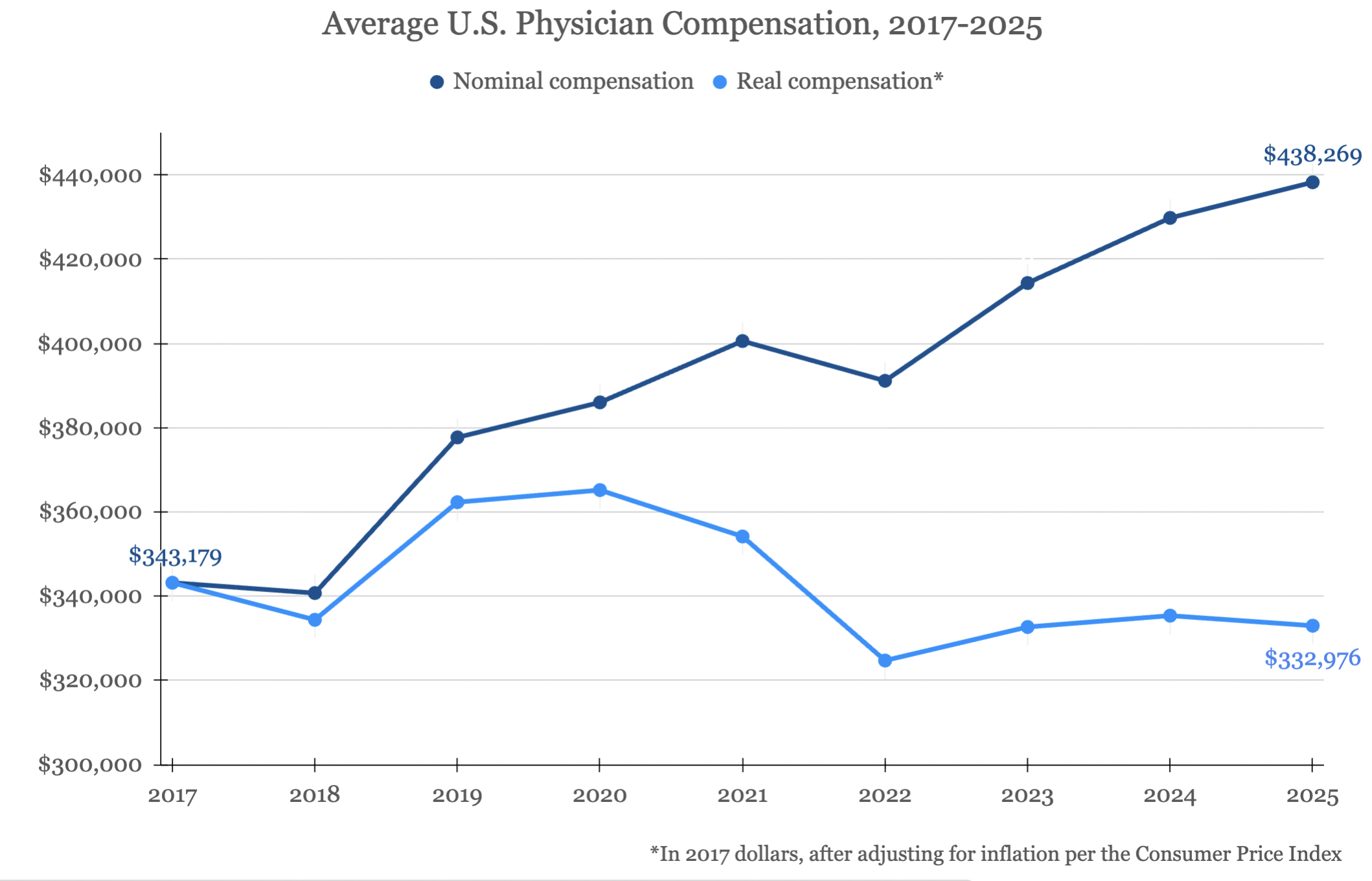
Average physician pay in 2025 was $438,269, an increase of 2% from the prior year, according to Doximity’s 2026 Physician Compensation Report.
The report confirms three consecutive years of growth for a profession with relatively high pay on average. After factoring in inflation, however, physicians’ real income and purchasing power have actually decreased since 2017. Physicians’ average real compensation was $332,976 in 2025, after adjusting for the U.S. Bureau of Labor Statistics’ Consumer Price Index (CPI) over the past eight years. This reflects a nearly 3% decrease in that period. The compensation report is based on surveys of more than 250,000 U.S. physicians who practice full time, including about 23,000 in 2025 alone.
Whether due to hospital consolidation, the corporatization of medicine, or falling insurance reimbursement, there are a multitude of factors that may be contributing to this lag in physician pay, said Shruti Mutalik, MD, a psychiatrist at the Icahn School of Medicine at Mount Sinai Hospital.
“It's all part of the broader culture of gaslighting doctors into believing they are worth less than what they are truly worth,” Dr. Mutalik said.
Pay by Specialty
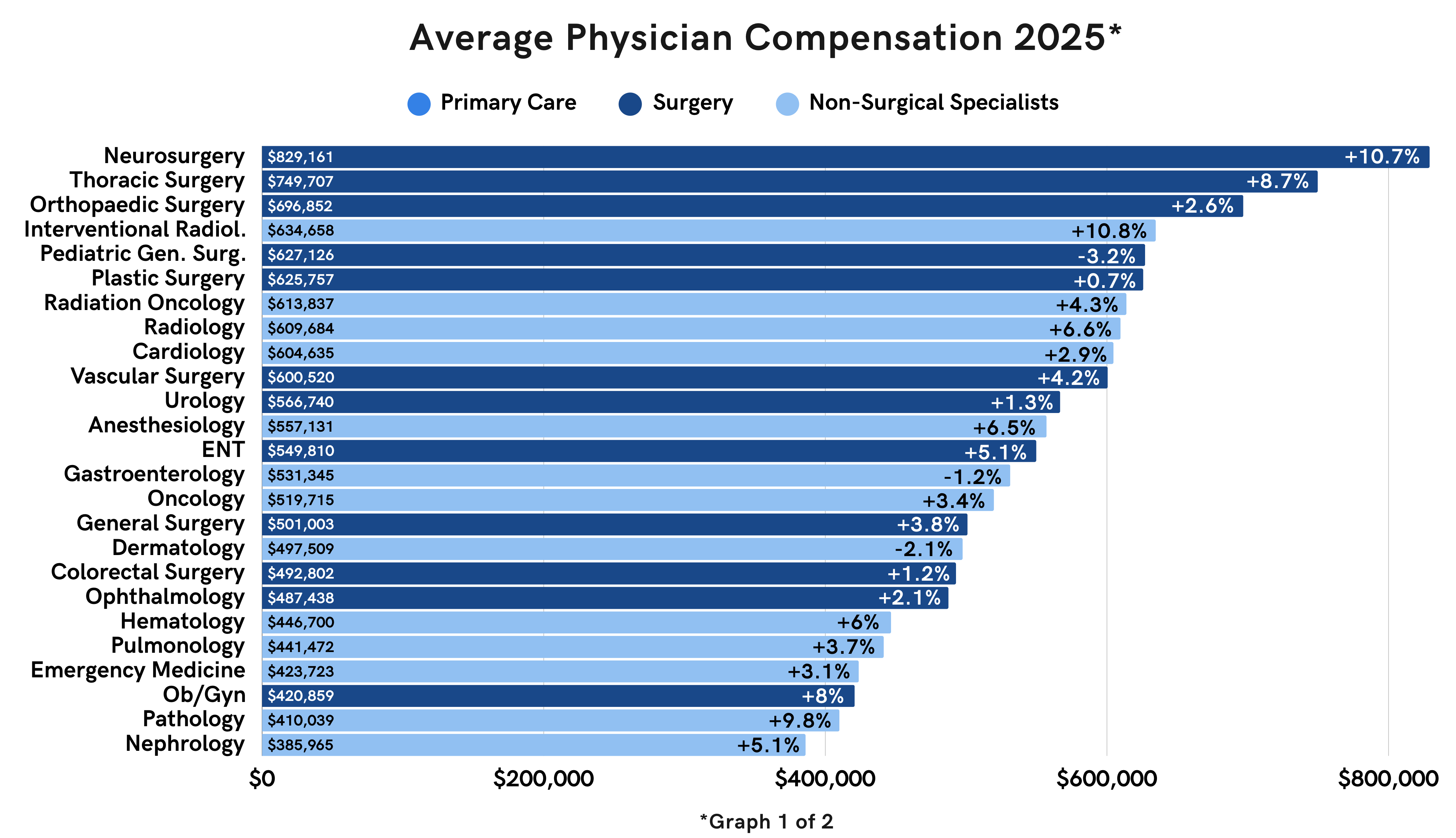
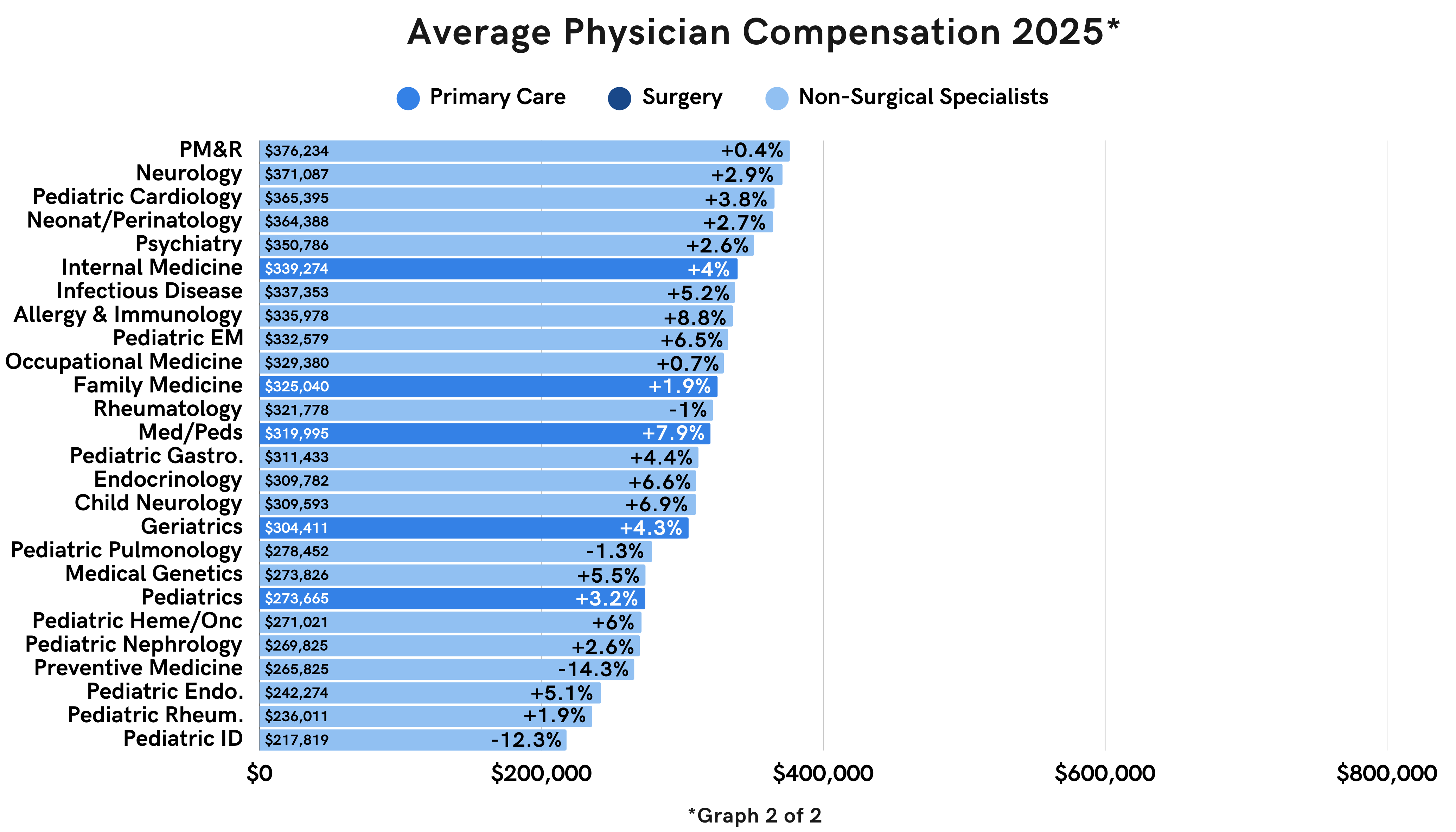
Average compensation for specialties in 2025 was mostly consistent with prior years: surgical specialties reported the highest pay and primary care and pediatric subspecialties reported the lowest pay. Neurosurgery topped the list at $829,161, whereas pediatrics ($273,665) and pediatric rheumatology ($236,011) hovered near the bottom.
The annual growth rate for physician pay ranged widely, from as low as -14.3% in preventive medicine to as high as 10.8% in interventional radiology. But in general, surgical and non-surgical specialists saw the highest increases in pay — further extending the gap in pay between the highest and lowest-paid specialties. The pay gap between surgery and primary care increased to 90.1%, up from 87.3% the prior year.
“The level of skill, dedication, and knowledge it takes to do primary care is astounding,” Dr. Mutalik said. “If primary care doctors continue to be poorly paid, it will result in much poorer recruitment into primary care, furthering the paucity of access to care.”
Pay for non-surgical specialists varied much more than it did for surgeons and primary care physicians. For example, oncologists reported an average pay of $519,715 with an above-average growth rate of 3.4%, marking their seventh straight year of pay increases. In comparison, rheumatologists stood at $321,778 with a growth rate of -0.98%. And dermatology was among the top 20 highest-paid specialties at $497,509 but saw a declining growth rate of -2.1%.
The gender pay gap also held steady at 26% for the third year running, with men earning $122,276 more on average, based on model-adjusted compensation estimates that account for factors including specialty, location, and years of experience. The difference in pay was at least 10% higher for men than women across all specialties except for pediatric cardiology.
Optimism Amid Strain
Beyond sub-inflation pay growth, physicians reported strain from several systemic pressures. Most (85%) said the physician shortage has affected their clinical practice, and 82% said they are overworked. These factors have prompted close to half (44%) to say they are “somewhat” or “very” likely to leave clinical practice entirely within the next two years.
Yet despite these headwinds, the vast majority of physicians expressed an enduring commitment to medicine. About 81% said they would still pursue a career as a physician if they had a chance to do it over. Many of them said they would choose their same specialty again. Two-thirds (66.2%) of dermatologists would pursue their specialty again, for instance, compared with 50.5% of oncologists and 40% of rheumatologists.
The community’s general optimism amid these challenges may invite opportunities to improve the way it works.
Many physicians, for example, appear willing to adopt relatively new or emerging technologies such as AI to help them. Indeed, about two-thirds of physicians reported using AI for their work on a weekly basis. That figure rises to 92% among oncologists, including 59% who said they use it daily.
What’s more, two-thirds of physicians said that staying current with AI tools will give them an earnings advantage over the next 12 months. And those who use AI more often seem to have greater faith in its earning potential. Roughly 55% of surgeons reported using AI at least weekly, and 58% said AI will give them a meaningful earnings advantage. Those figures rise to 66% and 67% among primary care physicians and 72% among non-surgical specialists.
“AI should increase physician pay,” said Nikhi Singh, MD, a plastic surgery resident at Indiana University. “One avenue is obvious in enhanced productivity and efficiency. But another is newfound opportunity and growth into other sectors.”
As AI continues its upward trajectory in medicine, it remains to be seen whether AI’s benefits will outweigh the costs required to maintain and develop the technology.
“AI tools themselves become an added cost,” said Akhil Adla, DO, a gastroenterology fellow at the University of Tennessee Health Science Center. “Things like licensing, integration, and maintenance are not free, and organizations facing those costs may look to offset them elsewhere, including in physician compensation. So while AI is likely a net positive for pay in the near term, its long-term effect on physician earnings will depend on how those costs get absorbed.”