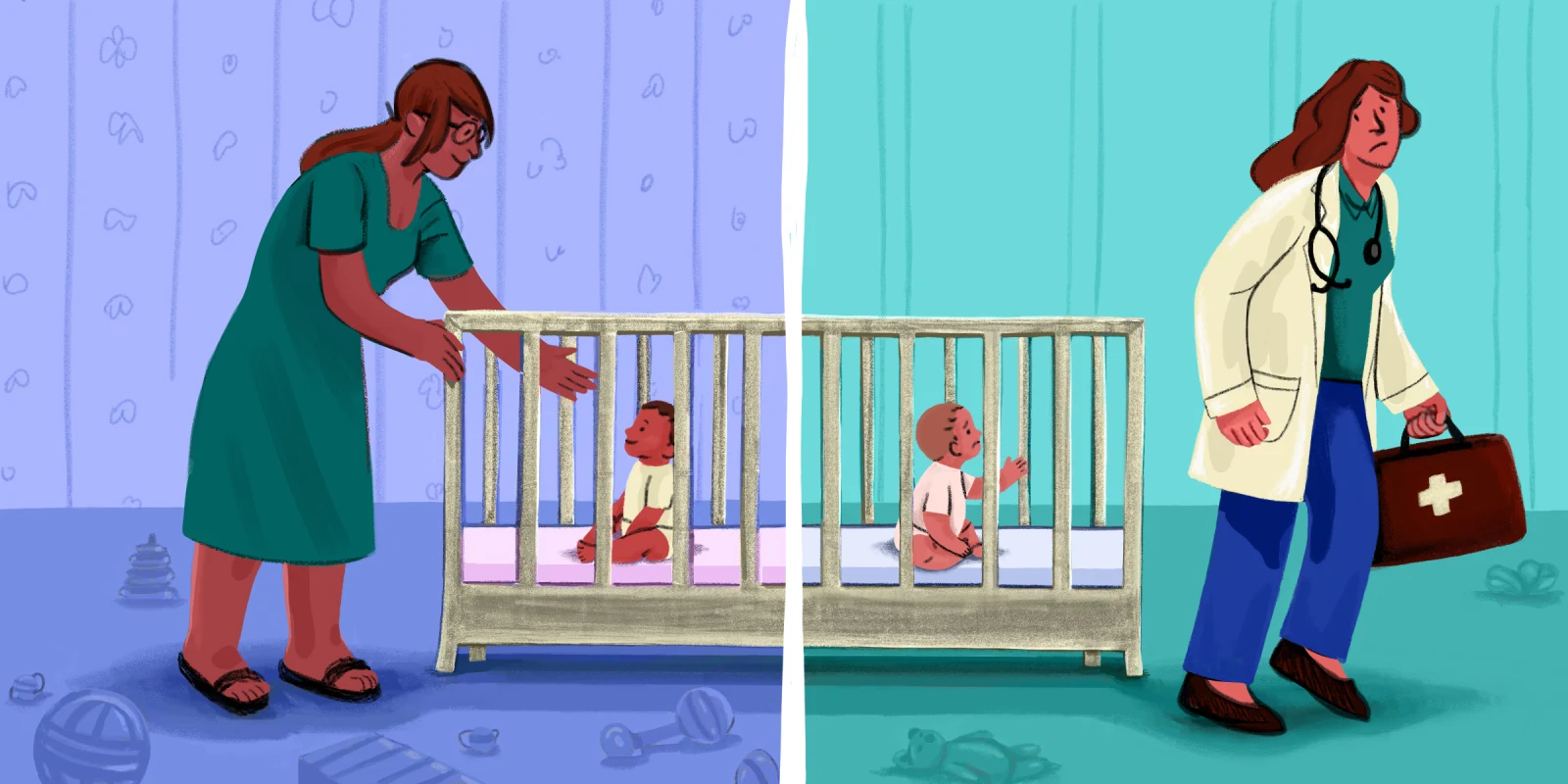

As women in medicine, we always seem to measure ourselves against the impossible. Over the course of training, there were so many moments to “get through.”
My first pregnancy went through the final year of my accelerated three-year medical school program. I have such visceral memories, standing nauseous with swollen ankles during an eight-hour colorectal surgery, fighting the smells and fatigue. I remember starting my intern year a month after my peers, kissing my infant goodbye to counsel other mothers about the importance of the postnatal period. I remember wondering if he even knew me, crying in the shower when he preferred to be held by my husband. It grew even more intolerable as he grew old enough to understand that black scrubs meant I was leaving, putting his back against the door, trying to untie my shoelaces. As life does not stop for medicine, I was pregnant again during my second year of residency. I was diagnosed with preeclampsia, and nurses checked my blood pressure on shift in the PICU. My second baby was born as I was starting my third year, chief year, and I came back to work still bleeding.
Every time I thought I’d “done it.” I was “in the clear.”
One evening, I found myself sitting on the kitchen floor after bedtime, scrubbing at a particularly stuck piece of food. My phone was buzzing, Epic chat pinging, emails stacked up, notes undone, a manuscript with edits due, a presentation only days away. A book I’d promised myself I’d read for work lay abandoned, its torn bookmark still stuck at Page 2. Laundry waited in the corner, dishes in the sink. Magna-Tiles mocked me on the floor. And there I was, full to the brim with overwhelm, energy, happiness, anger, resentment, and fatigue. It was the kind of moment that is both noise and silence, a stunned paralysis. I had survived 90-hour weeks, but this stubborn patch on the kitchen floor undid me.
I realized in that moment that I couldn’t do it all. For me, there would never be a “done,” I’d never be “through it.” And yet, this was not about giving up, it was about redefining what it meant to keep going.
In the weeks after that night, I found myself re-examining the way I defined strength. Strength had always meant pushing through — could it now mean knowing when to pause? It meant giving myself permission to read to my children instead of another article, to catch a Pee-wee soccer game instead of catching up on inboxes. It meant understanding the truth: that medicine will take as much as you give it, and the bravest thing you can do is decide where to draw your own line.
Since then, my conceptualization of my role has changed. I don’t measure myself by whether I can outlast the next storm. I measure myself by how I show up today, for my patients, for my colleagues, for my kids, for my husband, and for myself. I’ve embraced the ugliness, I’ve accepted the imperfection and I’ve stopped waiting for the mythical day when I’ll finally be “in the clear.” That day doesn’t exist. What exists is the messy, overlapping reality of medicine and family, where resilience isn’t about doing it all, but about doing the pieces that matter most.
And in finally releasing myself from “the impossible,” I’ve discovered something better: enough.
Alex Seabury, MD, MS is a developmental-behavioral pediatrics fellow at the Children’s Hospital of Philadelphia and a Master of Health Care Innovation candidate at the University of Pennsylvania. Her work focuses on reimagining hospital systems and medical training to improve care for neurodivergent children. She lives in Philadelphia with her husband and two sons.
Illustration by Diana Connolly