I sat on the sidelines, trying to make myself as unobtrusive as possible. As a resident rotating in gynecologic oncology, I had learned quickly where visiting residents belonged in the weekly fellow-driven tumor boards: close enough to listen, far enough to be out of the way. From my seat, I expected to learn guidelines, staging, and treatment algorithms. What I didn’t expect was how much I would learn about how decisions are actually made.
The cases moved quickly. A CT scan flickered onto the screen, followed by a pathology slide, then a summary delivered in shorthand that only the people in this room fully understood.
"Stage IIIC. Suboptimal debulking. Consider adjuvant chemotherapy."
The language was efficient and compressed, yet the implications for patients were enormous.
The conversations rarely followed a straight line. Radiology raised a question about lymph node involvement. Pathology hedged on tumor grade. Surgery weighed technical feasibility against morbidity. Treatment algorithms emerged almost automatically from the data: surgery versus chemotherapy, radiation fields, and clinical trial eligibility. The discussion was thoughtful and collaborative. Each specialty spoke fluently from its own vantage point, sometimes in harmony, sometimes in tension. The final recommendation emerged not as a single authoritative declaration, but as a negotiated consensus.
It was clear that tumor board is one of the few places in medicine where uncertainty can surface openly. Attendings who exuded confidence in the OR were comfortable saying, “I’m not sure,” or “This could go either way.” For a trainee, witnessing that was transformative. Our medical education system often rewards brevity and decisiveness, yet here was a room full of experts modeling thoughtful hesitation.
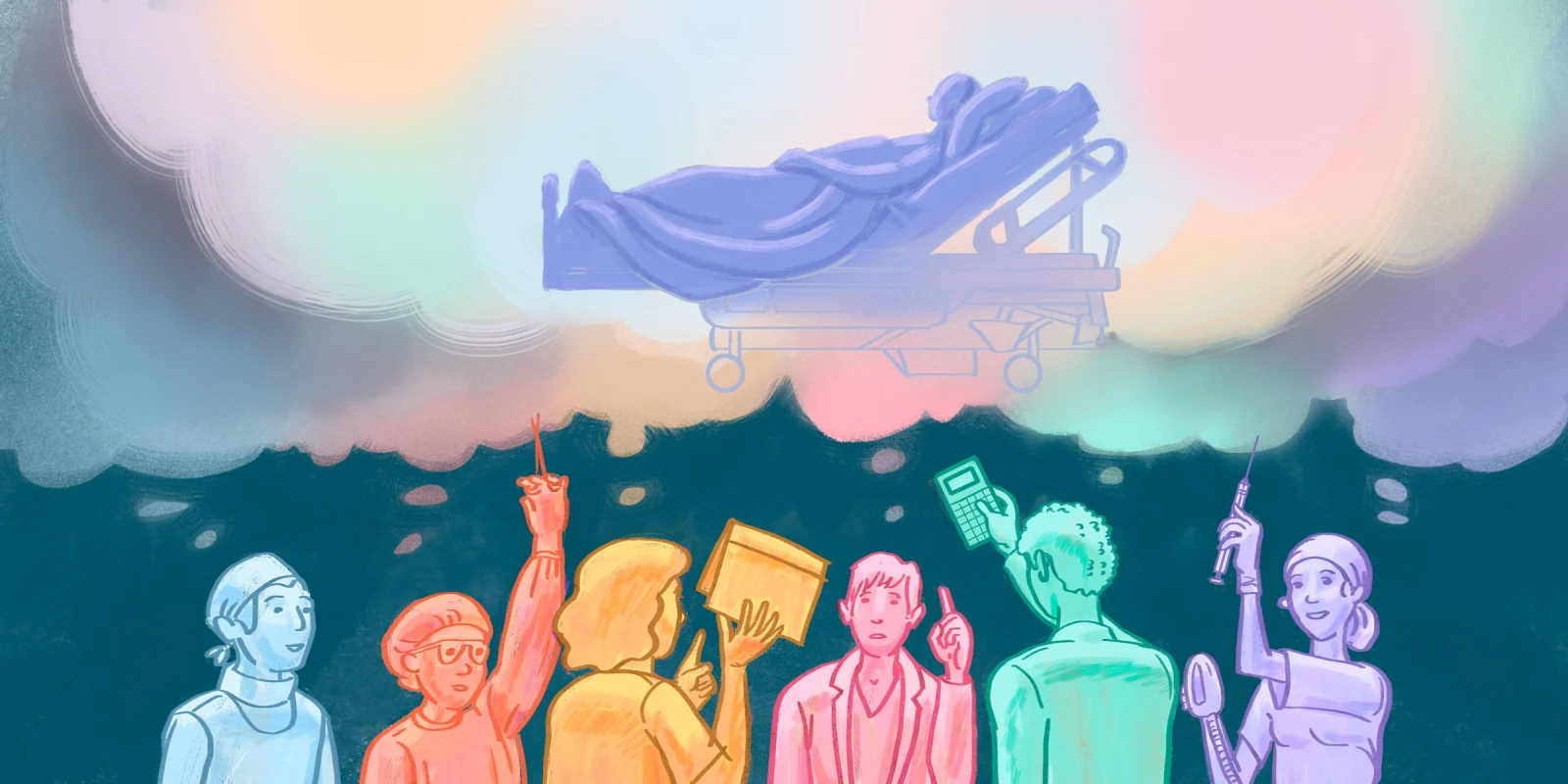
The patient, of course, was not in the room. Their story was distilled into imaging, histology, and a brief clinical summary projected on the screen. A few lines attempted to capture a life: age, diagnosis, stage, prior treatments. Social circumstances, support systems, work obligations, language barriers, childcare responsibilities — these rarely made it into the initial presentation.
I noticed how easily the human narrative fades with complex medical problems and when time is limited. Tumor boards are designed to solve clinical puzzles, and the puzzles themselves are intricate — staging systems, molecular markers, surgical feasibility, survival curves. Faced with this complexity, it is natural that attention gravitates toward the data that guide treatment. But the result is that the patient can become an abstraction, represented by a pathology slide or a series of CT images.
As a trainee, the experience can be unsettling. Earlier that morning, I might have been at the bedside with a patient whose anxieties filled the room: worries about fertility, about time off work, about who would care for children during recovery. Those conversations were messy and deeply human. Yet by the time the case arrived at tumor board, much of those details faded, leaving only what is necessary to reach a clinical recommendation.
I realized how fragile the patient’s narrative can be; if no one carries their story into the room, it disappears. The scans and pathology remain, but the story — the reasons a treatment may or may not be acceptable to the person living with the disease — can vanish. However, a single sentence can change the tenor of the discussion:
"She hopes to preserve fertility," or, "He wants to be present for the birth of his granddaughter." These details rarely alter the biology of the cancer, but they often shape what treatment is truly possible.
From the sidelines, I see tumor board differently — not just as a forum for multidisciplinary expertise, but as a place where the patient’s story can be deliberately carried into the room. Without that effort, the conversation risks becoming technically perfect yet personally incomplete.
Tumor board feels like a hidden classroom. There are no slides explaining how to weigh surgical morbidity against oncologic benefit, or how to counsel a patient when the evidence is incomplete. Instead, we learn by watching how experienced physicians reason out loud, disagree respectfully, and ultimately commit to a plan despite lingering doubts. There, I learned that medicine’s most important decisions are rarely made alone, rarely made quickly, and rarely made with complete certainty. That lesson, though unspoken, may be one of the most enduring parts of my training in gynecologic oncology.
What did you learn in an unexpected place as a resident? Share in the comments.
Dr. Vidya Visvabharathy is an ob/gyn in Cleveland, OH. She enjoys dancing, baking, and taking long walks with her husky mix, Lilo. Dr. Visvabharathy is a 2025-2026 Doximity Op-Med Fellow.
Illustration by Jennifer Bogartz