

Doximity polls in 2026 and 2023 asked physicians whether training for physicians should be shorter, longer, or stay about the same length. In 2026, most physicians in most specialties said the length of training is about right, compared with about a third of specialties in 2023.
Why it matters: As more specialties back the current length of training, the ones that break from that majority show where the debate is still open.
By the numbers: In four specialties, at least six in 10 physicians said training is “about right” in 2026:
Emergency medicine: 64%
Family medicine: 62%
Psychiatry: 61%
Otolaryngology (ENT): 60%
The context: Emergency medicine's training length was recently under review. About 81% of accredited EM programs run three years, and 19% run four. After the Accreditation Council for Graduate Medical Education’s (ACGME) review committee proposed requiring four years for all programs, its board voted on June 10, 2026, to keep allowing both formats.
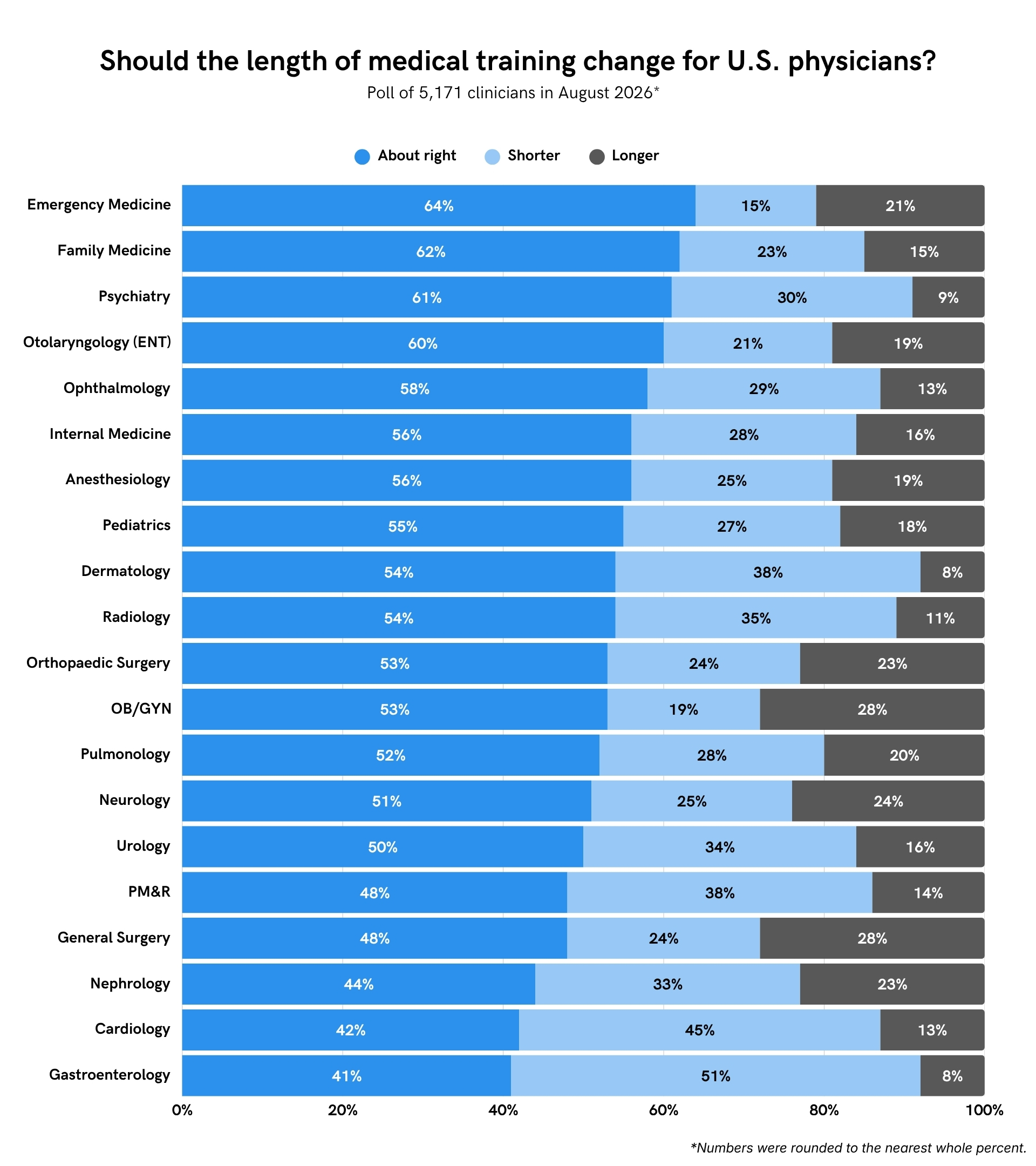
Zoom in: While most still say training is about right, three specialties had more physicians preferring longer training over shorter in 2026:
Ob/gyn: 28% longer, and 19% shorter.
General surgery: 28% longer, and 24% shorter.
Emergency medicine: 21% longer, and 15% shorter.
Between the lines: Ob/gyn and general surgery raised concerns about readiness at graduation.
Ob/gyn: ACGME case logs show graduating ob/gyn residents performed about 35% fewer abdominal hysterectomies and 15% fewer operative vaginal deliveries in 2024 than in 2018. Therefore, some clinicians are calling for extending ob/gyn residency from four years to five.
General surgery: Surgical educators have debated for more than a decade whether general surgery residency fully prepares graduates for independent practice. A 2017 study found graduating residents weren't universally ready to perform core procedures on their own, and a 2026 national study found attendings rated chief residents competent in fewer than half of evaluations for advanced foregut and bariatric procedures.
The other side: Gastroenterology is the only specialty with a majority for shorter training (51%). It also has the lowest share saying training is about right (41%) compared to other specialties.
GI physicians chime in: While the majority of gastroenterologists prefer shorter training, commentary from GI physicians on the poll itself told a different story:
“Premed should be cut, not medical training.”
“The hours worked by resident[s] were decreased to reduce fatigue, patient safety, work life balance, etc. Ok, no problem. But by doing that, they also cut the number of hours residents spent learning in the hospital and clinic. Therefore, the residency programs need to be lengthened to give the doctors the same training the older generation of doctors received.”
“Medical school [should be] reduced by 6 months and [instead should] add 6 months of internship (focused on system care, provider mental health, and etc)”
Additionally: These four specialties said the length of medical training was "about right" in 2026, though none of them had a majority for any of the poll response options.
Urology: 50%
PM&R: 48%
General surgery: 48%
Nephrology: 44%
Big picture: Specialties with the highest share of physicians choosing each response option in 2026:
Most wanting longer training: General surgery (28%) and ob/gyn (28%)
Most wanting shorter training: Gastroenterology (51%)
Most saying training is about right: Emergency medicine (64%)
The bottom line: Most specialties back the current length of training. Gastroenterology is the one field where most physicians want it shortened.
Methodology:
Doximity polls of U.S. clinicians were fielded in December 2023 (n=4,083) and August 2026 (n=5,171).
*Specialty figures reflect MD/DO respondents in specialties with at least 60 physician respondents in a given year, so the number of specialties compared differs by year. Infectious disease and neurosurgery were removed from the analysis due to limited poll responses from the specialty.