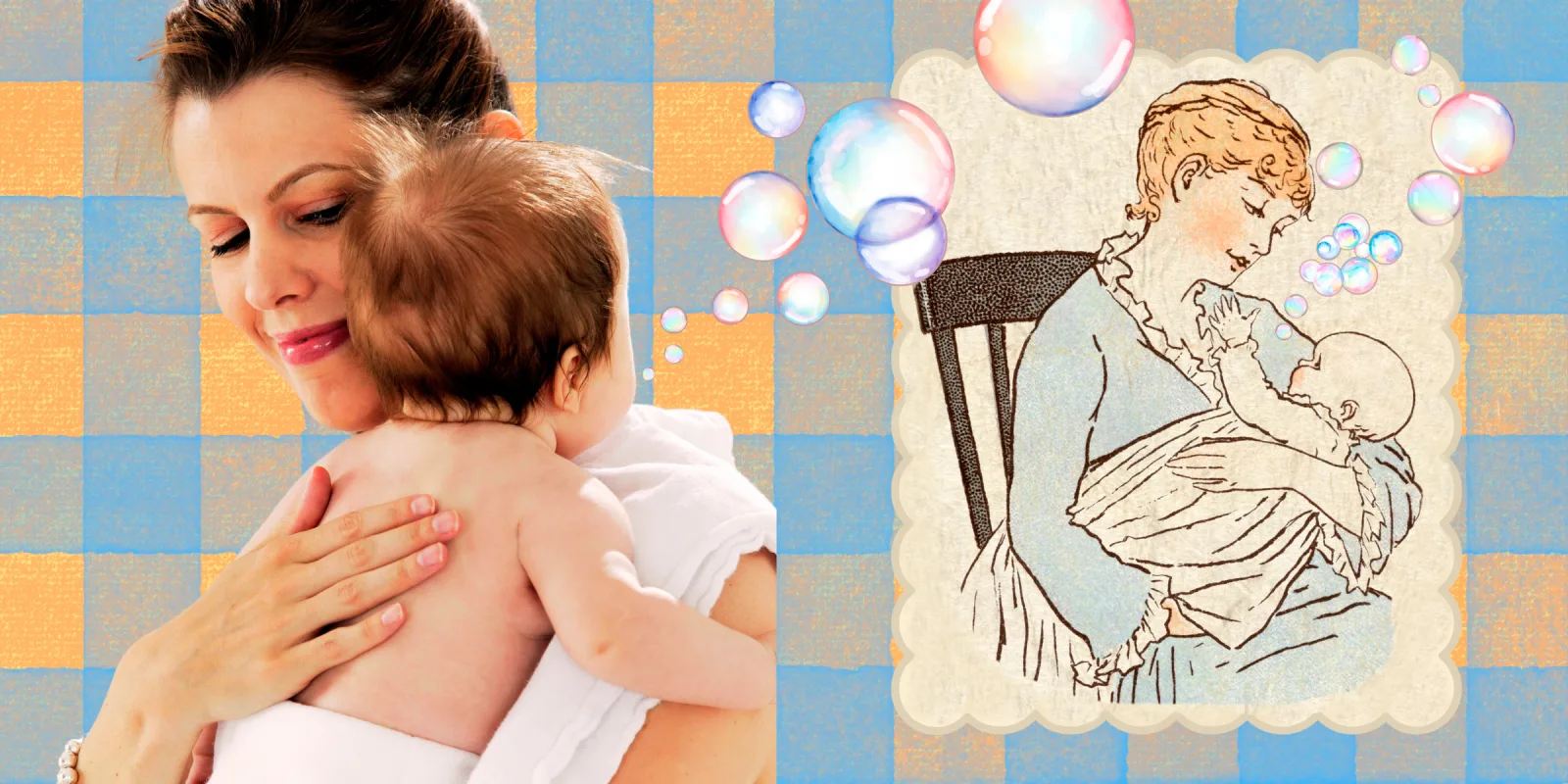

She was a new mother, exhausted in that particular way only the first weeks allow. Her baby had just finished feeding, and before I could say anything, she lifted him to her shoulder and began the rhythmic patting that mothers everywhere seem to know without being taught.
"Is this right?" she asked. "My mother says over the shoulder. My mother-in-law says sitting up. The nurse on the postpartum floor showed me a different way entirely."
She wasn't asking about feeding volumes or jaundice or sleep position. She was asking about burping: perhaps the most universally practiced, least examined ritual in newborn care.
I gave her the answer pediatricians have given for generations. Whatever feels comfortable. Whatever works. Keep his head supported. He'll let you know.
But her question stayed with me longer than my answer did.
Because the truth is, we don't really know.
Burping is something we recommend with confidence we haven't earned. Parents are told to do it. Nurses demonstrate it. Pediatricians reinforce it. Parenting websites diagram it. And yet, when you actually search the literature for evidence that burping reduces colic, prevents regurgitation, or improves any meaningful outcome, you find almost nothing.
The only randomized controlled trial on the question, conducted in a cohort of 71 mother-infant dyads, found no reduction in colic. It also found a statistically significant increase in regurgitation episodes among the burped infants. One trial is not the final word, but it is striking that the single piece of randomized evidence we have points in the opposite direction of the practice we universally recommend.
So why do we keep recommending it?
Part of the answer is cultural. Burping is intergenerational. It is taught by grandmothers and aunts and neighbors long before any clinician enters the conversation. Part of it is intuitive. Air goes in; it must come out. The infant cries; surely something is trapped. And part of it, honestly, is that burping gives caregivers something to do in the helpless minutes after a feed, when an infant is fussy and a parent is searching for a way to help.
That last part matters more than we usually admit. Much of newborn care exists in the space between physiology and reassurance, and rituals that comfort the caregiver are not nothing. A calm parent holding a calm infant is a clinical outcome, even if it doesn't show up on a chart.
But we should be honest about which part is which.
When I reviewed the literature with my colleague for a recent piece in BMJ Paediatrics Open, what struck us most was not that the evidence was weak. It was that the evidence had barely been pursued at all. Six commonly practiced techniques: over the shoulder, sitting upright, face-down across the lap, prone on a flat surface, the walking burp, the tiger hold … and not a single rigorous head-to-head comparison among them. We describe them in textbooks. We teach them in postpartum units. We pass them between generations. And the entire scaffolding rests on tradition rather than data.
There are real questions here that nobody has answered. Does burping matter more for bottle-fed infants who swallow more air? Does it matter for the subset of infants with reflux or feeding intolerance, where the positioning strategies of right lateral for gastric emptying, left lateral for reflux do have some physiological basis? Are some techniques actually counterproductive in specific infants? We don't know. We've never really tried to find out.
This is not a call to stop burping babies. Plenty of practices in pediatrics exist comfortably without trial-level evidence, and asking exhausted parents to abandon a soothing ritual would be both unkind and beside the point. But there is a difference between a practice we acknowledge as cultural and supportive, and one we frame as medically necessary. The first invites flexibility. The second creates anxiety for parents whose infants refuse to burp, who worry they have somehow failed at a task we have told them matters.
What this experience reinforced for me was something larger than burping. It was the recognition of how much of routine care, especially in pediatrics, runs on inherited certainty. We absorb practices during training, repeat them during residency, and pass them along to families without ever pausing to ask what supports them. Most of the time, the practices are harmless. Sometimes they are even helpful in ways we haven't measured. But the habit of not asking is its own kind of problem.
The mother in my clinic didn't need a definitive answer that day. What she needed, I think, was permission to follow her instincts and her infant rather than a hierarchy of competing experts. She needed to know that the absence of a single correct technique isn't a gap in her knowledge. It's a gap in ours.
Sometimes the most honest thing we can offer parents is not a protocol, but the acknowledgment that we are still learning the things we have long assumed we knew.
What's something you or your patients take for granted in medicine, but that actually doesn't have much of an evidence base? Share in the comments!