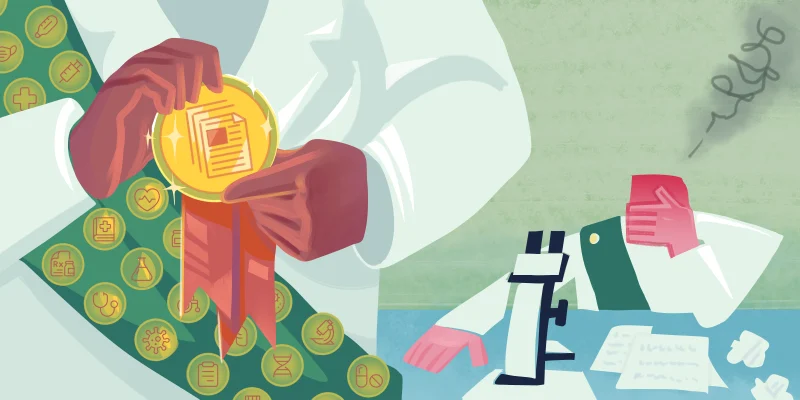

There is a familiar scene for women in medicine. The moment is often small, almost unforgettable in the greater scheme of the clinic day, when something shifts and a comment lands just slightly off-center. It’s the “You really are beautiful,” said with a look that lasts a little too long, or “The boys must be all over you,” said with a grin. For me, one of the most memorable moments was when a patient reached for my name badge pinned to the neck of my shirt, turned it around, and said, “Now, this is off the record …”
There is an unmistakable, visceral sensation that occurs in an instant like this. The next planned question about symptoms or medications just hangs in the balance. A silent internal battle ensues over who will respond first: me the PA or me the person.
I have never quite settled on the right answer.
As a clinician, I was trained to navigate uncertainty, respond under pressure, and maintain composure in the context of potentially stressful, complex medical situations. But I was never explicitly trained to manage this particularly complicated situation when the patient crosses a boundary of dignity and professionalism. Instead, I was exposed to the hallway stories and half-laughs with colleagues. These quiet lessons share a message: handle it, stay professional, and redirect the encounter. Don’t acknowledge, don’t escalate, just move on.
The reality is, that often does work. Sometimes it really is easiest to let the comment slide and debrief with colleagues later. The problem is that inappropriate, sexist comments from patients don’t come in a single form. They exist along a spectrum and they aren’t rare. Some statements do demand immediate response. On one end are the subtle insinuations: the compliment with an undertone, the crass joke, the unearned familiarity. These are easy to dismiss in isolation, which is exactly what makes them difficult. They invite the recipient to second-guess and question if the remark was intentional and if they are overreacting. This approach can be so subtle and shielded by ambiguity that it has a way of placing the burden of interpretation and response on the recipient.
On the other end of the spectrum are the comments that abandon subtlety completely. Explicit remarks are sometimes disconcerting enough to interrupt clinical flow altogether. These moments are easier to name as what they are and leave no question that a line has been crossed. They demand an immediate response.
Neither scenario is inherently more difficult to handle. The struggle lies in the responses that both situations demand. The subtle comments require clinicians to decide whether to make something out of almost nothing. The thoughts that go into these decisions have the power to dictate the outcome, not just of that patient encounter, but of how we will be perceived and what is in our best interest. Do I risk seeming overly sensitive in a culture that rewards grit? Do I risk interrupting a visit with a change in dynamic when everything could pass without consequence? Whether a clinician chooses to address a comment directly or redirect and carry the personal weight forward, the decision comes at a cost.
Outside of the office, I don’t have the same hesitancy to react directly. What makes these encounters particularly arduous, then, is the context in which they occur. Medicine is built on a foundation of trust and a commitment to protect, as the AAPA puts it, the “health, safety, welfare, and dignity” of all humans. In the clinical space, patients are vulnerable and clinicians are expected to be accommodating and composed. To not judge and to treat everyone equally. For women in medicine, that expectation is also layered with the unspoken expectations of society to be agreeable, kind, and non-confrontational. Patient satisfaction, both explicitly measured after visits and implicitly valued, also lingers in the background of our thoughts.
Within that context, responding directly to inappropriate behavior can feel like stepping outside the bounds of professionalism, even when it is actually an assertion of it. So we develop scripts, laugh things off, redirect, or occasionally draw a line more firmly. We compare experiences with each other, testing out what feels acceptable, proofreading messages, asking for feedback on what has been effective. And still, there is no consensus. There is no single approach that works for every woman and no guaranteed response that will diffuse the tension between maintaining a therapeutic relationship and maintaining a sense of self.
What also goes unrecognized is the cumulative weight of these decisions. The moment may be brief, but the pattern of interactions is not. The solution is not as simple as telling individual clinicians to be more resilient. Framed that way, the responsibility remains where it has always been: on those experiencing the harmful behavior. This is not an interpersonal challenge; it is a workplace issue that directly impacts safety, equity, and professionalism.
When I started writing this essay, I was asking myself: “Which is harder to handle: the subtle insinuations or the crude, deliberate comments?” Ultimately, I was asking the wrong question. The reality is, it doesn’t matter which is harder. We don’t need to rank experiences that are, at their core, variations of the same problem. The question now is, how will we address the expectation that some clinicians — mostly the female ones — must absorb boundary violations as part of their work?
Though sexism is a societal issue that extends far beyond medicine, that does not mean it should be dismissed when it occurs within the medical context. As a field, we can and should take measurable steps to reduce the number of inappropriate patient interactions. The first step is to allow women clinicians to speak openly about the confusion, and the double burden of concerns over professionalism, that accompany these comments. Acknowledging the pressures on us, and the insidious bind such comments place us in, can help relieve them.
The next steps are to set clear hospital policies and create pathways for clinicians to take a stand. Infrastructure changes must be created to empower women to speak up without fear of professional repercussion. An immediately actionable change would be reviewing how we respond to clinicians who take a stand against inappropriate comments and ensuring that such acts don’t impact their livelihood and online reputation. Women should not be penalized, in pay or promotion, by patient satisfaction scores that are driven by appropriate boundary-setting.
In addition, a fast and accessible reporting system to track repeat offenders across medical specialties and environments would allow institutions to generate data, identify patterns, and intervene faster. Intentional institutional committees should be developed with dedicated time to strategize and train about these incidents. When leadership publicly reinforces culture changes against harassment, teams know that safety matters.
We expect a lot of people in medicine. It is right to expect skill, sound judgment, empathy, and composure. But as women, it should not be too much to ask that we are not also required to choose, repeatedly, between professional perception and personal dignity.