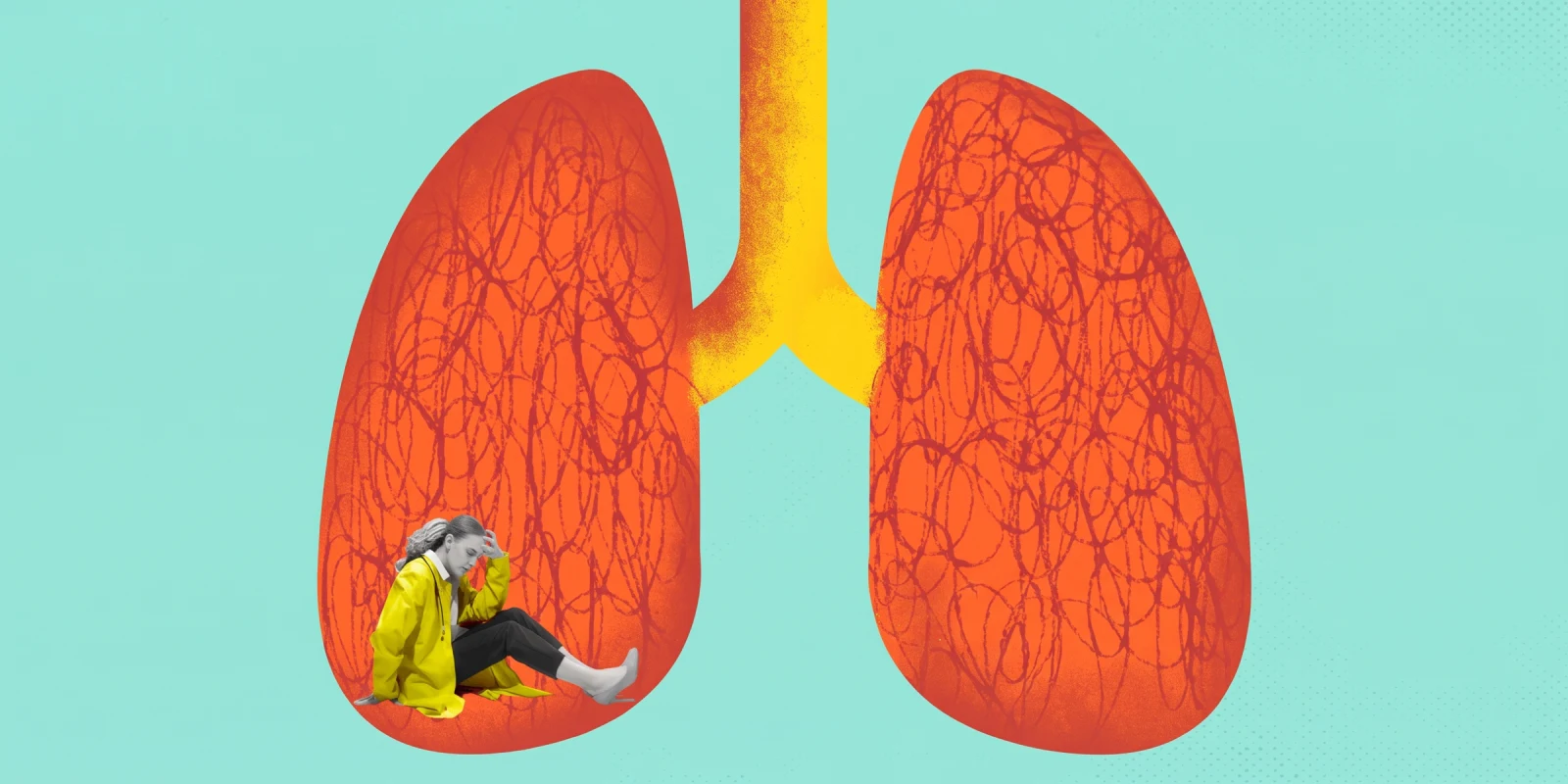

The night before Thanksgiving 2025, I developed severe lower back and flank pain that worsened whenever I breathed. I drove myself to the ED, thinking I had a kidney stone. Instead, a CT scan revealed a large mass in my lung, and the pain I was feeling was pleuritic. I was caught off guard, but it was in the same area that a cystic lesion had been discovered incidentally in 2021. When the ER physician showed me the images, she looked concerned. I recall saying flippantly, “Oh, that’s fine. We already know about it. It’s been there for years.” Because that lesion had appeared stable on prior imaging and was thought to be benign, neither I nor the physicians caring for me initially suspected cancer. I had no risk factors; I never smoked or vaped; I’m a physician who exercised regularly, ate a balanced diet, and was otherwise considered healthy — all of which reinforced that reassurance.
That night, I also produced a small amount of blood-tinged sputum. The physicians worried that it could represent a “sentinel bleed,” a warning of potentially catastrophic hemorrhage. Because no further bleeding occurred in the ED, they believed surgery could safely wait. Two months later, I underwent a right lower lung lobectomy because of that bleeding risk, not because anyone suspected cancer. Ten days later, I opened my patient portal and read the pathology report. The diagnosis: adenocarcinoma.
Thirty-one lymph nodes were removed. All were negative. The tumor measured nearly six centimeters. My final staging was stage IIB lung cancer.
Ultimately, I am doing OK. I received several rounds of cisplatin chemotherapy and am currently receiving immunotherapy, with curative intent. I am grateful for the care I am receiving and hopeful about the future.
But my experience has forced me to confront something that many physicians and practitioners still do not fully appreciate. Lung cancer remains the leading cause of cancer death among women in the U.S. In fact, it kills more women each year than breast, ovarian, and uterine cancers combined. And while smoking remains the largest risk factor, lung cancer in people who have never smoked is far from rare. Roughly 20% of lung cancers occur in people who have never smoked. If lung cancer in never-smokers were considered its own disease, it would still rank among the leading causes of cancer death in the country.
Increasingly, physicians are seeing cases like mine — lung cancer in patients who do not fit the traditional risk profile. Yet current screening guidelines have not caught up: The U.S. Preventive Services Task Force advises lung cancer screening only for adults ages 50 to 80 with a significant smoking history. A 2025 Northwestern University study published in JAMA Network Open found that nearly 65% of patients with lung cancer would not have qualified for screening under current guidelines; women and people who had never smoked were disproportionately represented among those excluded.
These guidelines have saved lives and represent an important public health effort. Yet my experience exposes two related gaps. I would have never qualified for routine lung cancer screening, and even after an unrelated scan revealed a lung lesion, surveillance ended after a year of apparent stability. I was told the lesion was probably benign, perhaps an old scar that had likely been present for years. Like many patients reassured by stable imaging, I eventually stopped thinking about it. I was fortunate that when the cancer was diagnosed nearly five years later, it had remained confined to my lung. Had it behaved more aggressively, it might have spread before producing symptoms. As awareness of lung cancer in women and people who have never smoked increases, cases like mine raise questions about both who qualifies for screening and how long certain incidental findings should be followed.
The epidemiology of lung cancer is changing in ways that our screening models may not yet fully reflect. Adenocarcinoma, now the most common form of lung cancer, increasingly affects people who have never smoked, particularly women. Researchers are working to better understand why. Environmental exposures, radon exposure, air pollution, genetic susceptibility, and other factors may all play a role.
My case is not an argument that every incidental lung finding should be aggressively pursued. But it does illustrate how our assumptions about who is at risk for lung cancer may need to evolve.
This does not mean current screening guidelines are wrong. They were developed using the best available evidence and have undoubtedly prevented many deaths. But it does mean we have to face an important question: Should lung cancer screening continue to rely almost entirely on smoking history?
Researchers are already exploring new approaches. That same JAMA Network Open study modeled universal age-based screening for adults ages 40 to 85 and estimated that it could detect nearly 94% of lung cancers. Risk-prediction models that incorporate additional factors beyond smoking history are being studied. Advances in imaging, artificial intelligence, and blood-based biomarkers may eventually help identify people at risk earlier. The conversation about how best to detect lung cancer earlier in a broader population is clearly underway.
My story is only one example, but it reflects a broader shift that researchers are increasingly recognizing. I still look healthy. Most people who meet me would have no reason to suspect that I went through all this and am currently receiving immunotherapy.
That disconnect, between what lung cancer is assumed to look like and what it sometimes is, may be one reason the disease continues to be diagnosed late. As both a physician and a patient, I hope my experience encourages greater awareness and continued research into how we identify those at risk.