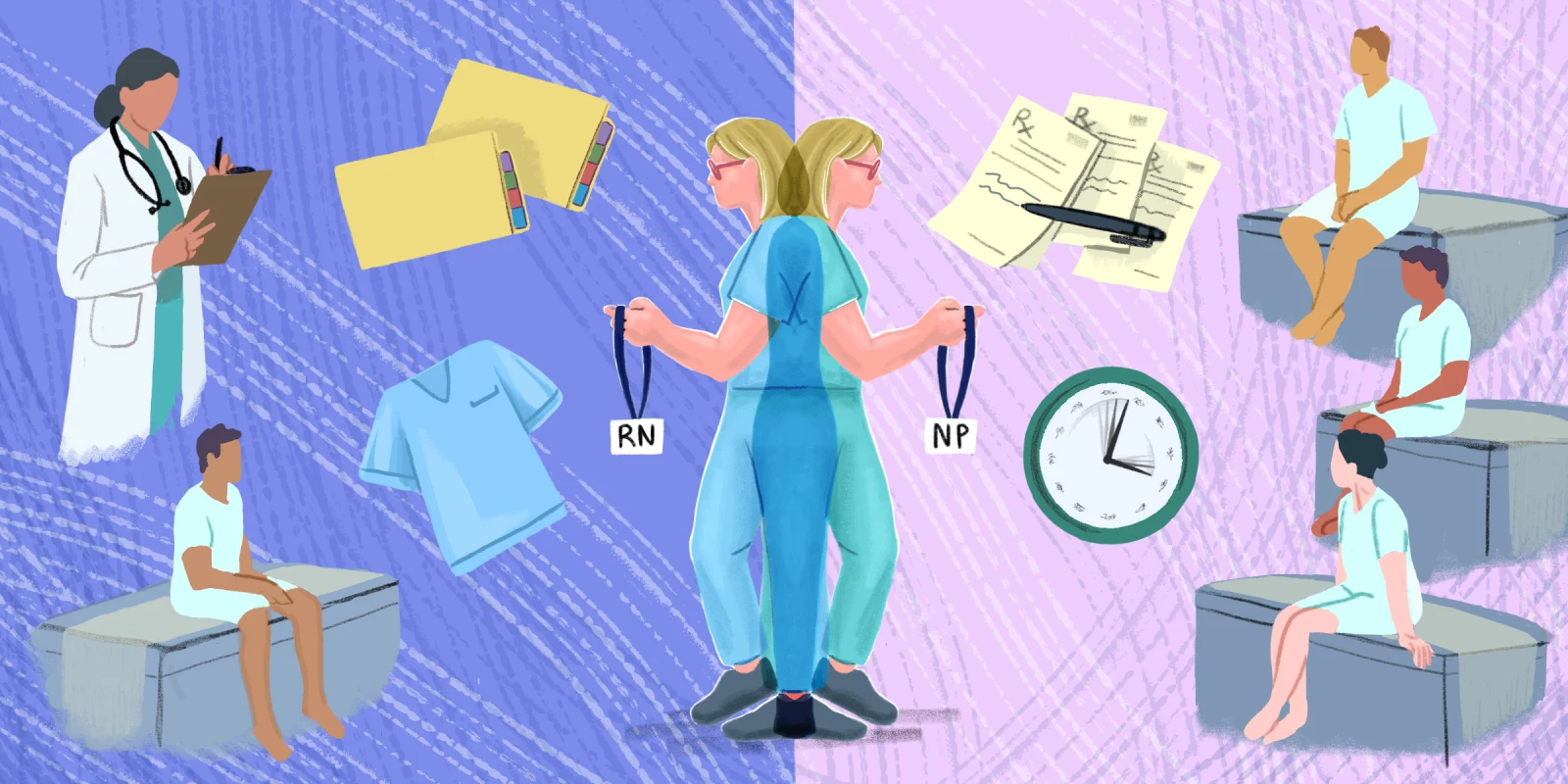

If you talk to college students who are pursuing a nursing degree now, almost all of them want to go on to get their advanced nursing degree. It seems that very few nurses are entering the hospital bedside with the intent to stay there. The days of earning stripes for years before heading back to school are less common than when I was a baby nurse in CCU circa 1997 … and it’s causing some waves in the pool.
In the ‘90s, only a few of my nursing colleagues went back for their Advanced Practice Nursing degree upon completion of their mandated three-year critical care requirement. Watching them, I thought, I have been working for three years and I am fairly confident I would cause harm in that role. I’m not ready. Maybe it was a lack of confidence, but more likely it was due to senior nurses and cardiologists reminding me that time is a great teacher and at 25, there is a lot to learn. My nurse gut instinct hadn’t had time to develop fully. I knew what “sick” looked like, as this was before tracking door-to-balloon time was a thing in cardiac care and our patients were acutely ill. I was capable of managing “on death’s door,” but I didn’t yet have the skills to recognize a healthy-looking sick person.
Fast forward 15 years, and I was back in school at the urging of my spouse and colleagues. I chose the University of Cincinnati online program for my FNP degree for a variety of reasons. The most convincing was that their courses relating to more complex topics like advanced pathophysiology and pharmacology were taught out of the medical school, so I’d be trained by someone who had experience with the role I was stepping into as an APP.
The online program had a more robust clinical requirement than any school in my home state. 150 hours more, to be exact. However, I ended up with 300 extra hours because my preceptors (who had known me for decades) let me stay on to learn as much as I cared to. I graduated with a total of around 900 hours, plus 16 years as an RN. I did get some comments about not enrolling at a local brick and mortar university, but I was in a better program and it worked for my life at the time.
In 2026, the schooling options, both online, and in person, are more robust. In my state of Tennessee, the requirement for clinicals falls between 500-600 hours per Board of Nursing guidelines. While that does sound like a lot of hours, without adding in 3-5 years of working at the bedside seeing patients day in and day out, it’s really not much. It amounts to about 15 weeks of clinicals in different areas of nursing for FNPs. When you consider most of the APPs are working as PCPs, the amount of actual time spent in that area is not sufficient for someone who hasn’t honed their skills in seeing nuance and thinking critically.
Without the required nursing experience that was historically mandated, APPs are robbed of valuable time learning how to care for people with a myriad of conditions. Additionally, by putting more APPs into the job pool, the demand drops and jobs are harder to find. It affects quality of care, of course, but it also reduces the salary range. Currently, APPs in the southeast as a whole are paid below the national average. Our supply is starting to outpace demand. Some physician colleagues have even told me that because of the impact on RVUs they are scaling back the use of APPs in primary care in our area.
In Tennessee, the newest trend is for a non-nurse degree-holding student with a 3.6 or higher GPA in their field of study to fast-track their DNP without taking the basic nursing courses. This is currently going on at multiple major universities in the state and because school is expensive, I’m sure others will hop on board to grow revenue. I can’t speak to the rigor of the programs because I’m long out of school, but I CAN speak to the referrals I get in gastroenterology and the workup done beforehand.
Please understand it is not my intent to malign my profession, but if we are being truly honest, we know there is an issue in preparedness, clinical exposure, and lack of mentorship. We should speak up and be willing to express our concerns out loud without fear of retribution. Delicately put, we can tell when a clinician hasn't been out in the nursing trenches before they head back for the FNP (and other APP degrees in adult, peds, psych, and women’s health) or DNP. It is apparent in the notes, initial workup, lack of physical exam documentation, and tests ordered.
I will concede that being a better APP likely has more to do with one’s guidance in the role itself by a mentoring physician than what grade one got in “Advanced Pharmacology” — but even the best mentor cannot replace the knowledge that comes from years spent dealing with critically ill people in crisis.
There is a reason medical school is so long. It is to expose those students to patients over and over until the answer to clinical questions becomes innate. That is completely lost when a clinician is able to push straight through to DNP with little bedside experience. The medical example would be putting an MS4 into a fellowship and letting them skip residency. No one would dare do that because residency is where the practice of medicine starts. The RN role is where you learn how to think critically and react appropriately in clinical situations. You cannot pass go and collect $200 when it comes to being in the position of diagnosing and treating disease. You cannot fast track critical thinking skills or the art of caring for people safely or thoughtfully.
At present, I’m doing an IBD fellowship at the Cleveland Clinic. There, I have met so many smart, capable APPs who are sometimes just out of school, and I have to remind myself that there are those who excel regardless of years of nursing experience and I should probably be less Gen X about my opinions. Still, I agree with my mentors that time is a great teacher, and while I don’t think a clinician needs to wait 16 years to go back, I do think there is value in maybe 2-3 years before one attempts to be in the driver's seat. After all, there is no such thing as too much experience when it comes to being the person in charge of someone’s life and well-being.