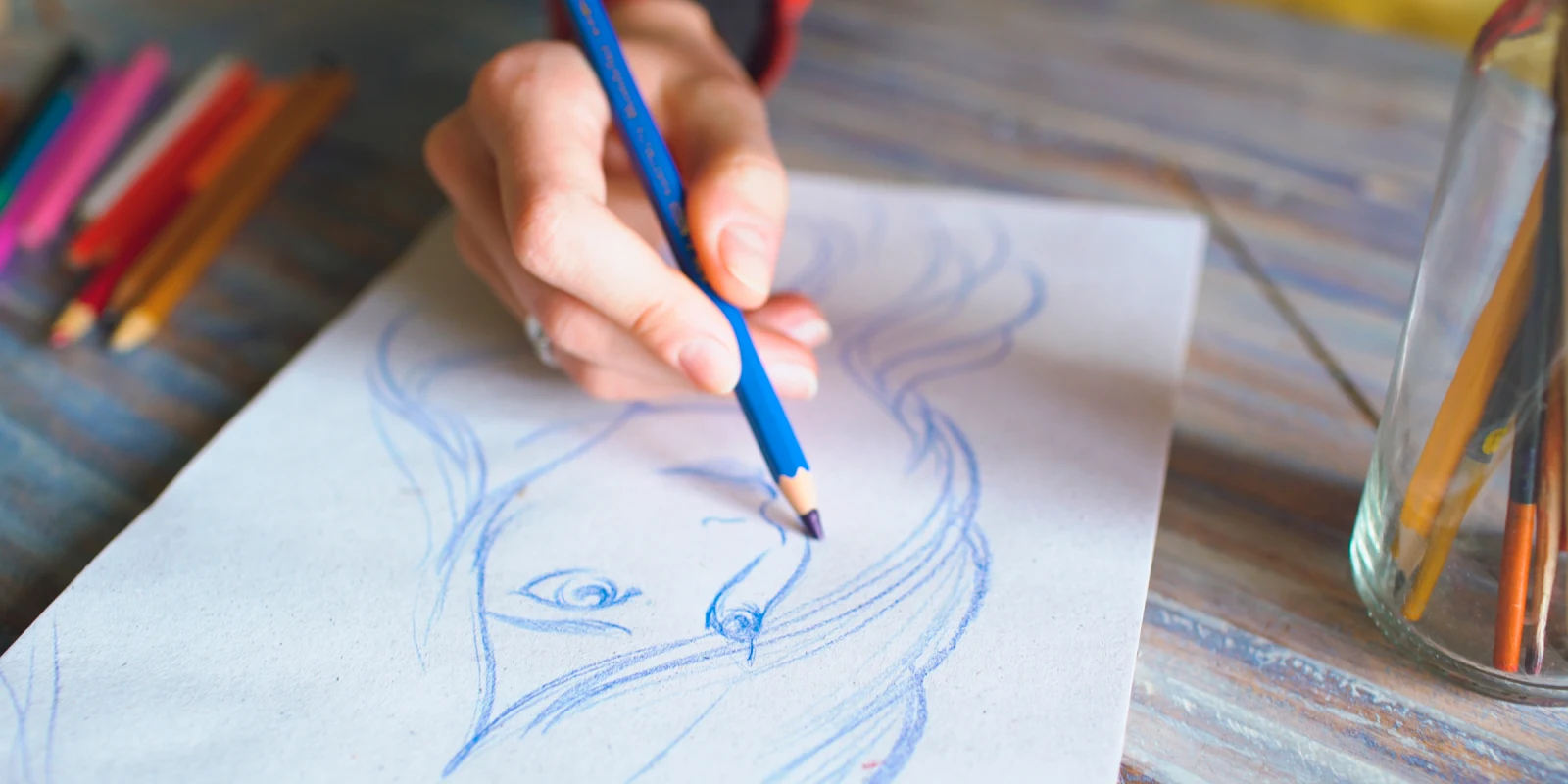
I have always been an artist. I have always had a sketchbook on me, through college, through medical school, through nightfloat, the first two years of residency. Drawing was always something I turned to when I wanted to take a break from medicine. So when I committed to a daily portrait challenge, inspired by artist Ahmed Aldoori, I committed to drawing one face, every day, for 100 days. You might assume I dove into the challenge confidently. I did not. If anything, the deliberateness of the challenge terrified me. Portraits had always felt like the territory where my artistic confidence collapsed. Faces are unforgiving. They are the thing humans are evolutionarily wired to scrutinize, and a face drawn slightly wrong announces itself immediately. For all my years of drawing, I had been avoiding this particular test. What I didn't expect was that finally facing it would make me a better psychiatrist.
The paradox of drawing faces for an experienced artist is that they have more to unlearn. Beginners struggle because they lack skill. So, considering myself a novice in portraits, I thought that my largest struggle would be my lack of portraiture skills. But what I learned was something else: The challenge forced me to dismantle what I noticed first. Where exactly does the shadow fall beneath the lower lip? How far apart are the eyes? How can I convey texture without overworking the paper? I had to stop drawing what I knew a face looked like and start drawing what was actually in front of me.
The challenge opened my eyes, and by Day 42 (week 6), I started recognizing this problem in my clinical work. As a PGY4 in psychiatry, I had enough experience now to be dangerous in precisely this way, enough pattern recognition to mistake a familiar outline for the full picture, especially when one consciously or subconsciously employs a "prototype" diagnostic approach. I have seen psychosis present in many forms, and that experience is valuable. But it also means that I, mistakenly, can begin constructing a narrative before the patient has finished telling me theirs. The portrait challenge became a daily reminder that expertise can be a form of inattention. It reminded me that seeing clearly sometimes requires setting down what you already know and looking again, and even when I think I have the full picture, to look once more.
I learned something else through this challenge: the portraits I was most proud of were rarely the ones that came easily. They were the ones I almost abandoned, and walked away from in frustration, where I had to resist the urge to rush to completion or start over, and instead stay with the difficulty until something "right" started to appear on the page. As someone who had always drawn for pleasure, sitting with a drawing that wasn't working felt genuinely uncomfortable in a new way. There were stakes, even if only personal ones. It also taught me that what feels "right" is not necessarily what looks aesthetically pleasing, or what is comfortable to draw.
Psychotherapy asks for exactly this. It asks you to stay present with a patient in a session that isn't resolving, in an emotion that doesn't have a name yet, in silence that might mean something or might mean nothing. The instinct, especially in a field as action-oriented as medicine, is to move, to reframe, to intervene. "Don’t just stand there, do something!" The portrait challenge gave me a small daily rehearsal in resisting that instinct. I had to trust that staying with discomfort is not the same as being stuck, and then the pieces started to fall in the right place. The sessions started to feel "right," and just like with the portraits, I learned that feeling "right" is not equivalent to feeling comfortable.
As the challenge progressed, I became more attuned to asymmetry, to microexpressions, to the way grief and joy can occupy a face simultaneously if you know how to look. I started to appreciate the paradoxical expressions, and I look forward to drawing more of them. I brought this into sessions with me. I began noticing when a patient's affect and their words were slightly out of sync, when the smile didnt quite reach the eyes, or when someone describing a mundane event was holding something in their jaw or their shoulders.
I always knew that art and medicine were connected for me. What I didn't know was how directly the discipline of portraiture would sharpen my clinical attention, teaching me to question my own assumptions, to tolerate incompleteness, and to look past the outline of a person toward what is actually, specifically there. A face, rendered honestly, is an act of witness. So is good psychiatry. I just needed 100 portraits to remind me of that connection.